

01 · Overview
The six-cylinder that made the E30 great
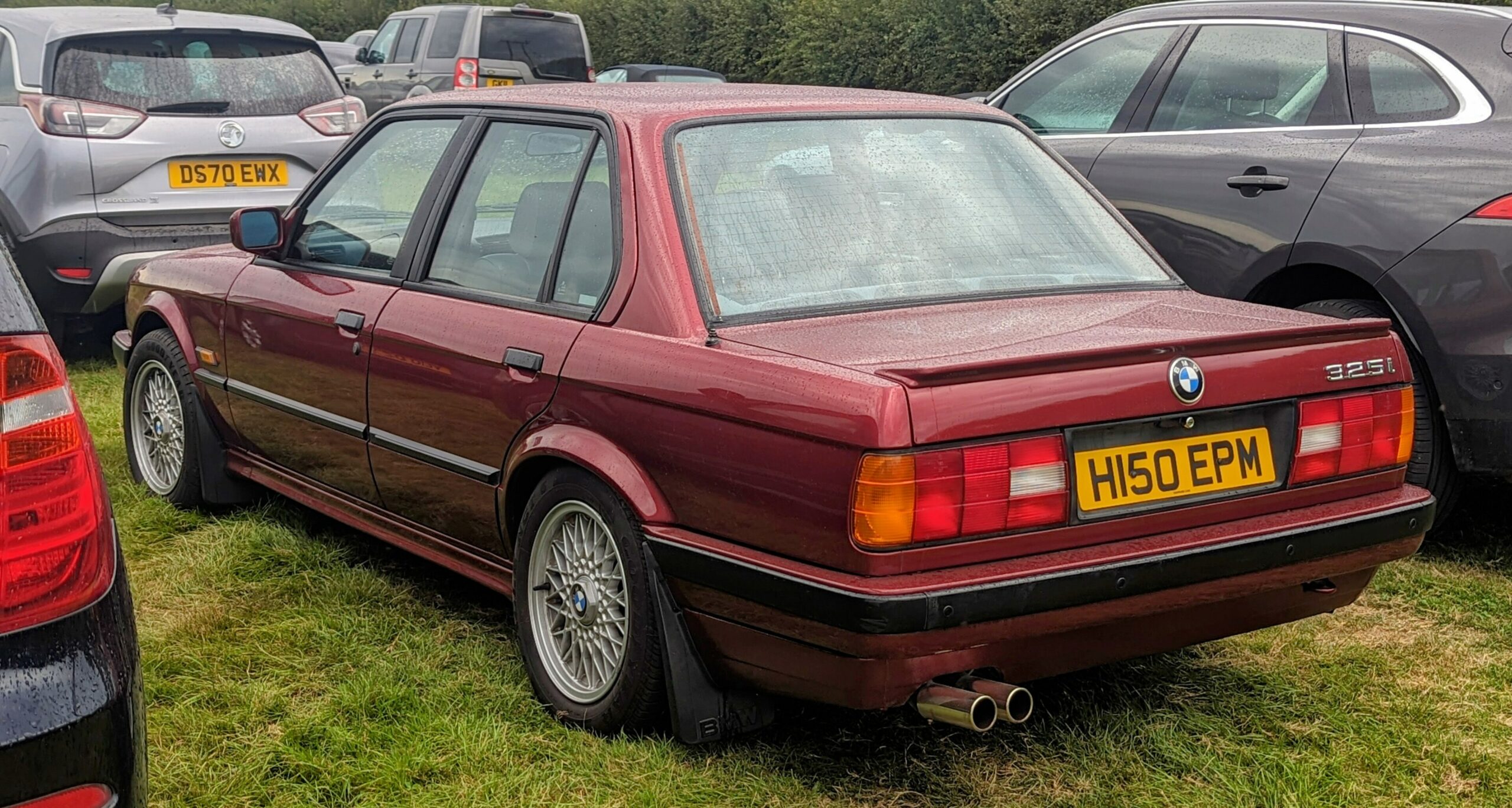
In September 1985 the 325i replaced the 323i as the top model of the model line. From 2,494 cm³ the M20B25 produces 171 PS at 5,800/min, good for 220 km/h — a clear step up from the 139 PS of its predecessor. It was identifiable by the twin tailpipe and the spoiler lip on the boot lid. The price was 33,000 Mark.
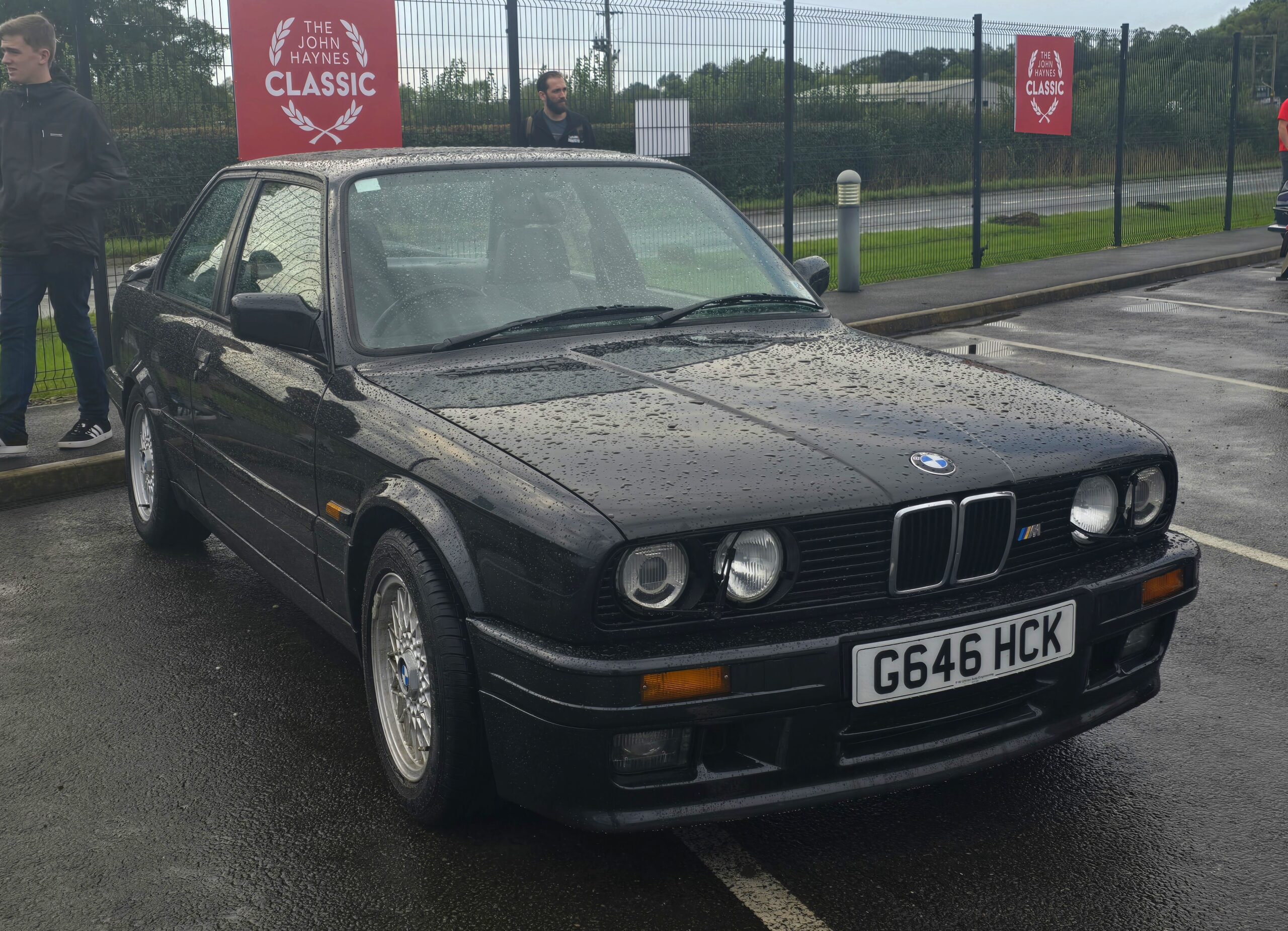
With the facelift in September 1987 the E30 received plastic bumpers instead of chrome bumpers, larger tail lights and a larger fuel tank. For the 325i this meant: catalytic converter as standard, compression ratio down from 9.7:1 to 8.8:1, 170 instead of 171 PS and 218 instead of 220 km/h. The Motronic changed from version 1.1 to 1.3.
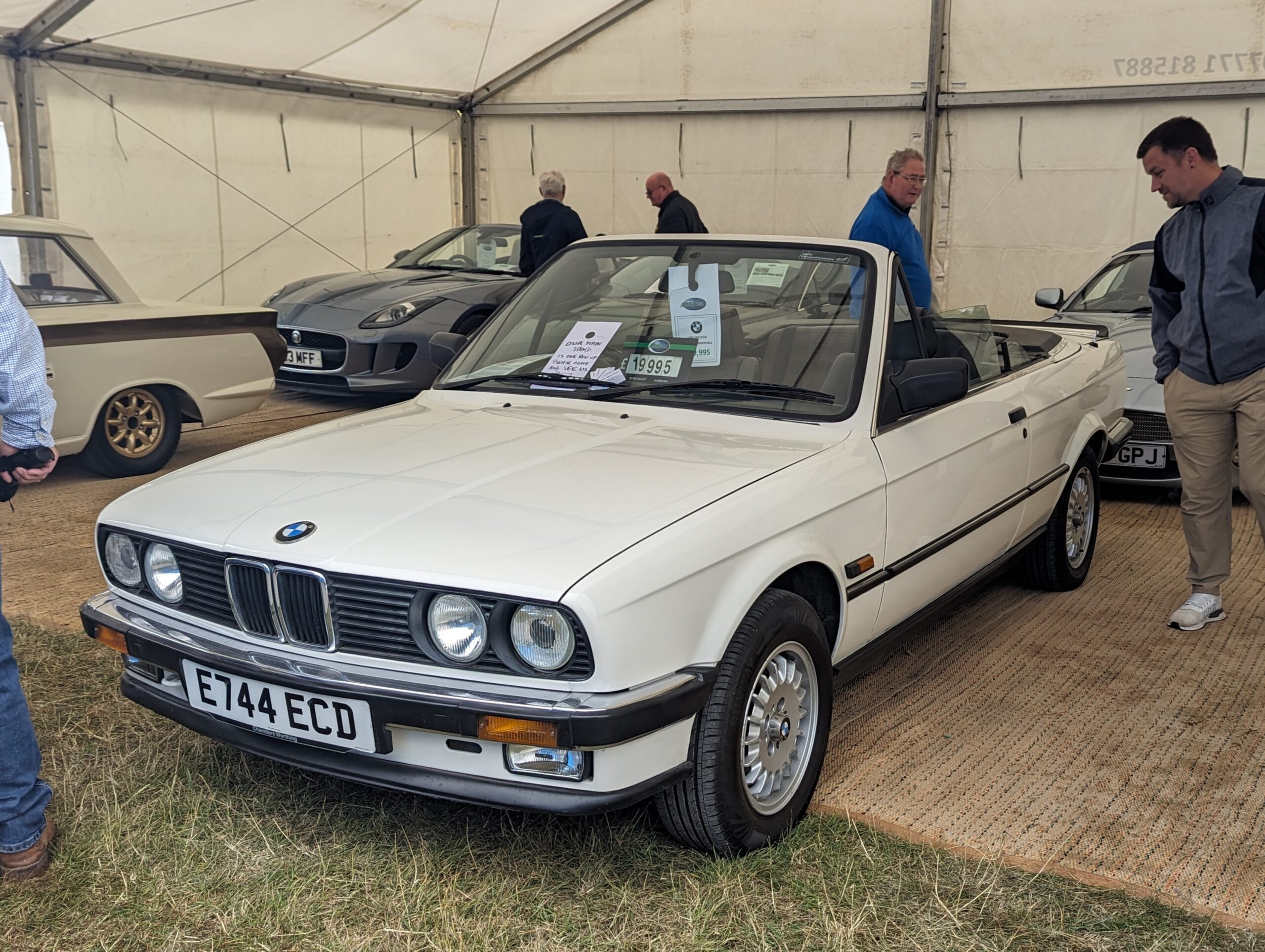
No other E30 model was offered in so many body styles. Alongside the two- and four-door sedan, it was available from March 1986 as a full Convertible — the first factory-developed BMW Convertible since the 503 of 1956 —, from 1988 as a Touring, and from October 1985 as the 325iX with permanent all-wheel drive, the first all-wheel-drive BMW ever.
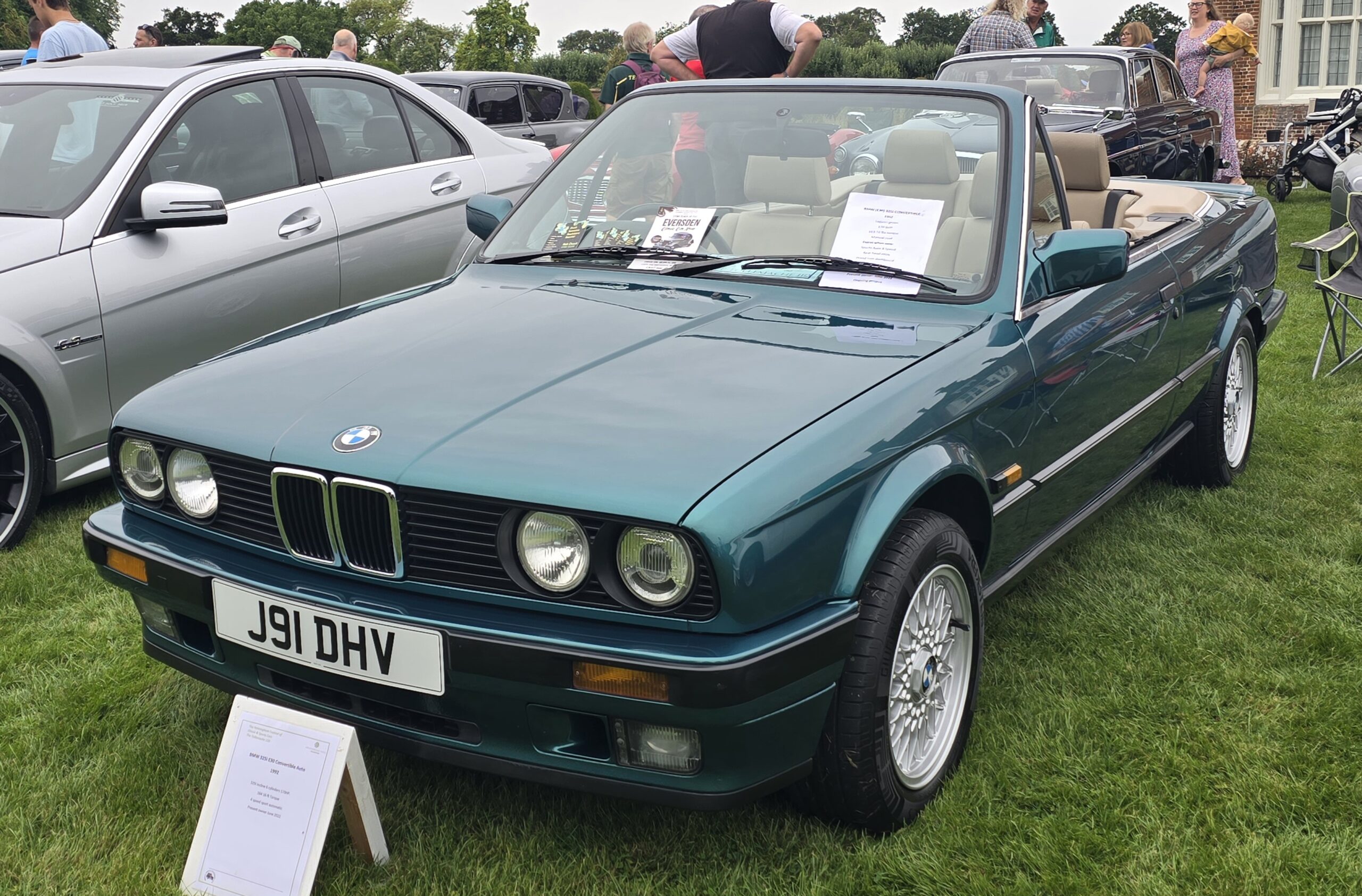
At the end of the production run comes the series known in the scene as the “Last Edition”. The name doesn’t come from BMW — the factory designation is the special equipment package SA 798 “M Technic Ausstattung” for the 325i Convertible, offered in two series of 250 vehicles each. It bundled the M Technic II package, full leather, BBS cross-spoke wheels in 7 × 15 and a fixed colour selection. More on this below.
BMW Group Classic states around 200,000 325i units built up to 1991. There is no reliable source for a breakdown by body variant — individual figures circulating could not be verified by two sources and are therefore not listed on this page.
02 · History
Six years in six dates
From debut to the end of the sedan.
- 1985 In September the 325i arrives as the new top model with 171 PS. In October the 325iX follows — the first BMW with all-wheel drive.
- 1986 In March the full Convertible launches. It is not a conversion but a standalone body with a reinforced floor pan and reinforced sills.
- 1987 Facelift in September: plastic bumpers, larger tail lights, catalytic converter as standard. The 325i now produces 170 PS. The Touring debuts at the same IAA.
- 1988 The 325i Touring joins the line-up — from the start also as the top-of-the-range engine. In June production of the 325e ends.
- 1990 From May BMW offers the special equipment package SA 798 "M Technic Ausstattung" for the 325i Convertible — 250 vehicles in Macao Blue and Sebring Grey. From January 1991 a second series follows with five colours, known in the scene as the "Last Edition".
- 1991 In May production of the 325i sedan ends, in November that of the 325iX.
- 1993 The Convertible and Touring run out as the last E30 variants. The successor E36 has long since arrived.
03 · Model overview
The 325i and its relatives
The six-cylinder E30 came in three engine variants. The 325e was the economy sibling with long stroke and low revs, the 325iX the all-wheel-drive version with the same engine as the 325i.
Source: factory and literature data · verified
Technische Daten anzeigen — komplette Modellmatrix
| Modell | Motor | Hubraum | Leistung | Production |
|---|---|---|---|---|
| 325e | M20B27 | 2.693 cm³ | 122 PS (90 kW) | 10/1983–06/1988 |
| 325e (late version) | M20B27 | 2.693 cm³ | 129 PS (95 kW) | — |
| 325i (without catalytic converter) | M20B25 | 2.494 cm³ | 171 PS (126 kW) | 09/1985–1987 |
| 325i (with catalytic converter) | M20B25 | 2.494 cm³ | 170 PS (125 kW) | 1987–05/1991 |
| 325i Convertible | M20B25 | 2.494 cm³ | 170 to 171 PS | 03/1986–01/1993 |
| 325i Touring | M20B25 | 2.494 cm³ | 170 PS (125 kW) | 1988–1993 |
| 325iX | M20B25 | 2.494 cm³ | 171 PS (126 kW) | 10/1985–11/1991 |
04 · Body variants
Body variants
Sedan

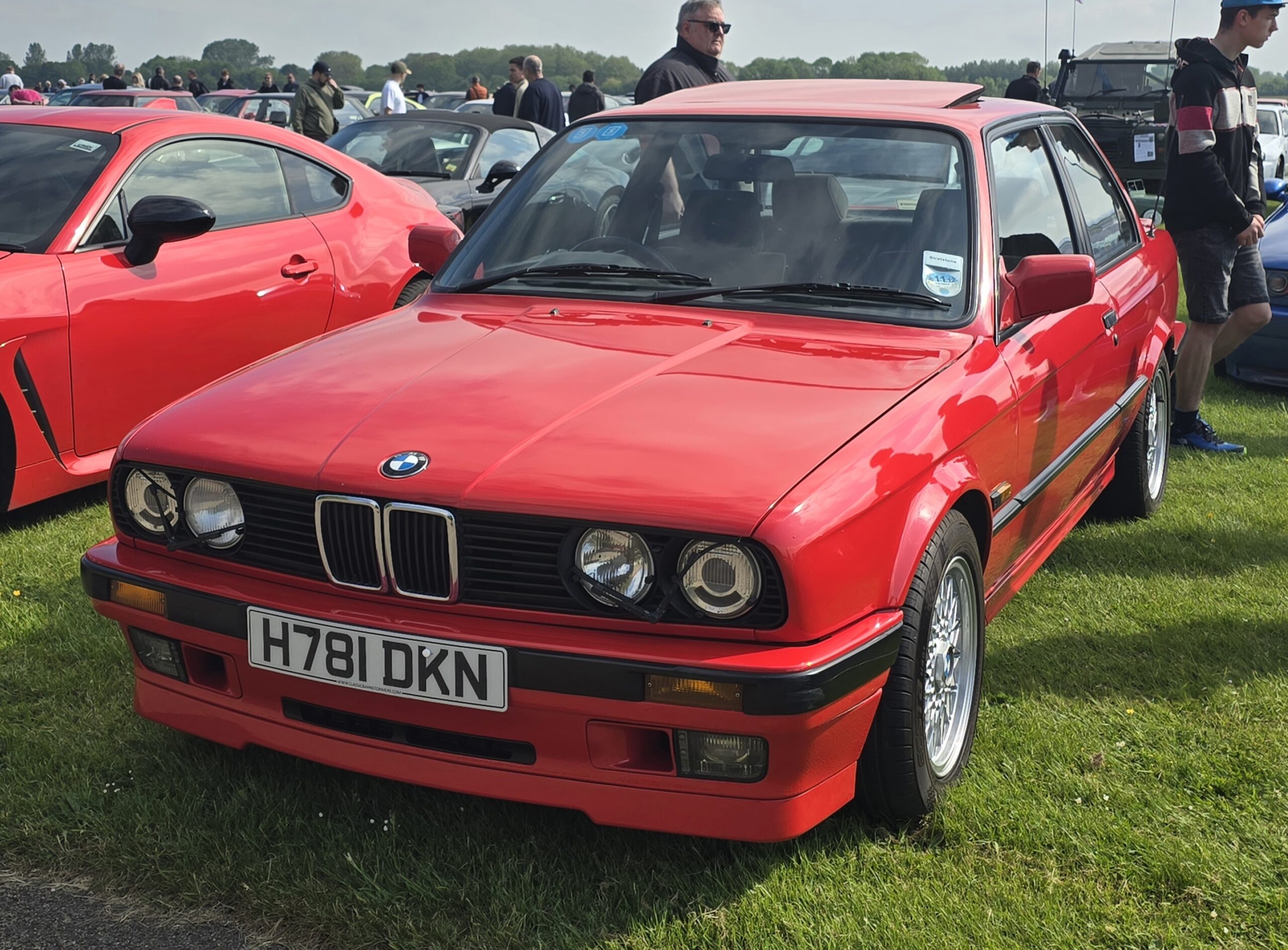
Two-door and four-door. Two-door production ended on 30 April 1991 in Regensburg, four-door on 29 February 1992. Wheelbase around 2,570 mm, length depending on version 4,325 to 4,360 mm.
Cabriolet

The factory Convertible from March 1986: no window frames, no roll bar, reinforced floor pan and reinforced sills. 215 km/h, with catalytic converter 216 km/h, with automatic 210 km/h. Built in Regensburg and Dingolfing until January 1993. Not to be confused with the Baur Topcabriolet — see below.
Baur Topcabriolet
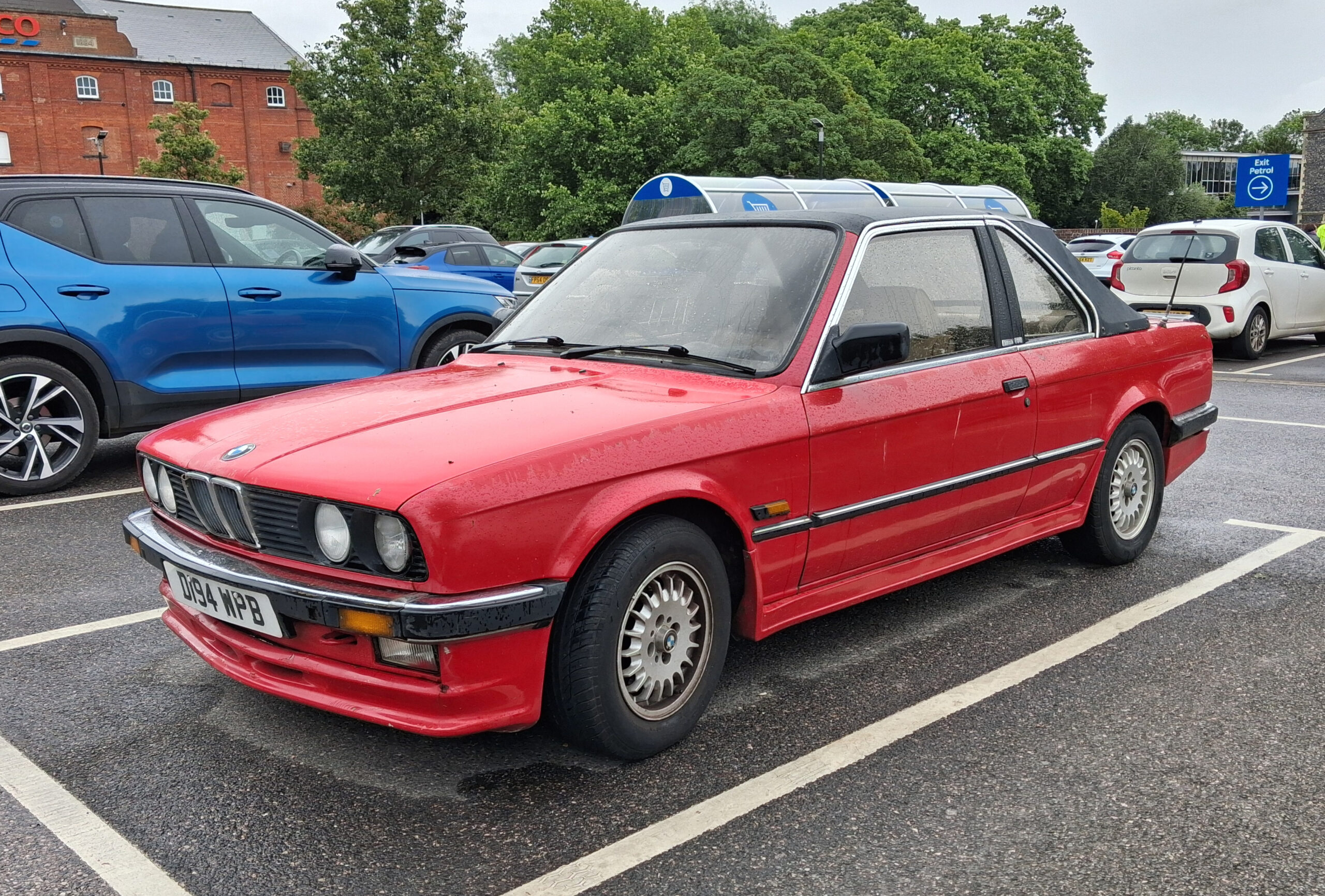
The other open E30, built from 1983 to 1991: a conversion of the two-door sedan with a fixed roll bar and fixed window frames. The roof opens in two sections, creating four configurations from Targa to Landaulet. BMW Group Classic states 14,455 vehicles; of these, according to consistent club sources, around 10,900 are complete conversions, the rest conversion kits. Demand collapsed after the launch of the factory Convertible.
325i Convertible "Last Edition" (SA 798)
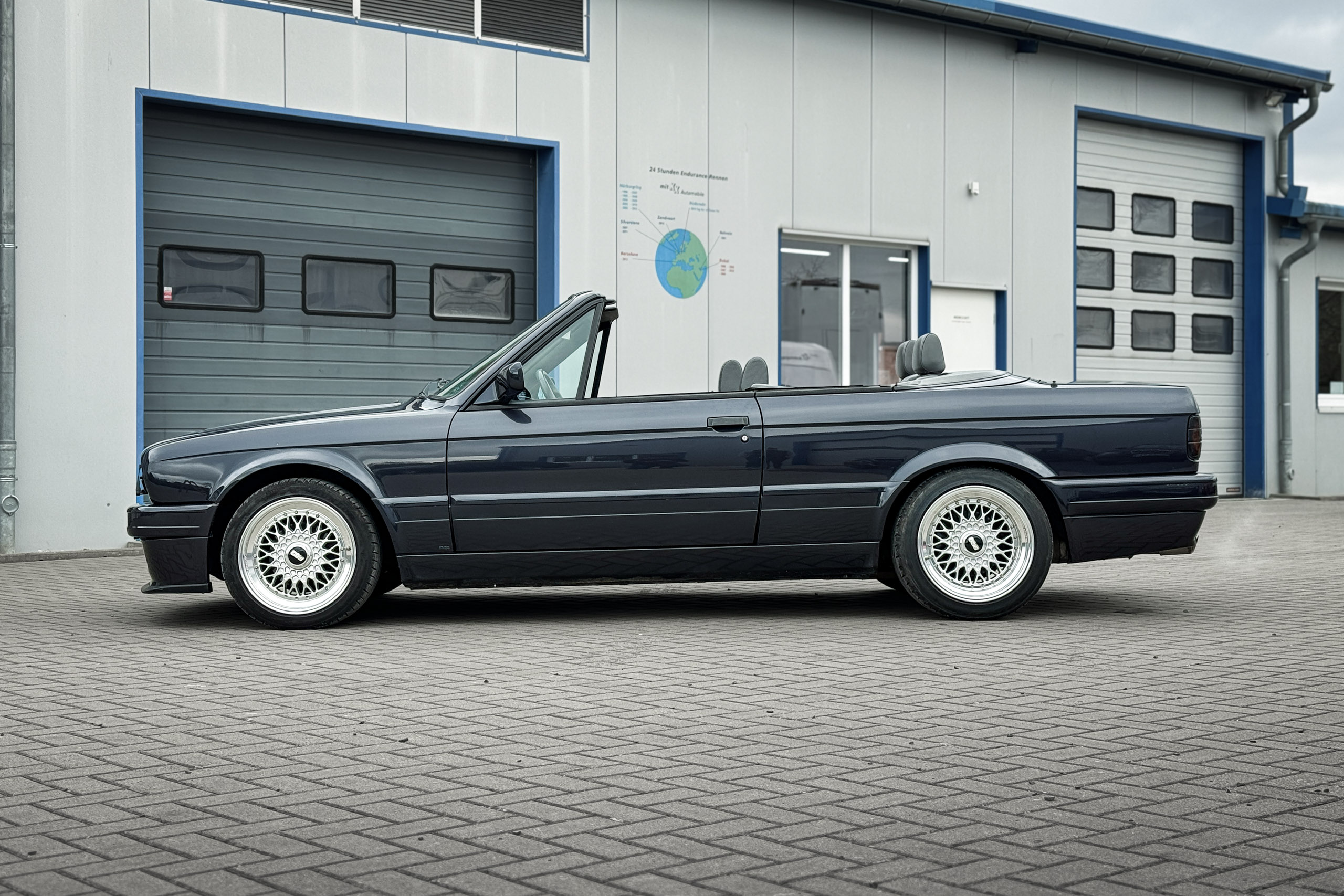
The name is scene terminology, not BMW terminology: the factory designation for the package is SA 798 "M Technic Ausstattung". It was offered in two series of 250 vehicles each, 500 in total. The first ran from May to September 1990 on pre-facelift bodywork, but already with M Technic II aerodynamics, in Macao Blue metallic 250 and Sebring Grey metallic 229. The second series from January 1991 — the actual "Last Edition" — came on facelift bodywork and in five colours: Macao Blue 250, Sebring Grey 229, Calypso Red 252, Lagoon Green metallic 266 and Mauritius Blue metallic 287. Equipment included the M Technic II package with sports steering wheel and sports suspension, full leather trim in Nappa-Tex "Klima" (black 0318, silver 0319, from January 1992 also Lotus White 0462), BBS cross-spoke wheels 7 × 15 with a Nogaro-coloured star, and an electric hood. The surcharge was around 14,300 Mark. Important for context: Macao Blue was the signature colour of these cars, but not exclusive in either series.
touring

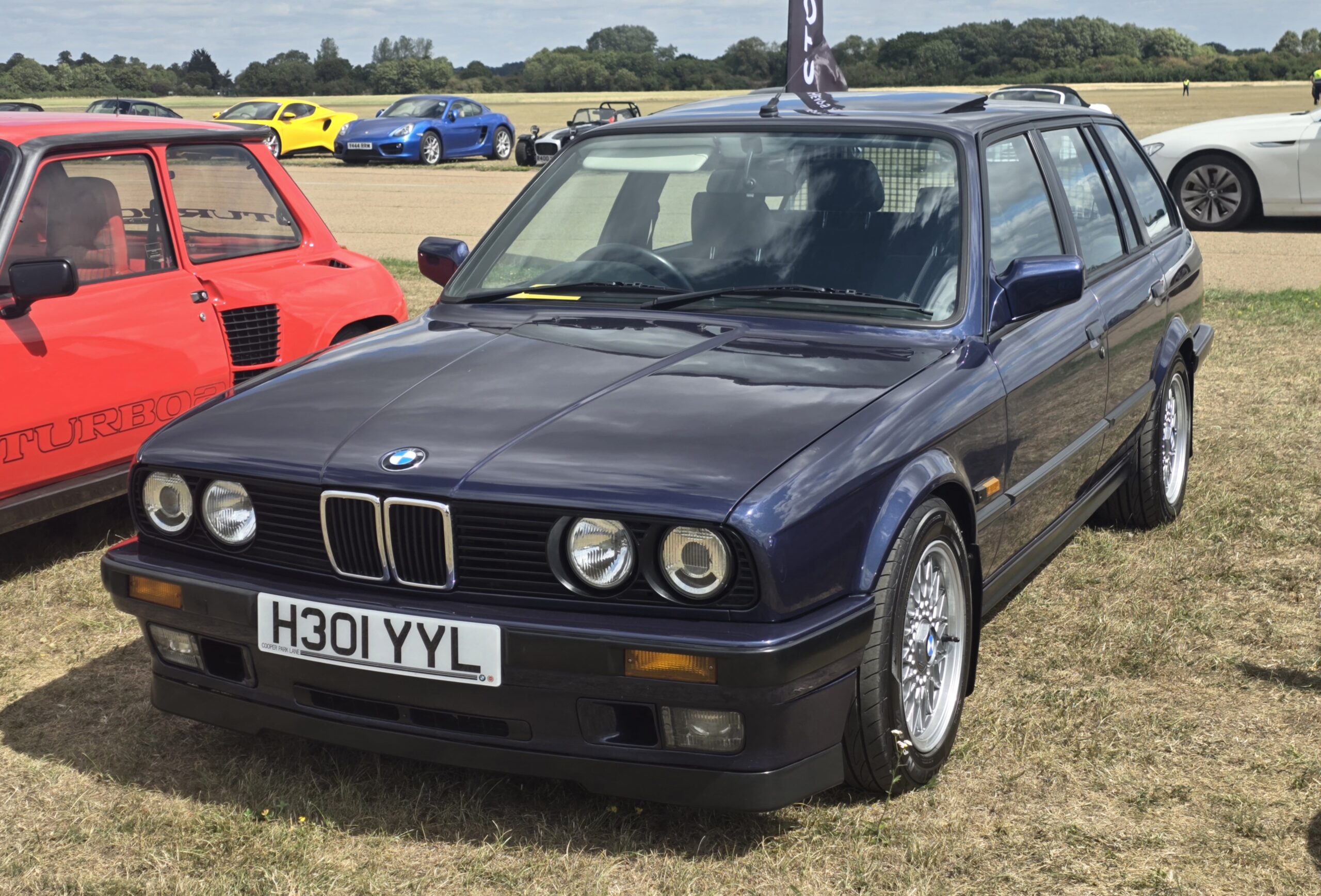
Presented at the IAA in September 1987, in series production from 1988, built until April 1994. Its origin is a prototype that BMW engineer Max Reisböck built privately in a garage in 1984. 215 km/h, price 46,200 Mark.
325iX
The first BMW with all-wheel drive, from October 1985. Permanent four-wheel drive with a transfer case and automatically acting viscous locks, designed to be ABS-compatible. The drive split is 37 percent front and 63 percent rear. 210 km/h, price 42,500 Mark. From 1988 also as a Touring.
05 · Engines
Der M20
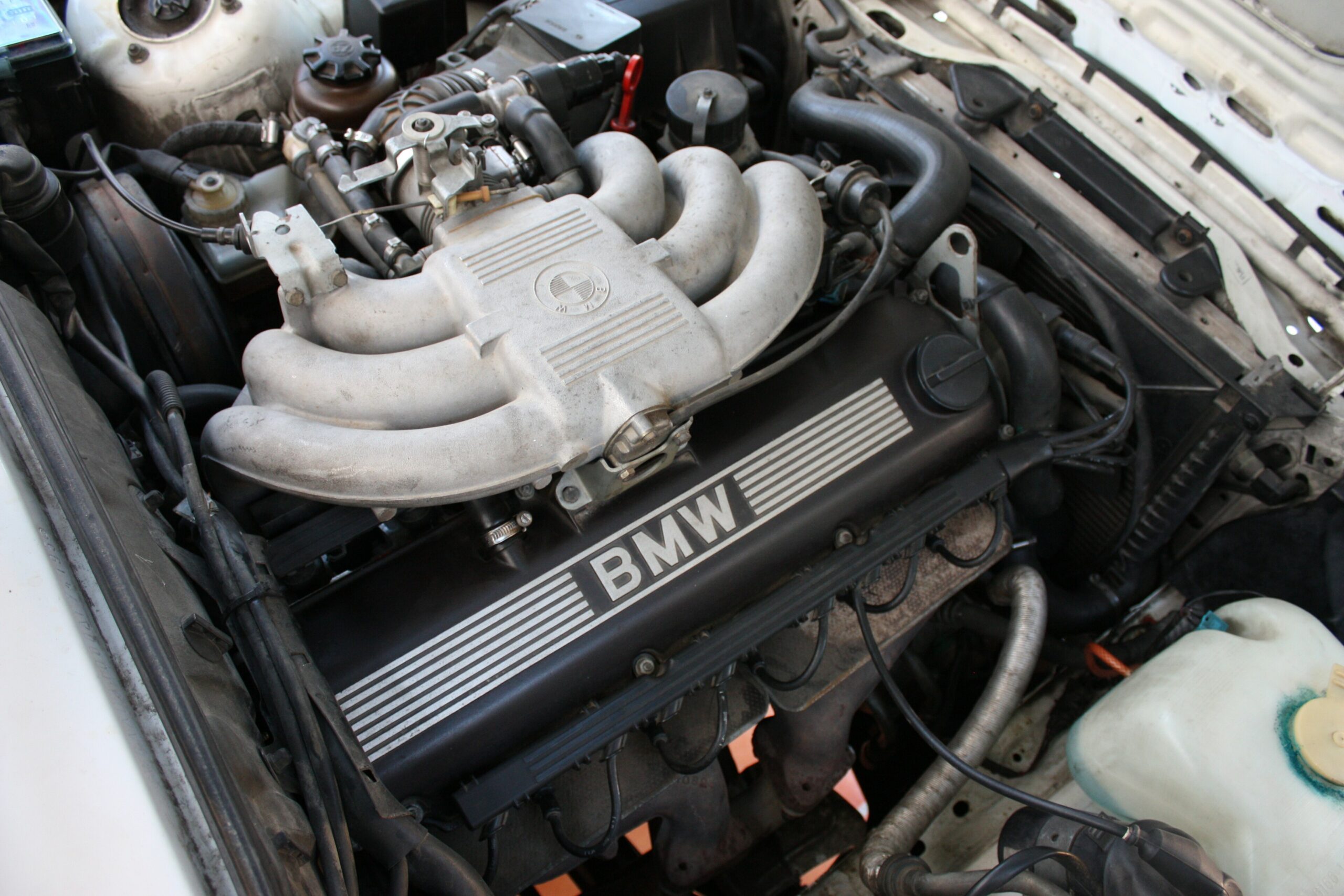
A straight-six with a single overhead camshaft, two valves per cylinder and timing belt drive. Not a high-revving engine, but a smooth-running everyday engine with sufficient torque.
M20B25 · 2,494 cm³ · 170 and 171 PS verified
The engine of the 325i. Bore 84.0 mm, stroke 75.0 mm. Without catalytic converter 171 PS and 226 Nm at 4,000/min, with catalytic converter 170 PS and 222 Nm at 4,300/min. The catalytic converter version therefore costs exactly one PS — the difference lies in the compression ratio, which drops from 9.7:1 to 8.8:1. There is no hydraulic valve clearance adjustment; the valves must be adjusted by hand. The camshaft is driven by a timing belt, and the M20 is not an interference-free engine: if the belt breaks, the piston hits the valve.
Technische Daten anzeigen
| Bauart | Straight-six M20, single overhead camshaft, two valves per cylinder |
| Camshaft drive | Zahnriemen |
| Hubraum | 2.494 cm³ |
| Bore × stroke | 84,0 × 75,0 mm |
| Compression ratio without catalytic converter | 9,7:1 |
| Compression ratio with catalytic converter | 8,8:1 |
| Power output without catalytic converter | 171 PS (126 kW) at 5,800/min |
| Power output with catalytic converter | 170 PS (125 kW) at 5,800/min |
| Torque without catalytic converter | 226 Nm at 4,000/min |
| Torque with catalytic converter | 222 Nm at 4,300/min |
| Motorsteuerung | Bosch Motronic 1.1, from 1987 Motronic 1.3 |
| Drehzahlgrenze | 6.500/min |
| Ventilspielausgleich | mechanical, no hydraulic lifters |
Sources: BMW Group Classic, Wikipedia DE and EN (BMW M20). For the compression ratio without catalytic converter the sources differ: 9.7:1 (DE) versus 9.4:1 (EN).
M20B27 · 2,693 cm³ · 122 PS — the 325e verified
The e stands for Eta, the symbol for efficiency. The 325e is the counter-design to the 325i: more displacement, lower revs, less power, lower consumption. 2,693 cm³ with 81 mm stroke, 122 PS at just 4,250/min, rev limit 4,800/min, plus a five-speed gearbox with an overdrive-style ratio spread. Top speed 193 km/h. On the compression ratio the two Wikipedia versions contradict each other significantly; we therefore do not list it. The end of production is also disputed: BMW Group Classic states June 1988, while the English Wikipedia says the 325e was discontinued with the facelift in September 1987.
Technische Daten anzeigen
| Hubraum | 2.693 cm³ |
| Bore × stroke | 84,0 × 81,0 mm |
| Leistung | 122 PS (90 kW) at 4,250/min |
| Power output of the late version | 129 PS (95 kW) at 4,800/min |
| Drehmoment | 230 Nm at 3,250/min with catalytic converter, 240 Nm without |
| Drehzahlgrenze | 4.800/min |
| Höchstgeschwindigkeit | 193 km/h |
| Getriebe | Five-speed gearbox with overdrive-style ratio spread |
| Units built | around 189,000 |
Sources: BMW Group Classic, Wikipedia DE and EN. The compression ratio figures contradict each other (8.5:1 in EN versus 8.8:1 in DE for the late version) and are therefore omitted.
06 · Weak points
Reliability & weak points
- Timing belt. The M20 is not an interference-free engine — if the belt breaks, the engine is done. The available sources contradict each other on the replacement interval (80,000 km or four years versus 60,000 miles), both citing BMW. We do not state a figure, but a recommendation: ask for proof of replacement, and if in doubt, replace it.
- Cracks in the cylinder head between the fifth and sixth cylinder, especially at high mileage. Diagnosis via the oil filler cap: brownish, watery deposits are a warning sign, as are coolant loss and white smoke.
- Engines built before 1989 have a cylinder head secured with hexagon bolts. These bolts tend to break unexpectedly.
- Worn barrel bearings on the rear axle — audible as clunking during load changes.
- Front axle: ball joints, tie rods and porous rubber bushings.
- The hydraulic headlight levelling system is prone to faults and leaks on many cars. Without it functioning, there is no roadworthiness certificate.
07 · Engineering
Suspension, brakes, transmission
Body and dimensions
Radaufhängung
Bremsen
Getriebe
Technical data — final drive ratios & gearboxes
- Wheelbase
- 2,565 to 2,570 mm
- Length
- 4,325 to 4,360 mm
- Width
- 1,645 to 1,680 mm
- Height
- 1,365 to 1,380 mm
- Front axle
- MacPherson struts
- Rear axle
- semi-trailing arm axle
- Brakes
- discs all round, ventilated at the front
- ABS
- available from 1986, standard from 1992
- Gearbox
- Getrag 260 five-speed, ZF automatic on request
- Fuel tank capacity
- 55 litres, from the 1987 facelift 64 litres on the six-cylinder sedans
- Top speed 325i without catalytic converter
- 220 km/h
- Top speed 325i with catalytic converter
- 218 km/h
- Top speed Convertible
- 215 km/h, with catalytic converter 216 km/h, with automatic 210 km/h
- Top speed Touring
- 215 km/h
- Top speed 325iX
- 210 km/h
- Not verifiable and therefore not listed
- final drive ratios, limited-slip differential, individual gear ratios, steering type and steering ratio, as well as all acceleration figures. For the 325i we found neither a leading source nor two corroborating sources for 0–100 km/h. The axle and gearbox questions are included in our collective inquiry to the BMW Group Classic archive.
08 · Buying guide
What matters: bodywork, timing belt, cylinder head
The 325i is not a rare car, and that’s an advantage when buying: you can wait for the right one. The mechanicals are robust and well supported; the crucial points are the bodywork and two issues with the engine.
Gusset panels behind the front wheels, the transition from A-pillar to sill — the most critical point on the E30. Rusts from the inside out and stays invisible for a long time.
Battery tray, in advanced cases extending to the bulkhead into the cabin.
Rear wheel arches.
Sills and jacking points, usually due to blocked drain channels.
Boot: spare wheel well, area behind the tail lights, rear closing panel — especially below the rear tow eye on the right.
Frontscheibenrahmen.
The order is: first the bodywork, then proof of timing belt replacement, then open the oil filler cap. Anyone who can tick off all three points cleanly has, with the 325i, one of the most straightforward classics there is.
09 · The competition
The competition
Mercedes-Benz 190 E 2.6 (W201)
The most direct rival: a compact three-box sedan with a straight-six and rear-wheel drive. Tuned for more comfort and technically more modern than the semi-trailing-arm E30 thanks to its multi-link rear axle — but less playful to drive.
Audi 90 quattro
A five-cylinder with permanent all-wheel drive, and thus the true model for the 325iX. Due to its front-heavy layout, its handling differs markedly from the BMW's.
Alfa Romeo 75 2.5 V6
The emotional counter-design: transaxle layout with the gearbox at the rear axle, excellent weight distribution, superior in sound — but inferior to the BMW in build quality and value retention.
10 · Galerie
Bilder
The cover image shows a 325i Convertible in the SA 798 special equipment package in Macao Blue, photographed by us. Also shown: the sedan before and after the facelift, the four-door, the Convertible, the Touring and the M20.
11 · Sources
Sources & Further Reading
Leading sources are BMW Group Classic, the BMW PressClub and Wikipedia. Information from other sources has been checked at least twice. Where sources contradict each other, the contradiction is stated in the text. There is no factory source for the SA 798 special equipment: BMW Group Classic and the PressClub list nothing on E30 special editions. The information comes from the club scene and is based on a pictured BMW options letter — we present it as club knowledge, not as factory data.
- BMW Group Classic — BMW 325i (E30)
- BMW Group Classic — BMW 325e (E30)
- BMW Group Classic — BMW 325i Convertible (E30)
- BMW Group Classic — BMW 325i Touring (E30)
- BMW Group Classic — BMW 325iX (E30)
- BMW Group Classic — Baur Topcabriolet (E30)
- Wikipedia (DE) — BMW E30
- Wikipedia (EN) — BMW 3 Series (E30)
- Wikipedia (DE) — BMW M20
- M-Flight Europe — BMW E30 Convertible special models and special editions (SA codes and colour numbers)
- BMW E30 Club NL — Blogreeks 325i M-Tech Cabrio's (with pictured BMW options letter)
- e30.de — photo story: 325iC "Last Edition", built 05/1992 in Mauritius Blue (single vehicle)