

01 · Overview
The first 5 Series
The E12 is the model line with which BMW invented the naming system still in use today. Before it, the cars were called 1800, 2000 or 2800 CS; from September 1972 the mid-size BMW was called the 5 Series, and the same logic produced the 3, 6 and 7 Series. The car replaced the Neue Klasse and was the first BMW design by Paul Bracq, who had moved from Mercedes-Benz to Munich in 1970.
Technically much carried over from the Neue Klasse: MacPherson struts at the front, a semi-trailing arm axle at the rear, recirculating ball steering. What was new was the ambition. From 1973 there was the large six-cylinder M30, and from 1977 in the 520 the small six-cylinder, later known as the M20 but at the time still called M60 internally at the factory. And from April 1980 BMW Motorsport GmbH built the M535i — the first series production model from this outfit and the direct forerunner of all M5s.
What matters today: the E12 is the most affordable entry into classic large BMWs and sits well below the E9 and E24. The reason for that is covered further down in the buying guide, and it is called rust.
02 · History
Nine years in seven dates
From the premiere in the Olympic year to the M535i.
- 1972 On 13 September BMW presents the 520 and the 520i, with series production having run since June in Munich-Milbertshofen. The E12 replaces the Neue Klasse and establishes the numerical naming system.
- 1973 In September the 525 arrives with the 2.5-litre M30 and 145 PS, the model line's first six-cylinder. On 27 September the first 520 built in Dingolfing rolls off the line; Munich production ends two years later.
- 1974 In response to the oil crisis, the 518 appears with 1.8 litres and 90 PS. In the same year BMW Motorsport GmbH begins building one-off cars to order with three- to 3.5-litre engines.
- 1976 Facelift in August: a bonnet, arched around the kidney grille, standardised across all engine versions, significantly larger tail lights, and the fuel filler relocated to the right rear wing for safety reasons. The tank grows from 56 to 70 litres.
- 1977 The 520 switches from the four-cylinder to the new small six-cylinder: 1,990 cm³, 122 PS, Solex twin-choke carburettor. Internally at the factory the engine is called M60 at the time; it is only redesignated M20 in 1983.
- 1980 In April BMW Motorsport GmbH launches the M535i: 3,453 cm³, 218 PS, 222 km/h, five-speed sports gearbox, limited-slip differential, Recaro seats, M1 steering wheel. The first series production model from BMW M.
- 1981 In July German production ends, with the E28 taking over. In South Africa the E12 continues as the E12/8 with E28 interior and fuel-injected engines until September 1985.
03 · Model overview
All engine variants
Petrol only, sedan only. The lower half of the table are the special builds that BMW Motorsport GmbH produced by hand to order from 1974 to 1979 — they do not carry official series designations.
Source: factory and literature data · verified
Technische Daten anzeigen — komplette Modellmatrix
| Modell | Motor | Hubraum | Leistung | Bauzeit |
|---|---|---|---|---|
| 518 | M10 · 4 cylinders | 1.766 cm³ | 90 PS (66 kW) | 1974–1981 |
| 520 | M10 · 4 cylinders | 1.990 cm³ | 115 PS (85 kW) | 1972–1977 |
| 520i | M10 · 4 cylinders, fuel injection | 1.990 cm³ | 130 PS (96 kW), ab 1975 125 PS | 1972–1979 |
| 520 (six-cylinder) | M60, later M20 · 6 cylinders | 1.990 cm³ | 122 PS (90 kW) | 1977–1981 |
| 525 | M30 · 6 cylinders | 2.494 cm³ | 145 PS (107 kW), ab 1976 150 PS | 1973–1981 |
| 528 | M30 · 6 cylinders | 2.788 cm³ | 165 PS (121 kW) | 1975–1977 |
| 528i | M30 · 6 cylinders, L-Jetronic | 2.788 cm³ | 177 PS (130 kW), ab 1978 184 PS | 1977–1981 |
| 530i (USA and Japan) | M30 · 6 cylinders | 2.985 cm³ | around 176 PS (130 kW) | 1975–1978 |
| M535i | M30 · 6 cylinders, L-Jetronic | 3.453 cm³ | 218 PS (160 kW) | 1980–1981 |
| 533i (Motorsport GmbH) | M30 · 6 cylinders | 3.210 cm³ | 197 PS (147 kW) | 1974–1979 |
| 530 MLE (South Africa) | M30 · two Zenith carburettors | 2.986 cm³ | around 200 PS (147 kW) | 1976–1977 |
04 · Body variants
Body variants
Sedan

The E12 was available exclusively as a four-door sedan — no Touring, no Coupé, no Convertible. Within the group the Coupé role belonged to the E9 and, from 1976, the E24, both on their own platforms; BMW did not build a factory Touring at all during this period, the first being the E30 Touring in 1987. The kink in the C-pillar carried over from the Neue Klasse into the new model line and remained its most important identifying feature in profile. The drag coefficient was, by today's standards, a modest 0.44.
05 · Engines
From the M10 to the large six-cylinder
The E12 saw three engine families — and made the switch from carburettor to fuel injection.
M10 — the four-cylinder from the Neue Klasse verified
The M10 was already ten years old in 1972: cast-iron block, aluminium head, chain-driven overhead camshaft, cylinders inclined by thirty degrees. In the 518 it ran at 1,766 cm³ and 90 PS, in the 520 at 1,990 cm³ and 115 PS. Robust and durable, but acoustically strained in the large 5 Series — and that is exactly where it fell short: in 1977 BMW replaced it in the 520 with a six-cylinder. In the 518 it remained until the end.
M30 — the large six-cylinder verified
The M30 was born in 1968 in the E3 and E9 and ran in the E12 in four displacements: 2,494, 2,788, 2,985 and 3,453 cm³. Cast-iron block with a hundred-millimetre cylinder spacing, aluminium crossflow head, seven crankshaft bearings, chain-driven overhead camshaft, two valves per cylinder. It remained in the programme until 1994 and is the real reason the E12 worked as a driving machine.
The small six-cylinder — M60 or M20? verified
The small six-cylinder appeared in 1977 simultaneously in the 320 (E21) and the 520 (E12); the E12 is thus one of the two first applications. From 1,990 cm³ it produced 122 PS at 6,000 rpm with a Solex twin-choke carburettor. Important for labelling purposes: at the time the engine was called M60 internally at the factory, and the redesignation to M20 only happened in 1983. Anyone referring to an M20 in the E12 is using a retroactively assigned name.
The M535i engine verified
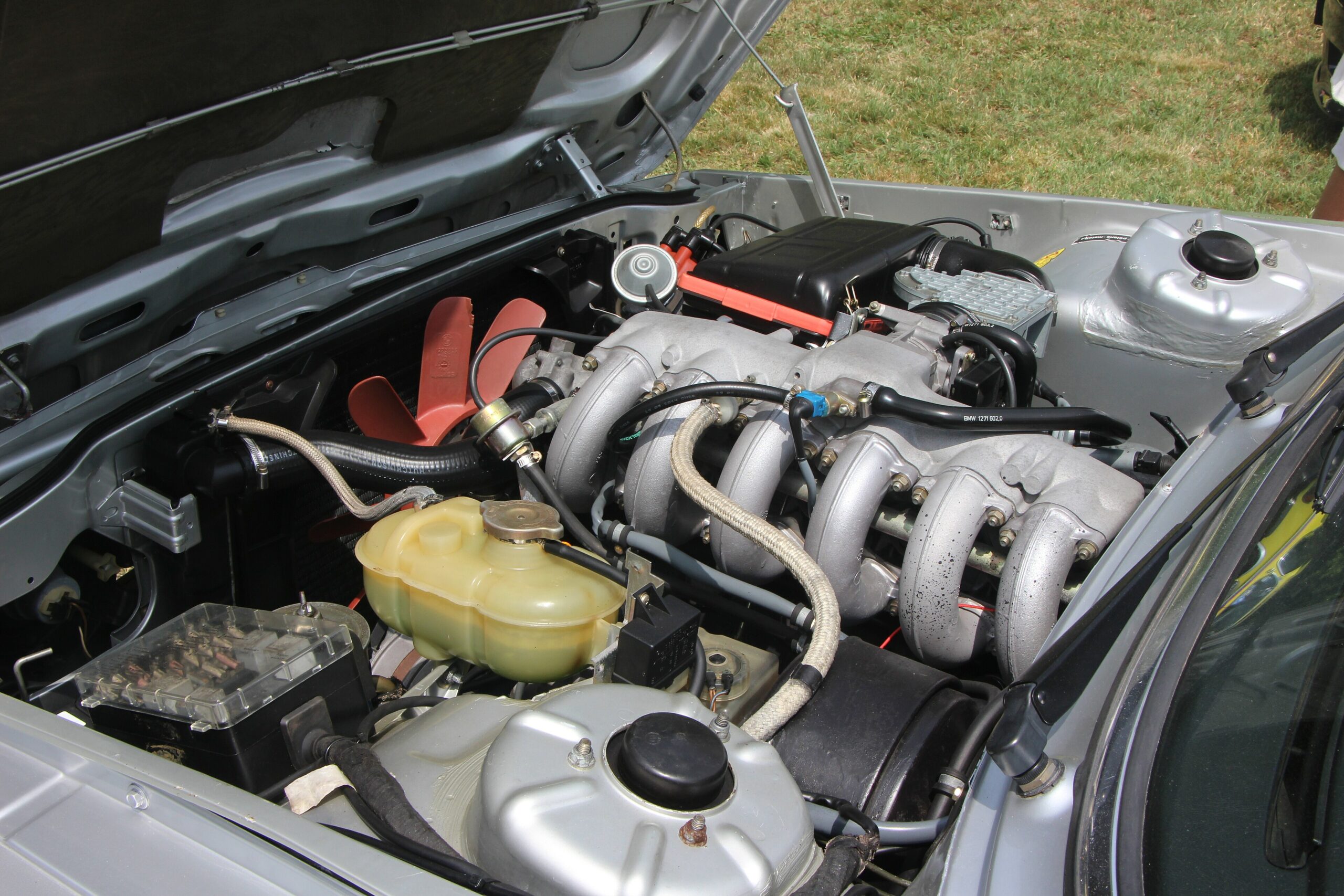
The 3,453 cm³ six-cylinder came from the 7 Series and the 635 CSi and was closely related in design to the three-litre M30, which made the conversion straightforward. With Bosch L-Jetronic it produced 218 PS at 5,200 rpm and pushed the M535i to 222 km/h. The designation is inconsistent: BMW Group Classic refers neutrally to an engine developed by Motorsport GmbH, the English Wikipedia calls it the M90, and parts catalogues list it as M30B34 or M30B35LE.
Carburettor versus fuel injection verified
The 518 ran with a Solex downdraught carburettor, the four-cylinder 520 with two Strombergs. The early six-cylinder 525 and 528 had twin Zenith carburettors; the 1976 facelift replaced them with a single Solex twin-choke carburettor, which also brought a slight power increase. Among the fuel-injected cars there were three systems: the 520i started in 1972 with a mechanical Kugelfischer system and switched to Bosch K-Jetronic in 1975, while the 528i, 530i and M535i ran electronic L-Jetronic. In practical terms this means Kugelfischer is today the most expensive and trickiest system, L-Jetronic the most forgiving.
06 · Weak points
Reliability & weak points
- Sills and lower door edges rust from the inside out. The entire rear section including the tail ends is the most expensive point in restoration.
- Strut towers and the lower ends of the A-pillars are part of the load-bearing structure. Corrosion through there means bodywork, not cosmetics.
- A strong smell of petrol inside the cabin points to a rusted-through fuel tank. The boot floor and the panels beneath the rear seat can only be honestly assessed after removing the seat bench.
- Loud clattering from the valvetrain comes from worn rocker arms and rocker shafts. This affects both four- and six-cylinder engines and is the rule, not the exception, where valve clearance adjustment has been neglected.
- Blue smoke on lifting off the throttle indicates hardened valve stem seals or worn piston rings. On the M30, the timing chain, tensioner and guide rails should also be on the checklist.
- The Kugelfischer injection of the early 520i becomes leaky and drifts out of adjustment with poor maintenance; replacement is barely affordable. With the six-cylinders’ Solex twin-choke carburettor, precise adjustment is essential.
07 · Engineering
Chassis, brakes, steering, gearbox
Fahrwerk
Bremsen
Lenkung
Getriebe
Technical data — final drive ratios & gearboxes
- Manual gearbox 518 and 520 four-cylinder
- Getrag 242, four speeds
- Manual gearbox 525, 528 and 528i
- Getrag 262 or ZF S4-18/3, four speeds
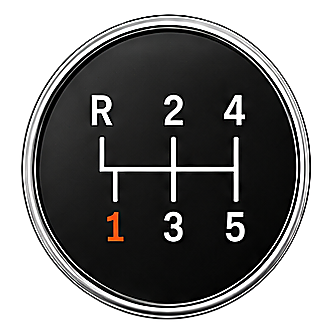
- Five-speed gearbox six-cylinder
- Getrag 265
- Automatic four-cylinder
- ZF 3HP12, three speeds
- Automatic six-cylinder
- ZF 3HP20, ZF 3HP22 or Borg-Warner BW 65, three speeds
- M535i gearbox
- Getrag 265, close-ratio five-speed sports gearbox
- M535i rear axle
- limited-slip differential as standard
- Front axle
- MacPherson struts with wishbones
- Rear axle
- semi-trailing arm axle
- Steering
- recirculating ball, power assistance available at extra cost
- Brakes 518, 520 and 520i
- discs front, drums rear
- Brakes from 525
- disc brakes on all four wheels
- Fuel tank capacity
- 56 litres until August 1976, then 70 litres
- Dimensions
- 4,620 mm long, 1,690 mm wide, 1,425 mm high
- Wheelbase
- 2,636 mm
- Drag coefficient
- cw 0.44
Axle ratios could not be confirmed from two independent sources for any E12 variant and are therefore not listed. For the M535i, 3.45 is cited, and for the Motorsport GmbH 530i, 3.25 — both figures come solely from the English Wikipedia.
The assignment of gearbox types to models and production periods is likewise only derivable from parts catalogues and dealer lists and is therefore deliberately kept general. BMW Group Classic and the PressClub do not publish gearbox and axle data for the E12.
08 · Top models
Top models
Three models that show how far the model line reached.
528i
Replaced the carburettor-fed 528 in 1977 and was the fastest series production model before the M535i arrived. From 2,788 cm³ the Bosch L-Jetronic produced 177 PS initially, then 184 PS from 1978 — enough for 208 km/h, a notable figure for a four-door sedan in 1978. Over 65,700 units by 1981. Today the most well-rounded 5 Series of this generation: enough power to suit the character, no special parts that are unobtainable.
To the sub-page →
533i (Motorsport GmbH)
Less well known than the M535i, but more significant in numbers: from 1974 to 1979 BMW Motorsport GmbH hand-built 895 sedans to order. The version sold as the 533i had the 3,210 cm³ six-cylinder from the 633 CSi with 197 PS, plus the driveline and rear axle from the same donor, bucket seats, Motorsport steering wheel and dual exhaust. At 34,030 Marks it cost significantly more than a 528i. The real beginning of the M Sedan.
To the sub-page →
M535i
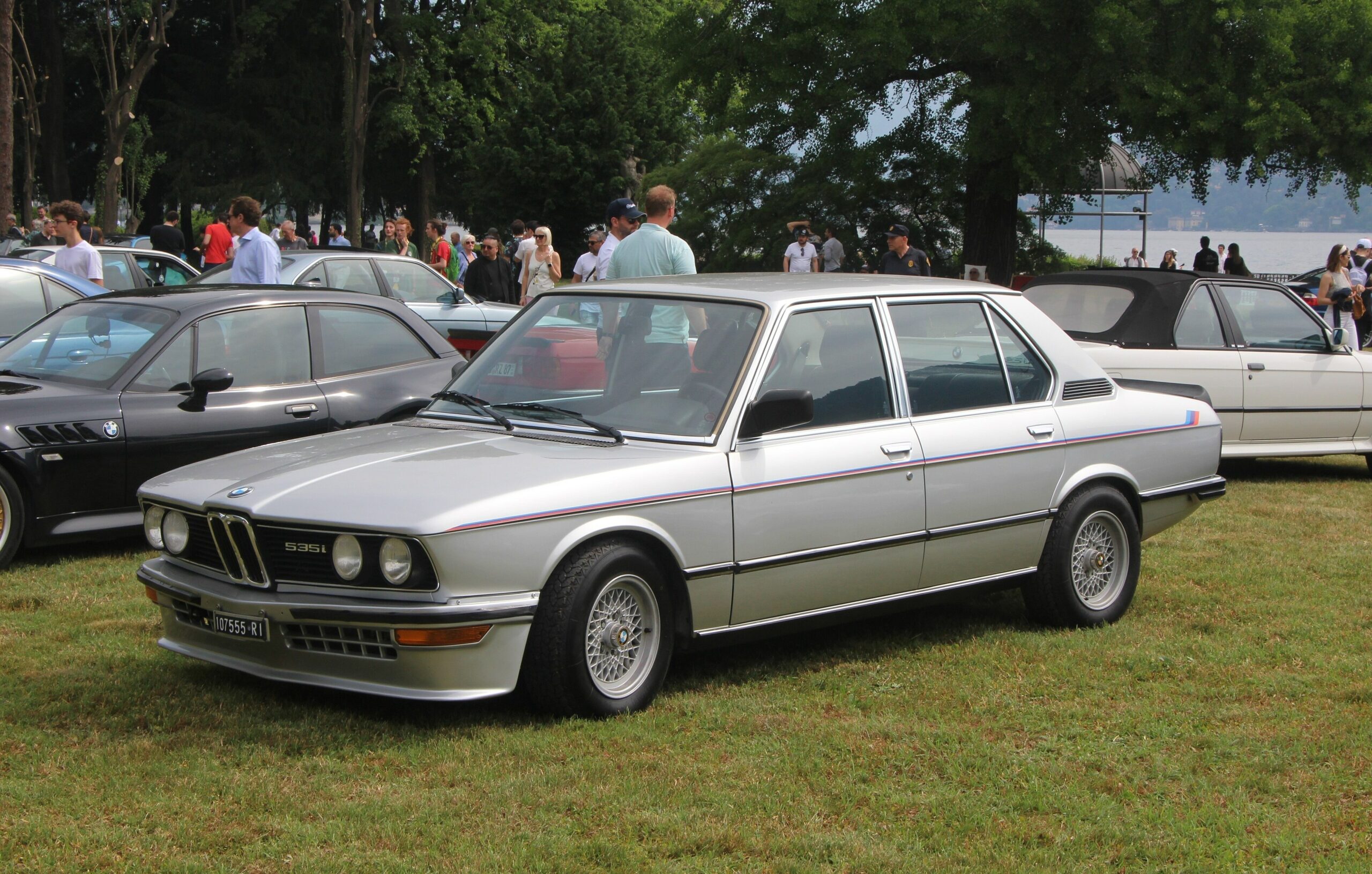
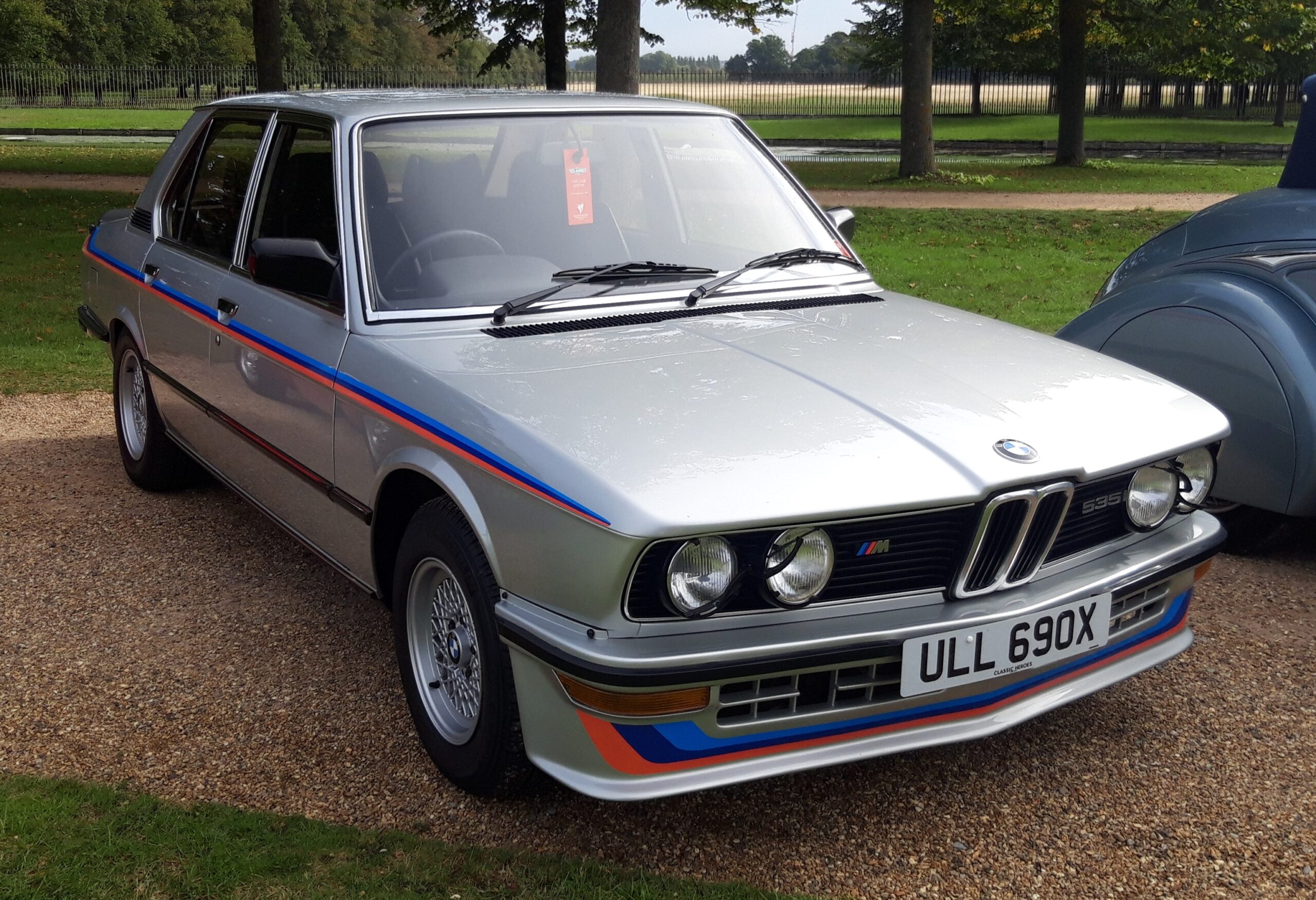
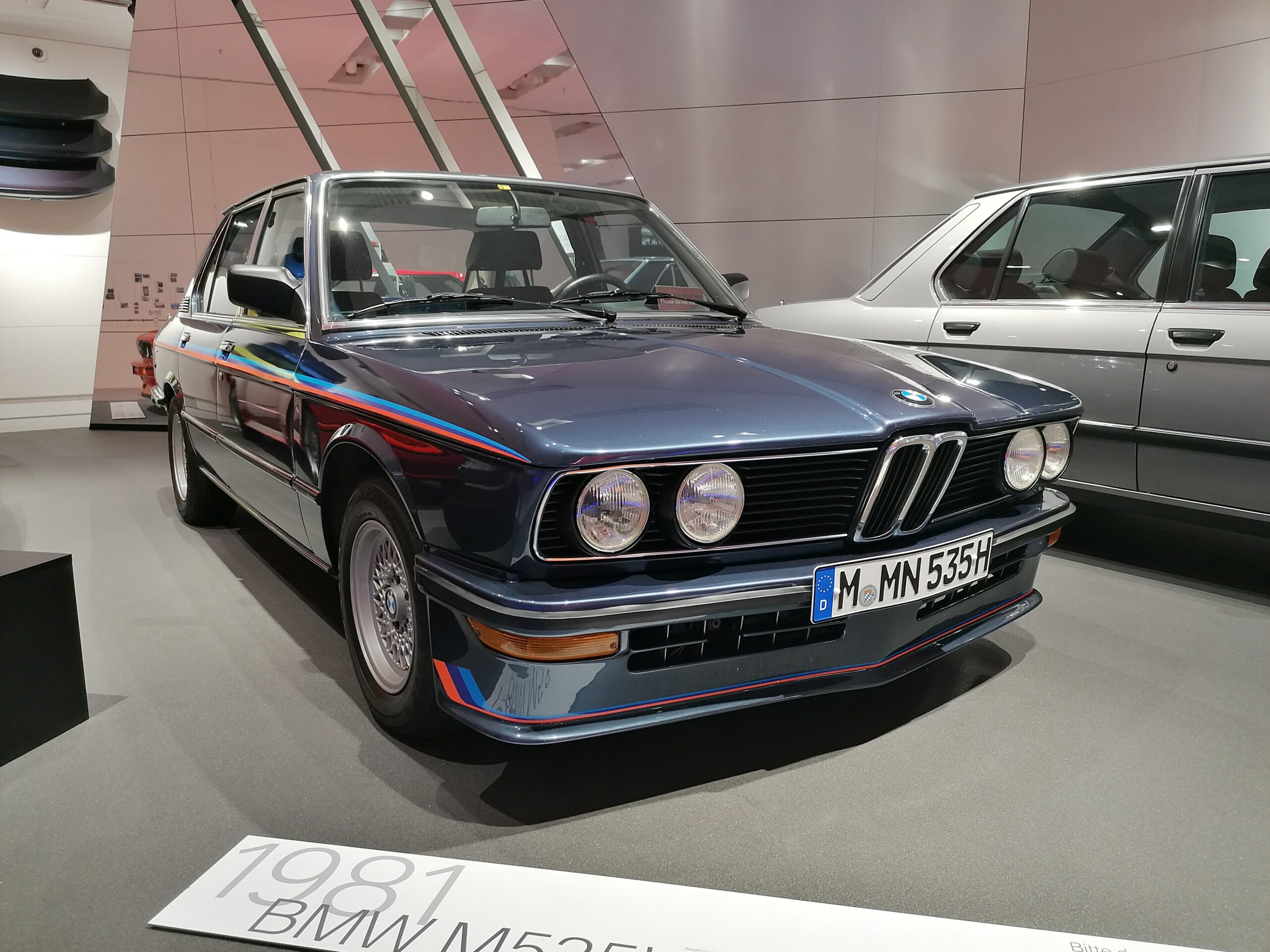
Built from April 1980, the first series production model from BMW Motorsport GmbH altogether and thus the direct forerunner of the M5. 3,453 cm³, 218 PS at 5,200 rpm, 222 km/h, 7.6 seconds to a hundred. Standard equipment included the five-speed sports gearbox, limited-slip differential, Recaro seats and the three-spoke M1-style steering wheel; front and rear spoilers as well as the M side stripes were optional and could be deleted at no cost. 1,650 units were built in fifteen months at a price of 43,595 Marks.
To the sub-page →
09 · Motorsport
The race car was in South Africa
In Europe the E12 was not a factory racing car. In 1970s touring car racing BMW relied on the Coupé — the 3.0 CSL — and later the 3 Series and the M1. What BMW Motorsport GmbH did in Munich with the 5 Series was bespoke vehicle enhancement: fast road sedans, not race cars. The exception lies eight thousand kilometres to the south and is considerable. From 1974, BMW South Africa built complete E12s from CKD kits at the Rosslyn plant near Pretoria — genuine local assembly, not import. To be eligible to compete in the South African Modified Production Series, a hundred road cars had to be sold. This gave rise in 1976 to the 530 MLE, the Motorsport Limited Edition. The attribution deserves precision: the initiative came from BMW South Africa, technical development was led by BMW Motorsport GmbH under Jochen Neerpasch, the engine specification traces back to Paul Rosche, and it was built in Rosslyn. A joint project, then, neither a pure Munich factory model nor a solo effort by the importer. Technically it was a 2,986 cm³ M30 with two Zenith carburettors, Mahle pistons, a sharper camshaft, a lightened flywheel and an oil cooler; the road version produced around 200 PS, the racing version around 275. Hand-drilled body and pedal panels, thinner glass, less insulation, aluminium parts, no air conditioning and no electric windows brought the weight down by around 152 kilograms to 1,233. 227 cars were built, 110 of Type 1 in 1976 and 117 of Type 2 in 1977. In its debut year the 530 MLE won all fifteen races of the season, followed by three consecutive championship titles. This makes it the most successful racing 5 Series in BMW history. There is, however, a discrepancy over the years: BMW and auto motor und sport date the winning streak to 1976 and the titles to 1976 through 1978, while Classic & Sports Car dates them to 1977 and 1977 through 1979. Also worth mentioning is Alpina, which built the B7 Turbo with 300 PS on the E12 base in 1978 and, from 1981, the B7 S Turbo with 330 PS — the fastest sedans in the world at launch. That, however, was Alpina, not BMW.
10 · Buying guide
What matters: sheet metal, sheet metal, and mixture preparation
The E12 is the most affordable entry into classic large BMWs. There is a reason for that: 1970s bodyshells were not rustproofed, and the number of structurally sound cars remaining is small. Buyers are primarily buying sheet metal — the mechanicals are, by comparison, manageable and well supported.
Sills and lower door edges — rusting from the inside out; check from underneath, not by looking at the paint
Tail ends and rear boot floor — remove the rear seat; the tail ends are the most expensive item on the whole list
Front strut towers and the base of the A-pillars — load-bearing structure
Fuel tank and surrounding area, and from August 1976 also the area around the filler neck relocated to the right wing
Rear wheel arches and wing mounts — popular spots for cosmetic repairs, watch for filler and waviness in the reflection of the paintwork
Valvetrain and timing chain — listen for rocker arm clatter at idle, and on the M30 also for chain rattle
With the E12 the order is clear, and it does not start with the engine. First check the bodywork, on a lift, with the rear seat removed and the boot emptied. A car that fails here is not a candidate regardless of the engine, because the bodywork alone regularly exceeds the market value. Only after that is it worth looking at the mechanicals, where mixture preparation determines the follow-up costs: a 528i with Bosch L-Jetronic is forgiving and well supported, while an early 520i with a Kugelfischer system can become very expensive if it fails. The third step is documentation — service records, previous ownership history and, above all, proof of bodywork already carried out, since a properly executed sill repair is a value argument, not a liability. Parts for mechanicals and wear items are reasonably available, but specific bodywork and trim parts from the first series up to August 1976 are not always. Anyone who doesn't need to commit to a specific variant is best served by a 525 or 528i from the second series. Only buyers with experience and budget should consider the M535i and the Motorsport special builds, since originality is hard to verify there and replicas are common. And factor the bodywork into every apparent bargain before comparing prices.
11 · The competition
The competition
Mercedes-Benz W114 and W123
The '/8' was the established rival in 1972 and was replaced from November 1975 by the W123, the best-selling Mercedes ever. The W123 offered what the E12 fundamentally lacked: a Coupé from 1977, an estate from 1978 and, above all, diesel engines. BMW, by contrast, focused consistently on driving dynamics — the E12 was the lighter, more agile sedan, the Mercedes the more durable and versatile one.
Audi 100 C2
Built from August 1976, with 902,408 units by 1982, technically the counter-design: front-wheel drive instead of rear-wheel drive, five-cylinder instead of six-cylinder. With the 100 5E, Audi introduced the first series production five-cylinder petrol engine in 1976 and the first five-cylinder diesel in 1978. With a cw of 0.36 it was clearly superior aerodynamically and more economical, while the BMW was the more emotional choice in acceleration and handling.
Opel Commodore B
Between January 1972 and July 1977, 140,827 units were built, of which 42,279 were Coupés — the production period almost exactly matches the early E12. Mechanically, with 2.5- and 2.8-litre six-cylinders producing 115 to 160 PS, it was directly on par with the 525 and 528. Opel offered more car for the money and, with the Coupé, a body variant the 5 Series lacked; but it fell short on prestige, build quality and resale value.
12 · Galerie
Bilder
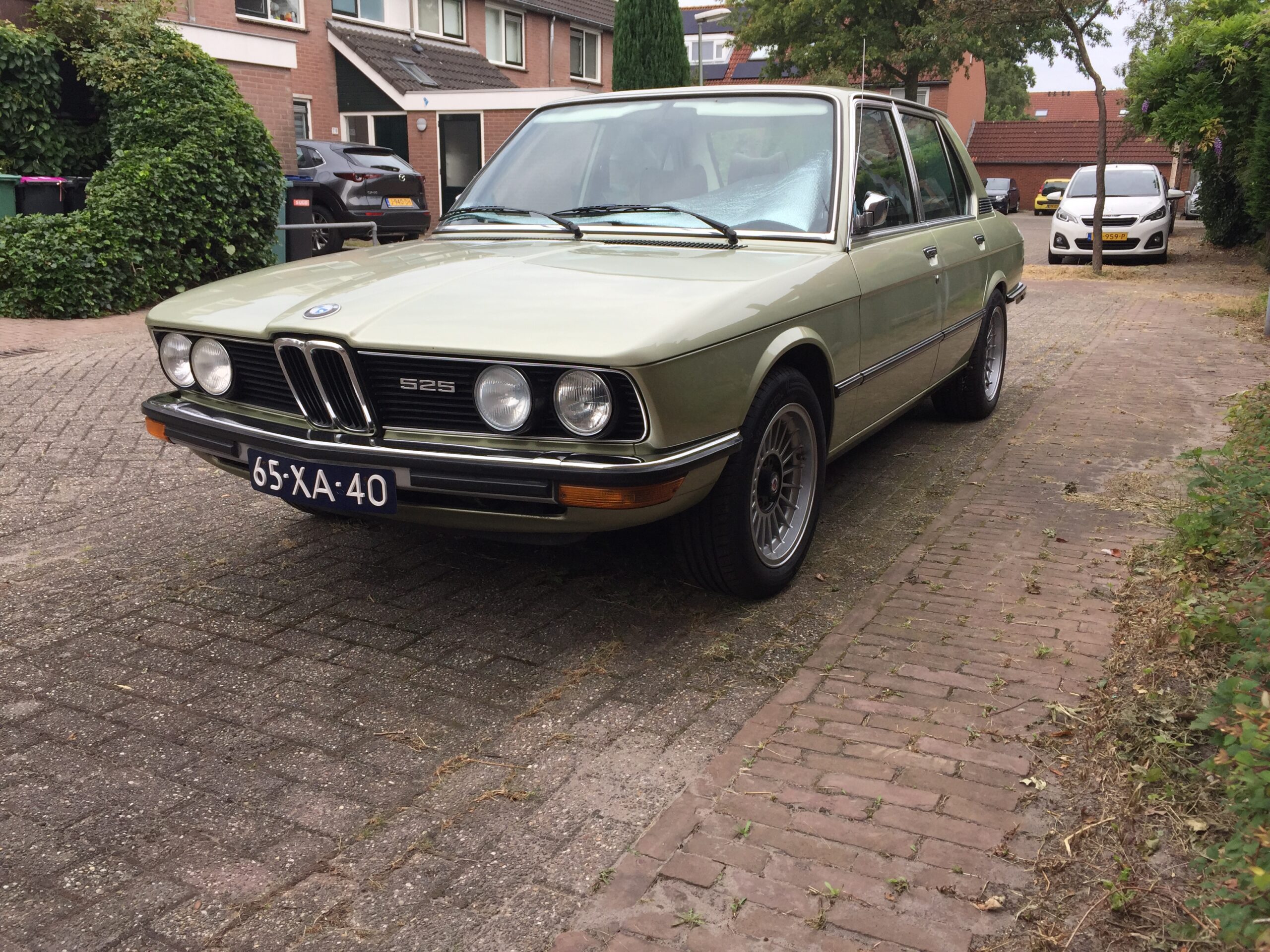
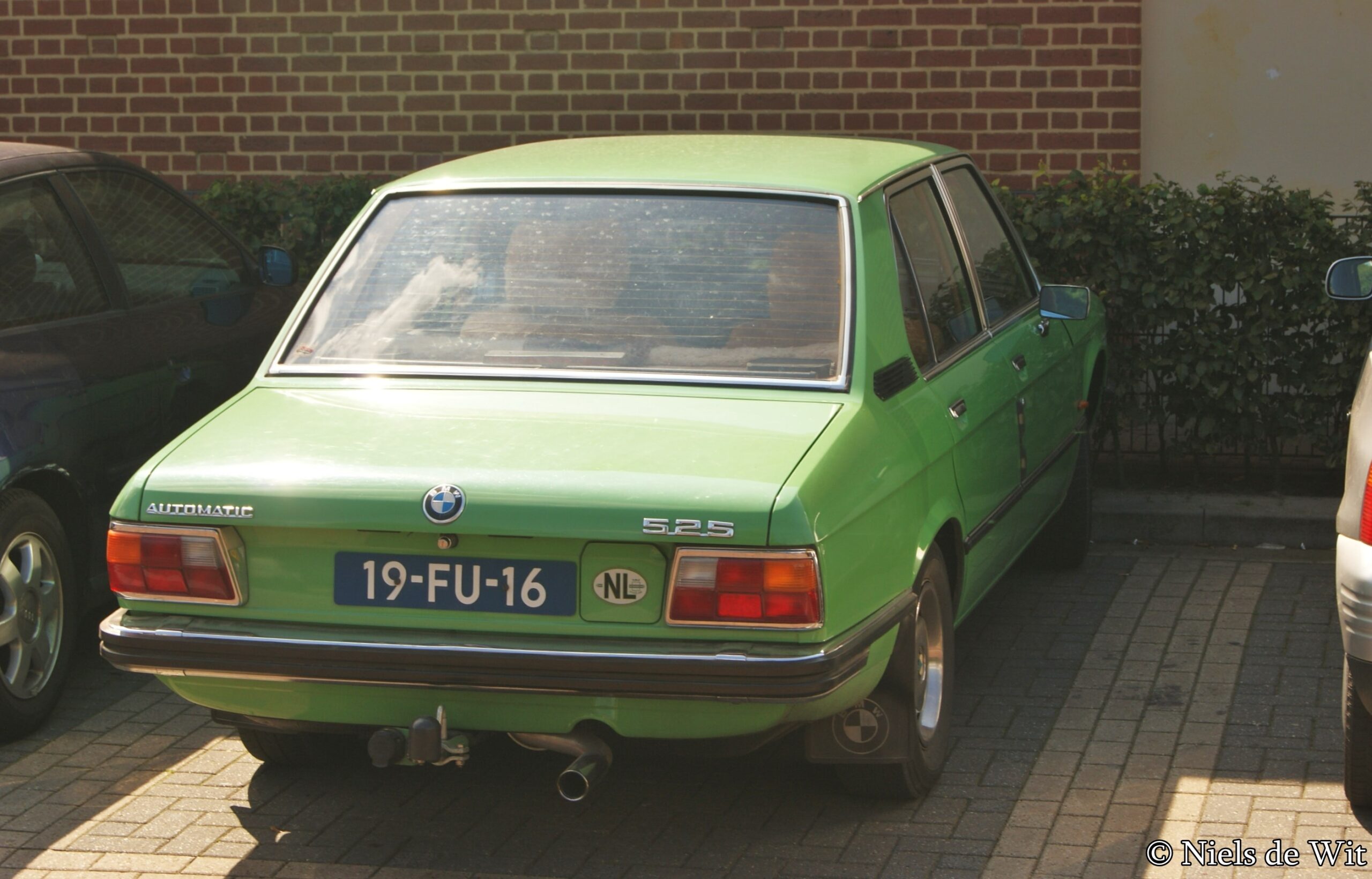
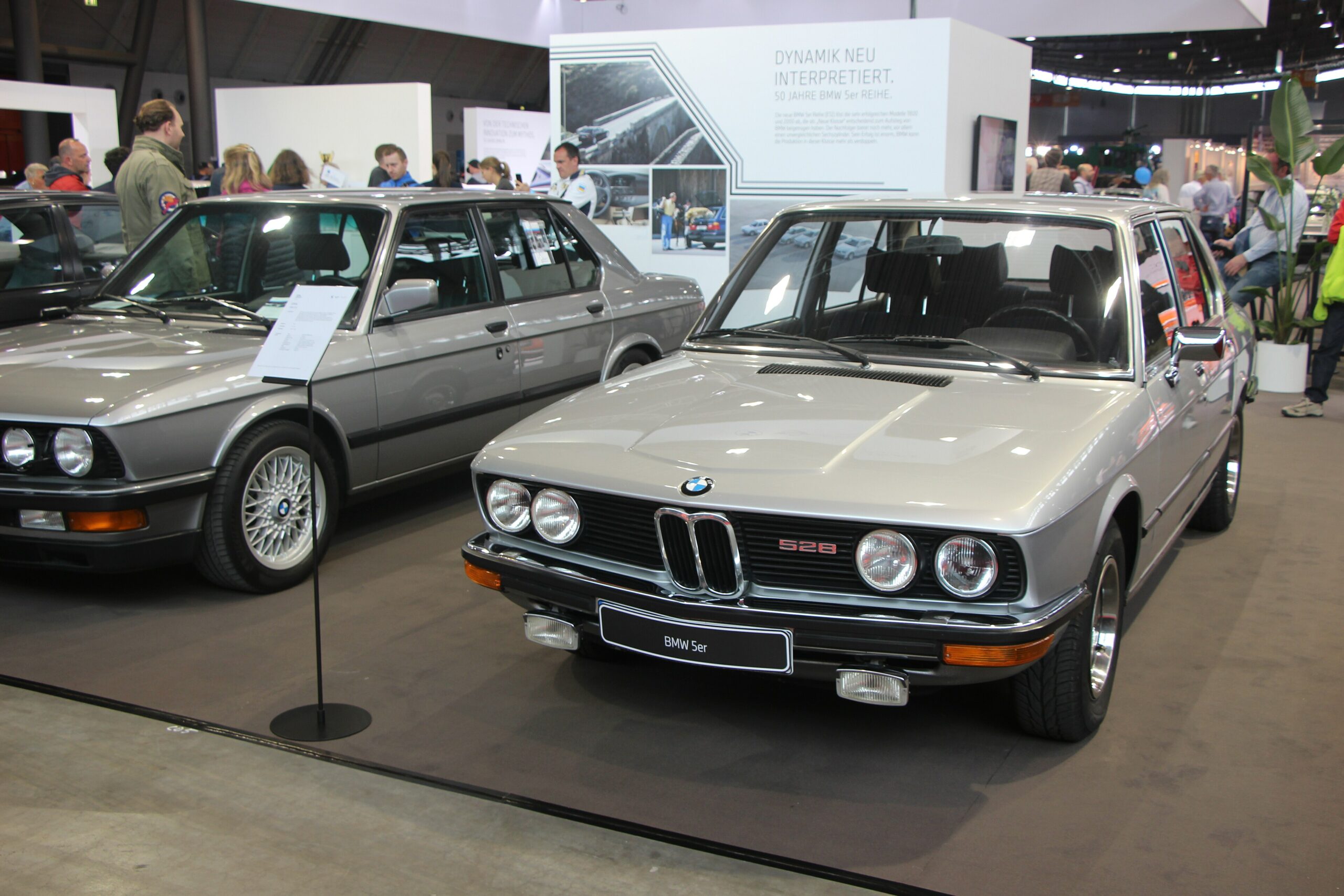
The 525 before and after the facelift through to the M535i. All cars in original condition.
Other BMW 5er generations
5 model lines with an E-number, from 1972 to 2010.


13 · Sources
Belege & Literatur
Primary sources are BMW Group Classic, the BMW PressClub, bmw-m.com and Wikipedia; everything else is considered verified only once two independent sources agree. What remains unresolved above all is the total production figure: the English Wikipedia and BMW's own anniversary text both cite 699,094, while the German Wikipedia cites 722,435 and explicitly relates this to German production. The difference of 23,341 corresponds almost exactly to South African E12/8 production from 1981 to 1985 — but this connection is not documented anywhere, and is therefore not presented here as an explanation. Also disputed: the years of the 530 MLE's racing successes and the engine designation of the M535i.
- BMW Group Classic — BMW 5 Series Sedan (E12)
- BMW Group Classic — BMW 525, 528 and 528i (E12)
- BMW Group Classic — BMW 533i (E12), Motorsport version
- BMW Group Classic — BMW M535i (E12)
- bmw-m.com — BMW E12 M535i: the first series production model from BMW M
- bmw-m.com — Special BMW models with M genes in South Africa
- BMW PressClub South Africa — The revival of the BMW 530 MLE
- BMW PressClub — The restored BMW 530 MLE comes home
- Wikipedia (DE) — BMW E12
- Wikipedia (EN) — BMW 5 Series (E12)
- Wikipedia (DE) — BMW M30 and BMW M20
- auto motor und sport — BMW 530 MLE 1976 South Africa
- Classic & Sports Car — BMW 530 MLE: the first M car
- AutoScout24 — BMW 525 (E12) classic test, buying guide
- Classic Trader — BMW 5 Series E12, model report
- SwissClassics Revue — Turning 50: BMW 5 Series E12