The interior of an M3 Sport Evolution: Recaro bucket seats, rear bench seat, both door panels, both rear side panels, red seat belts, M-Technic steering wheel and handbrake grip.
The end of a development line
The Sport Evolution is the final and most extreme version of the M3 E30 — and it was not created because someone wanted to sell a special model, but because the regulations demanded it. For Group A, whatever was to be used on the racetrack had to be homologated. What BMW fitted to the road car was therefore not an accessory, but the entry ticket for racing in the following season.
The list reflects this. The S14 grew to 2.5 litres and produced 238 PS at 7000 rpm, with torque at 240 Newton metres. Weight was reduced by 25 kilograms. Front and rear spoilers became adjustable, and the front apron featured inlets for brake cooling. 600 units were built, exclusively in Brilliant Red and Gloss Black.
The collector value stems from this origin, but by now it is driven almost more strongly by something else: originality. When a red example sold for just under 326,000 euros at Motorworld Munich in October 2025, condition was the argument, not the production number. This is exactly where a car’s value is decided — and exactly where the interior becomes interesting. Seats get reupholstered, belts are swapped for black ones, steering wheels wear out and are replaced. What remains original has become rare.
What defines the interior
As standard, the Sport Evolution received one-piece Recaro bucket seats with integrated headrests. Two upholsteries were available: anthracite-coloured cloth with woven-in M pattern, or black leather. Both variants came with red seat belts — the most conspicuous identifying feature in the interior, and the one most often missing on modified cars.
Recaro bucket seat from the front. Clearly visible: the high side bolsters for improved support and the integrated headrest.
The steering wheel hub with BMW emblem.The label of an original seat belt with BMW part number and certification details. Reproductions of these belts now exist — the comparison is made via the label.
The second set of features concerns the controls. The steering wheel, gear knob and handbrake lever were covered in suede, not smooth leather. This is not a matter of style: suede offers better grip with damp hands, and that was the point. Anyone who sees a smooth steering wheel in a Sport Evolution is looking at a replacement part.
In the cloth interior, the M pattern runs throughout the entire cabin — across both front seats, the rear bench seat, the door panels and the rear side panels. This consistency is the point. Individual seats with M cloth can be found; a set in which the rear bench and panels belong to the same car is something else entirely.
The interior documented here
The interior shown is the cloth variant and is complete apart from the gear knob. It comprises both Recaro seats, the rear bench seat, both door panels, both rear side panels, the red seat belts, the M-Technic steering wheel and the handbrake grip.
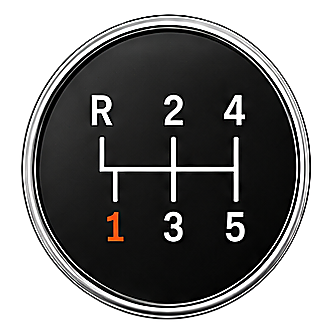
That it is precisely the gear knob that is missing is typical. It is the part with the most hand contact, the suede wears smooth at the tip, and eventually it gets thrown out. Among Sport Evolution interiors that appear on the market, it is missing more often than any other single part — which also explains why it is traded at a comparatively high price on its own.
The condition is good: the cloth shows no worn-through patches, the M colours have not faded, and the panels are free of cracks. The following photographs show each part individually, so that seams, weave edges and fixings can be assessed in comparison — the features, in other words, by which an original set can be distinguished from a reproduction.
The interior, laid out: rear bench seat, both door panels, both rear side panels, the Recaro bucket seats, four red seat belts, M-Technic steering wheel and handbrake grip.
The interior of an M3 Sport Evolution: Recaro bucket seats, rear bench seat, both door panels, both rear side panels, red seat belts, M-Technic steering wheel and handbrake grip.A view across the laid-out interior, with the red seat belts and the handbrake grip in the foreground.
Both seats with the door panels, with the steering wheel and belts behind.
Driver's and passenger's seats from an angle at the rear, with the steering wheel and panel in front.
The backs of both backrests, with the door panels alongside.
Both seats from the front. The bucket seats with optional belt guides — weight-saving, as is typical for the Sport Evolution.
Passenger's seat from the front.
Driver's seat, complete, from the front. The M pattern in the anthracite-coloured cloth runs across both the backrest and the seat cushion.
Seat cushion from above at an angle, with the steering wheel in front.Seat cushion with red seat belt and buckle.
Recaro bucket seat from the front. Clearly visible: the high side bolsters for improved support and the integrated headrest.
The backrest from the front, with the belt cutout in the upper area.
M-Technic steering wheel and handbrake grip side by side, both in suede.The steering wheel hub with BMW emblem.The suede rim close up. The surface has not been worn shiny — unusual for a steering wheel of this age.
Handbrake grip and gaiter, both in suede.
Two red seat belts with buckles, lined up.Seat belt buckle and deflector fitting close up.
Door panel with M cloth insert and grip recess.
Rear side panel, also with cloth insert.
The second door panel. Both are free of cracks.
The second rear side panel.Seat cushion and backrest of the rear bench seat side by side.
The rear bench seat complete, with both outer seat belts.
The rear bench seat's backrest from the front, with the central upholstery panel and both outer seat belts.
A single seat belt at full length, with the top edge of the backrest in front.
Seat belt with buckle and fitting, laid out at full length.
The rear bench seat with the seat belts fastened, from above.The underside of the rear bench seat with the original padding base — untouched, with no aftermarket clips.
On one rear side panel, the material has opened slightly, though in its fitted state it lies behind the rear bench seat.
The back of a rear side panel with a stamped date: 25 October 1990. Such stamps rarely survive — and on an interior part, it is the one feature that cannot be replicated.
The label of an original seat belt with BMW part number and certification details. Reproductions of these belts now exist — the comparison is made via the label.
The same label held up. The ADR 4 approval and the reference to FMVSS 209 are visible — the tape carries no manufacturing date.Door panel from further away, with insulation.
The back of the other door panel with insulation mat and fixings.
The label in detail: typeface, line breaks and seam routing are the features that distinguish an original from a reproduction.
Der Wortlaut aus der Nähe: „assembly meets ADR 4/02 — conforms to all applicable FMVSS 209″.
The underside of a front seat: frame, springing and the original jute padding.
The underside of the second front seat with the adhesive label on the frame.The label on the padding carrier of a front seat, between the jute and the upholstery cloth.
The seat from below at an angle, with the seat cushion construction visible.
Both seats from behind, side by side, comparing the smooth backrest backs.