

01 · Overview
The car that brought the series M3 its 215 PS
In April 1989 BMW launched two special editions of the M3, named after the two most successful drivers of the model line: the Cecotto after Johnny Cecotto and the Ravaglia after Roberto Ravaglia. The Ravaglia was expressly intended for the British market and, with 25 examples, remained the rarest M3 variant of all.
Both received the catalytic-converter version of the S14B23, now boosted to 215 PS — until then the catalyst M3 produced 195 PS. This specification moved into regular series production from late 1989. The Cecotto is therefore not merely a special edition but the car with which BMW introduced the stronger catalyst tuning.
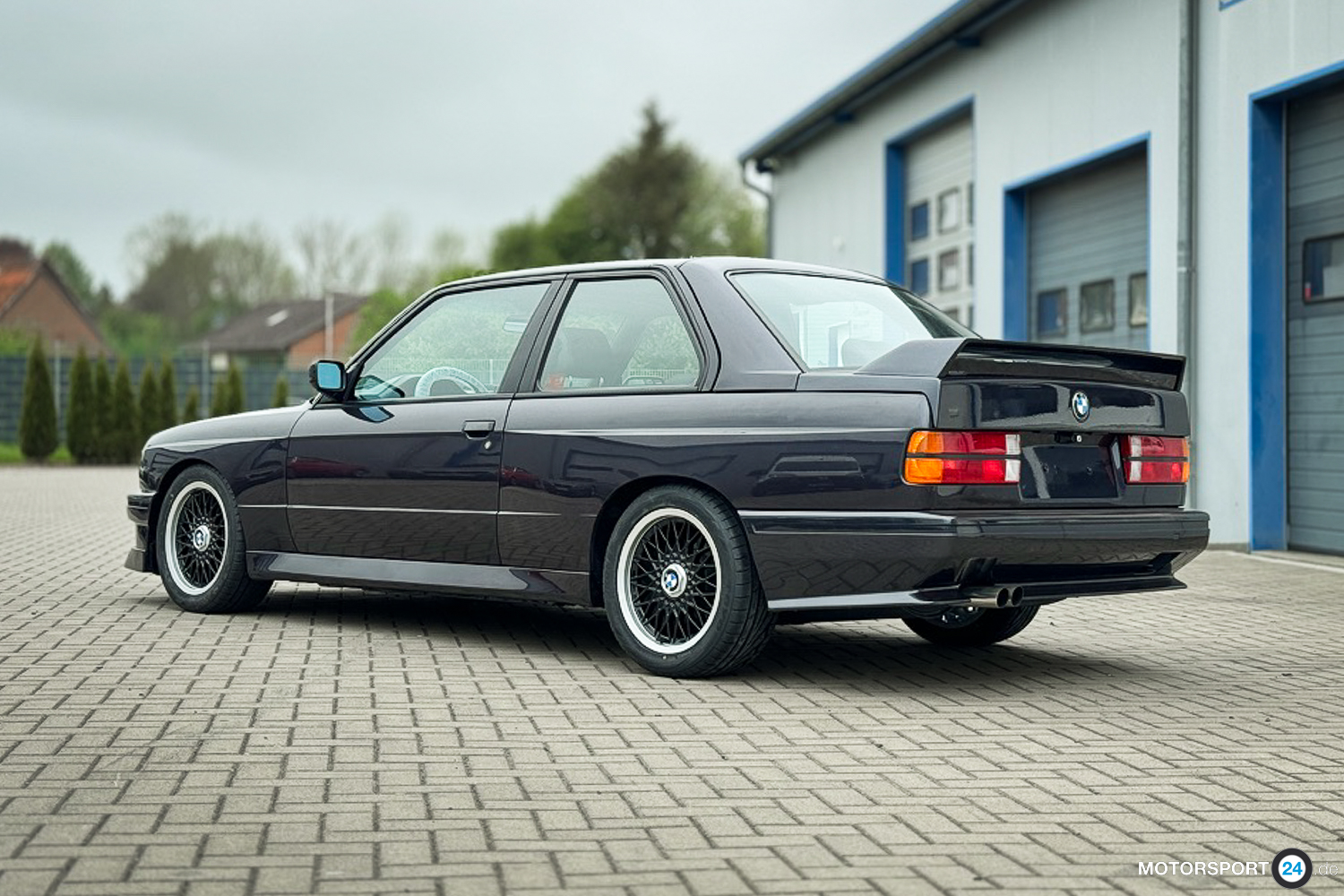
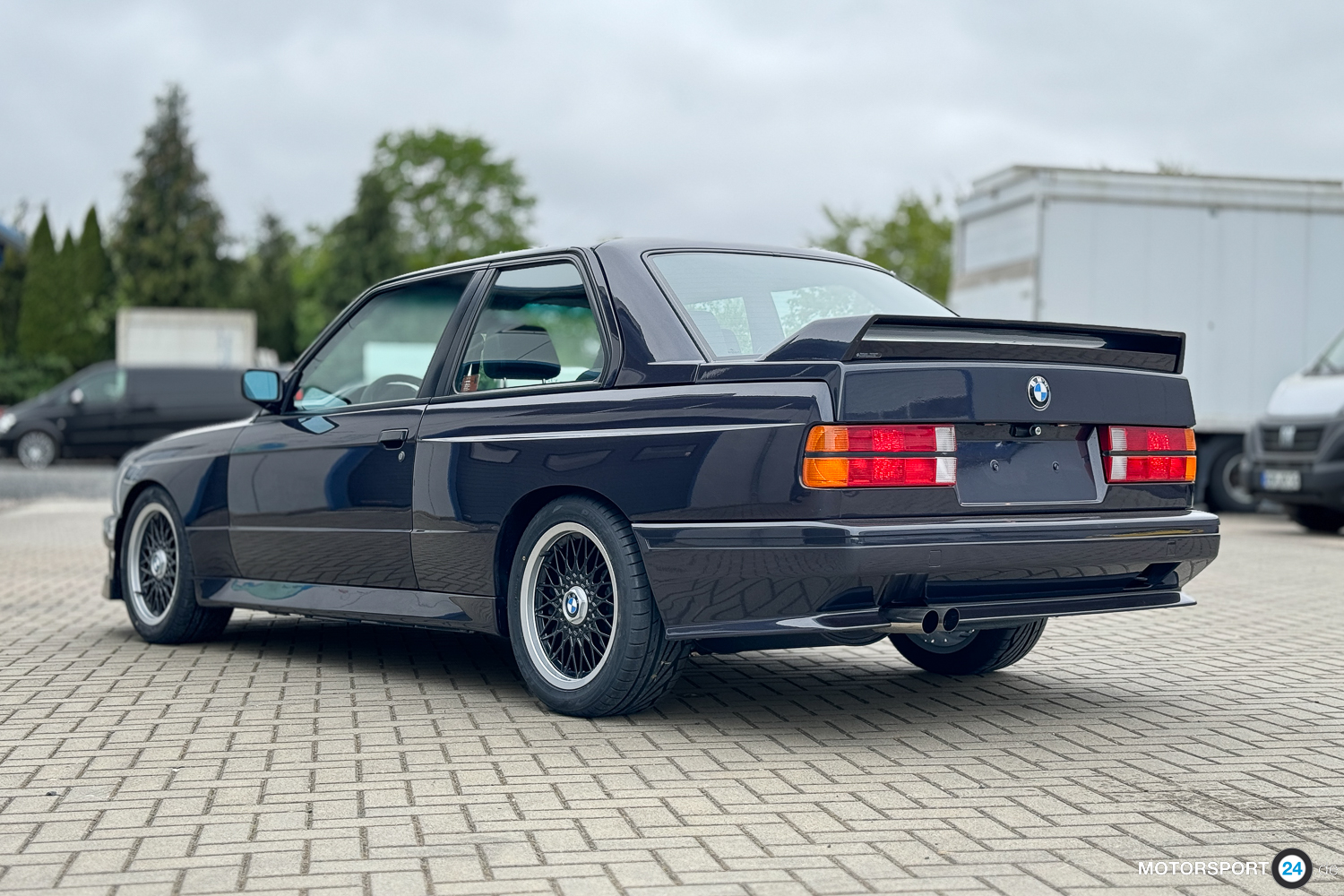
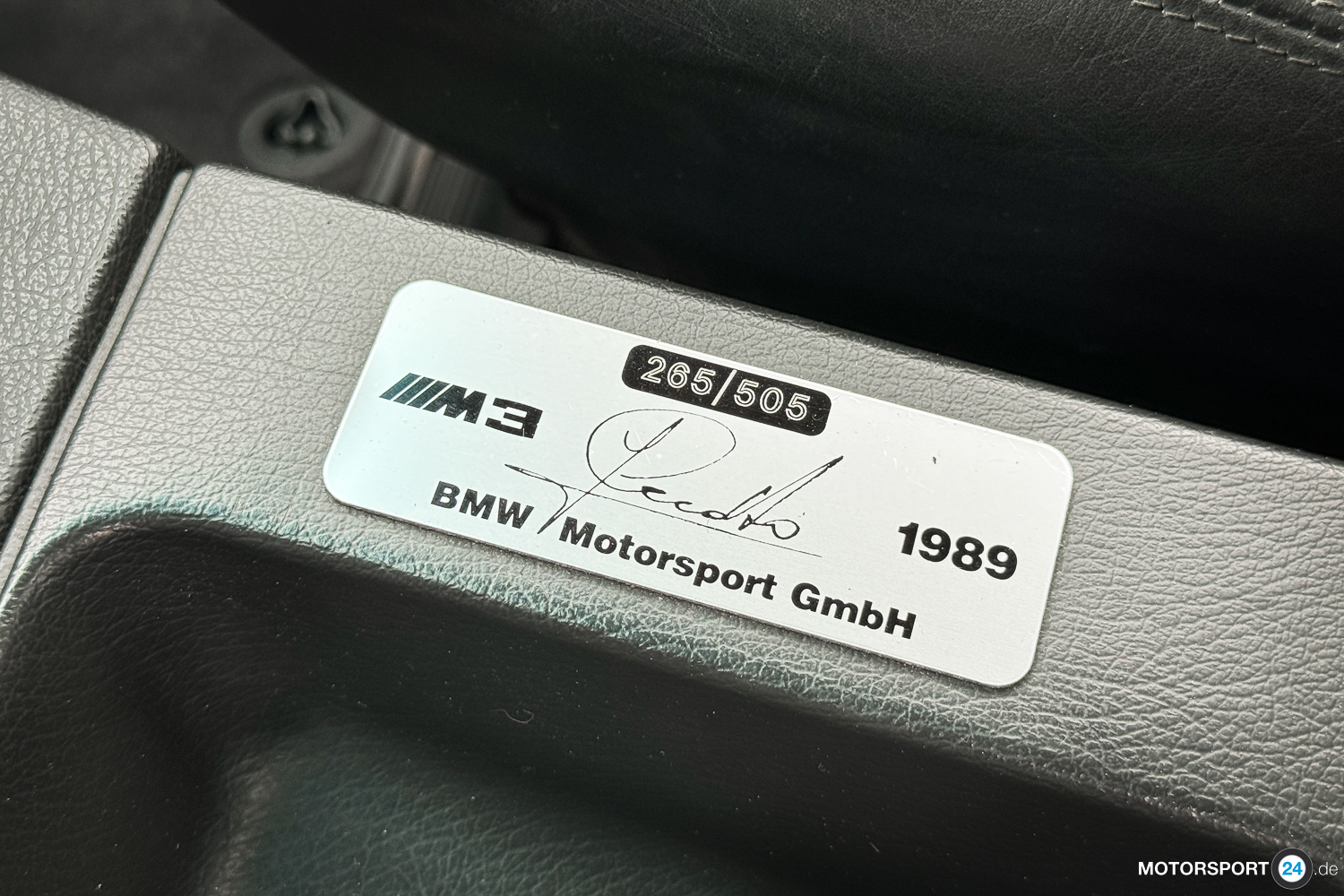
Visually, according to BMW Group Classic, the Cecotto adopted design features of the Evolution II. It was available in three colours: Misano Red, Macao Blue and Nogaro Silver. Inside sits a plaque with Cecotto’s printed signature and the running number — on the car shown in these images, 265 of 505.
For a long time there were differing counts for the production number — they resolve once the levels are separated. BMW Group Classic and bmw-m.com give 505 for the edition as a whole. The BMW PressClub gives 480 for the Cecotto in the narrower sense, bmw-m.com 25 for the Ravaglia. 480 plus 25 equals exactly 505 — and BMW Group Classic explicitly states that the Ravaglia edition was created “within” the Cecotto edition. Both figures are therefore correct, they simply count different things. This is confirmed by the plaques: documented examples include 142/505, 183/505, 265/505 and 489/505, and the recorded chassis numbers all fall within a block that adds up to exactly 505 vehicles.
One question remains open: Switzerland. The 3er-Club and m3-klassik cite 50 additional, de-restricted vehicles with 211 PS, while Wikipedia EN and classic.com cite 80. Both camps contradict each other, and both have a problem — one documented Swiss car carries the plaque 489/505, meaning it should not fall outside the 505 at all. We therefore leave the question open. Incidentally, the English-language “208 hp” is not a separate figure but the converted 211 PS.
02 · History
One year, two names
Where the special editions come from.
- 1987 Johnny Cecotto and Roberto Ravaglia are among the defining M3 drivers of the touring car years. Ravaglia wins the World Championship drivers' title.
- 1988 Ravaglia wins the Touring Car European Championship. BMW launches the M3 Europameister for this, in 148 examples.
- 1989 In April, Cecotto and Ravaglia follow with 215 PS. Ravaglia wins the DTM in the same season, and BMW takes a one-two finish at the 24-hour race at the Nürburgring.
- 1989 From September, the regular series adopts the 215 PS of the special editions.
- 1990 The Sport Evolution with 2,467 cm³ and 238 PS marks the closing point of the M3 special editions.
03 · Model overview
The M3 special editions compared
The Cecotto is the highest-volume of the named special editions — and the first with 215 PS.
Source: factory and literature data · verified
Technische Daten anzeigen — komplette Modellmatrix
| Modell | Motor | Hubraum | Leistung | Bauzeit |
|---|---|---|---|---|
| M3 Europameister | S14B23 with catalytic converter | 2.302 cm³ | 195 PS (143 kW) | Late 1988, 148 units |
| M3 Evolution | S14B23 | 2.302 cm³ | 200 PS (147 kW) | 1987, 505 units |
| M3 Evolution II | S14B23 | 2.302 cm³ | 220 PS (162 kW) | 1988, around 500 units |
| M3 Cecotto | S14B23 with catalytic converter | 2.302 cm³ | 215 PS (158 kW) | 1989, 505 units (of which 25 Ravaglia) |
| M3 Ravaglia | S14B23 with catalytic converter | 2.302 cm³ | 215 PS (158 kW) | 1989, 25 of the 505 Cecotto, Great Britain only |
| M3 Sport Evolution | S14B25 | 2.467 cm³ | 238 PS (175 kW) | 1990, 600 units |
04 · In detail
In detail
Coupé

Bodywork of the series M3 with design features of the Evolution II. Available in Misano Red, Macao Blue and Nogaro Silver. Length 4,346 mm, width 1,680 mm, height 1,370 mm, wheelbase 2,562 mm, five wheel bolts.
Plaque in the interior

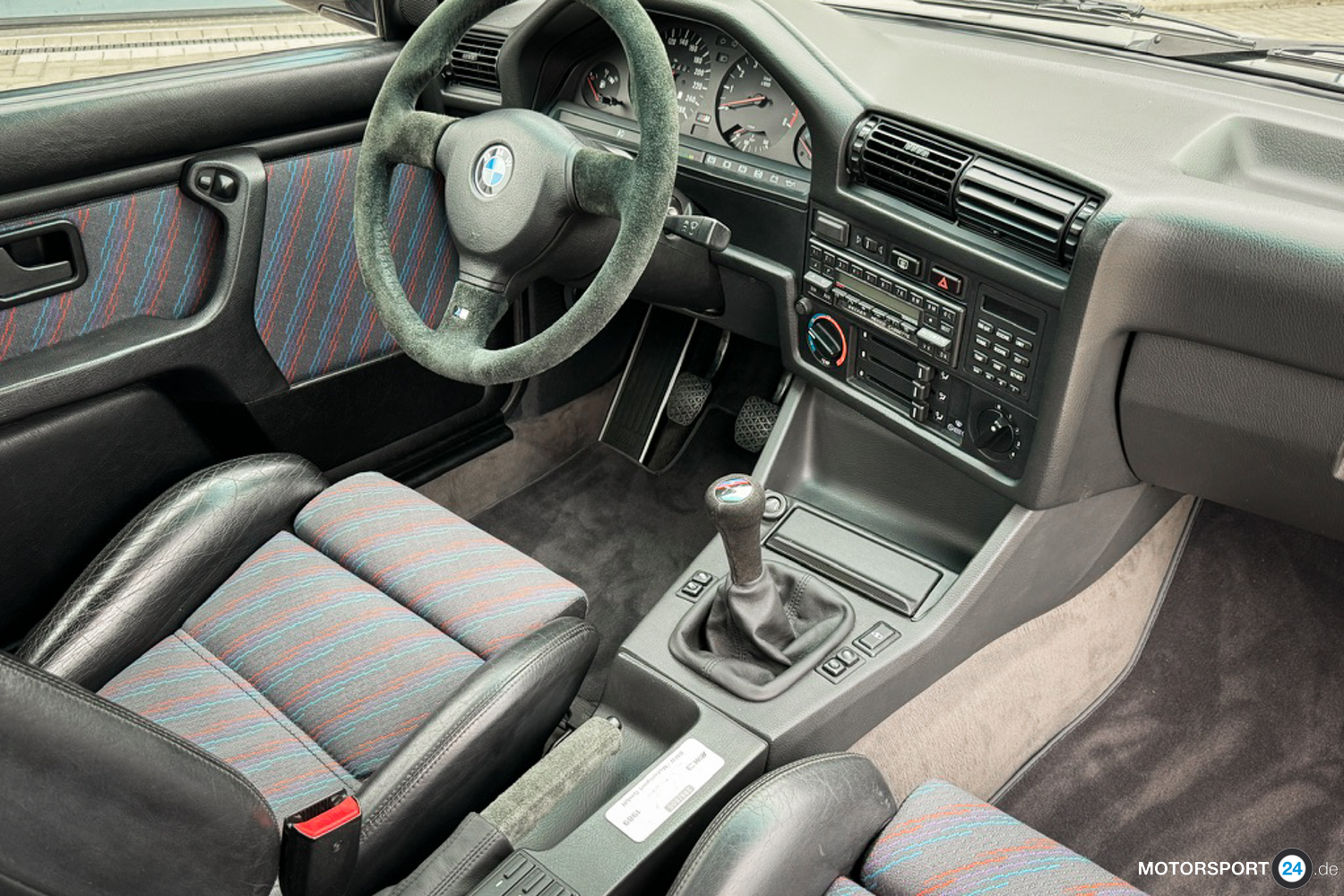
Every Cecotto carries a plaque in the interior with Johnny Cecotto's signature, the year 1989, the BMW Motorsport GmbH lettering and the running number. The signature is printed, no car was personally signed. The car in these images is 265 of 505 — the plaque thus documents the total number on the vehicle itself.
Innenraum

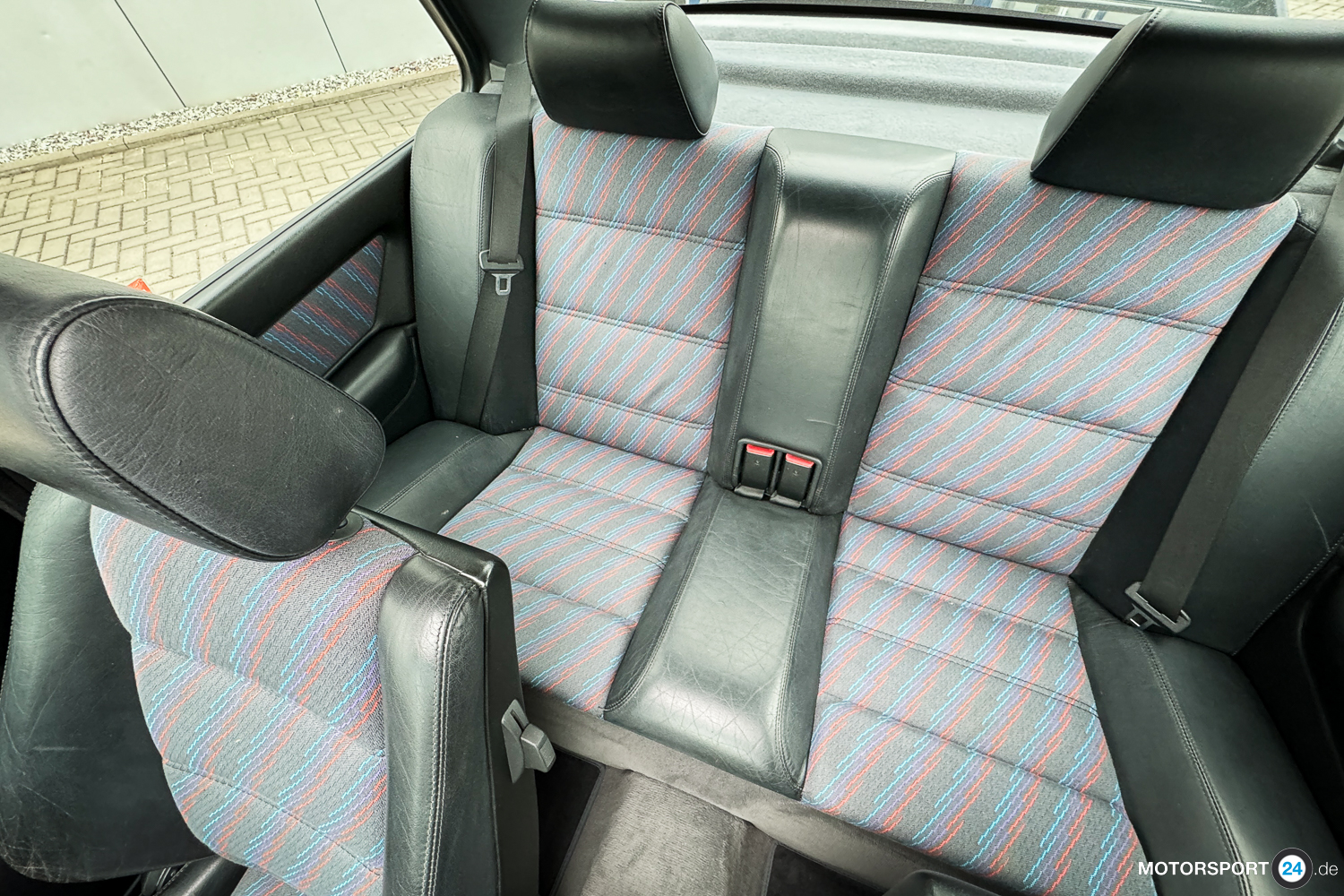
Sports seats with the chequered M-Technic fabric, M-Technic steering wheel, door panels in matching trim.
05 · Engines
The S14B23 with 215 PS
Not a new engine, but a new tuning: the Cecotto brought the catalytic-converter version boosted to 215 PS, which later carried over into series production.
S14B23 · 2.302 cm³ · 215 PS verified
Four-cylinder with four valves per cylinder and two overhead camshafts. Bore 93.4 mm, stroke 84.0 mm, compression ratio 10.5:1. With regulated catalytic converter it produces 215 PS at 6,750/min here; BMW Group Classic states a top speed of 241 km/h. For comparison: the regular catalyst M3 had produced 195 PS until then, the version without catalyst 200 PS. The Cecotto's 215 PS became the series output from September 1989.
Technische Daten anzeigen
| Bauart | Inline four-cylinder S14, four valves per cylinder, two overhead camshafts |
| Hubraum | 2.302 cm³ |
| Bore × stroke | 93,4 × 84,0 mm |
| Verdichtung | 10,5:1 |
| Leistung | 215 PS (158 kW) at 6,750/min |
| Abgasreinigung | regulated catalytic converter |
| Höchstgeschwindigkeit | 241 km/h |
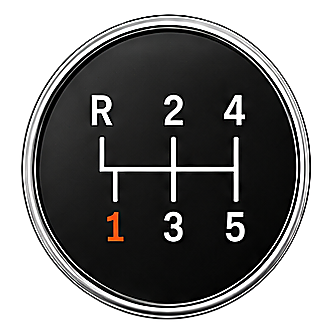
| Getriebe | Getrag 265/5 with dogleg shift pattern |
| Achsübersetzung | 3.25:1 with limited-slip differential |
Sources: BMW Group Classic (output, top speed, colours, plaque), Wikipedia DE and EN, Wikipedia DE (BMW S14). No leading source states the torque of the 215 PS version, so it is omitted.
06 · Weak points
What matters with this special edition
- The numbered plaque is the proof of identity. If it is missing, so is the evidence — and with it a substantial part of what makes up the car.
- Only three paint finishes were available: Misano Red, Macao Blue and Nogaro Silver. Any other colour means a respray.
- The chequered M-Technic fabric is difficult to replace true to original today. A well-preserved interior is worth real money.
- Otherwise the same points apply as for the series M3: originality of the M3-specific body parts, rust in the known E30 spots, complete service history for the S14.
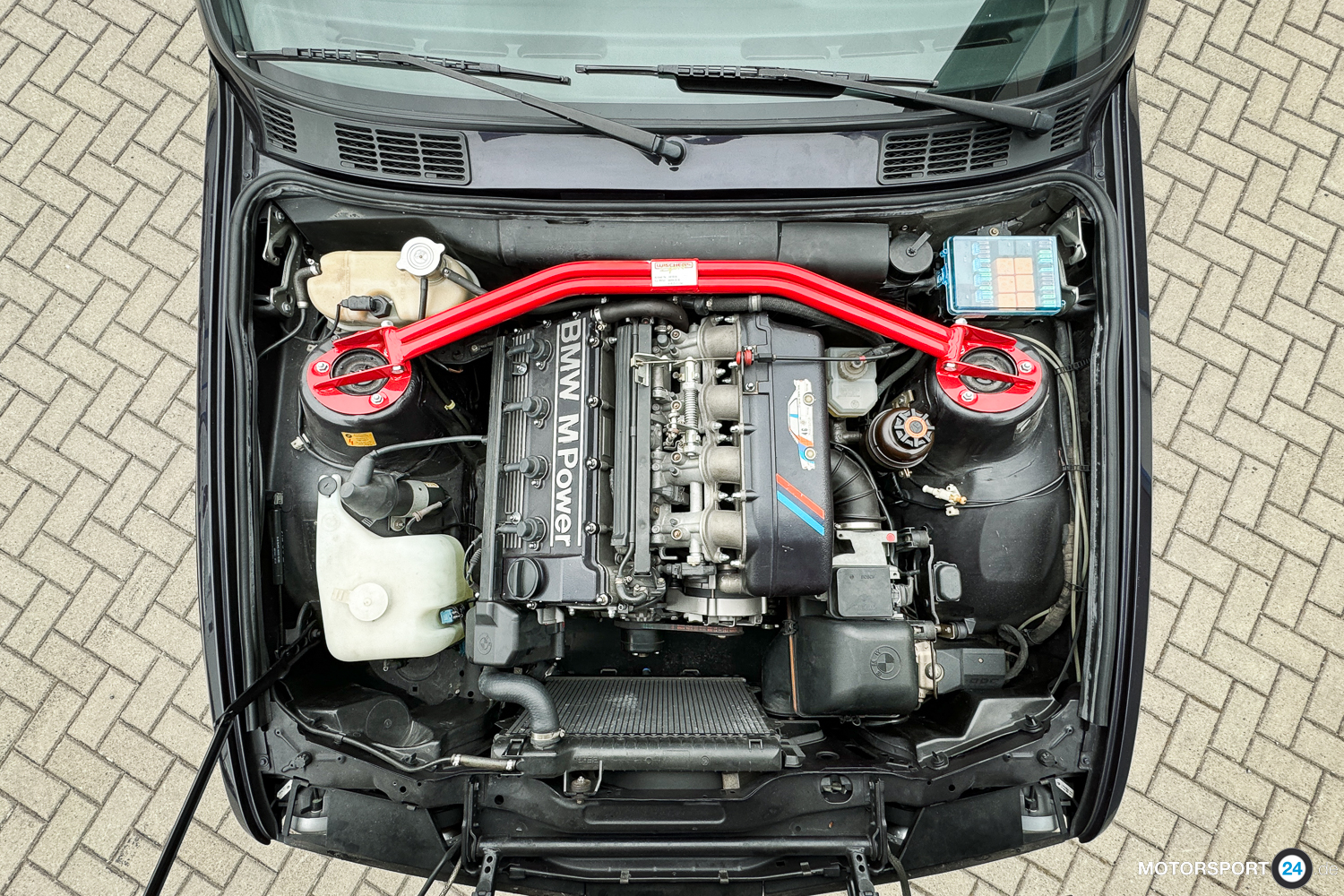
- Retrofitted strut braces and similar parts are common — the car in these images has one too. This is not a fault, but it is not part of the delivery condition.
07 · Engineering
Chassis, brakes, transmission
Bodywork and dimensions
Transmission and axle
Bremsen
What is not documented
Technical data — final drive ratios & gearboxes
- Production period
- 1989, market launch April
- Production number
- 505 according to BMW Group Classic and Wikipedia DE, of which 25 as Ravaglia for Great Britain
- Paint finishes
- Misano Red, Macao Blue, Nogaro Silver
- Engine
- S14B23 with regulated catalytic converter
- Output
- 215 PS (158 kW) at 6,750/min
- Top speed
- 241 km/h
- Transmission
- Getrag 265/5 with dogleg shift pattern
- Final drive ratio
- 3.25:1 with limited-slip differential
- Brakes front
- internally vented discs 280 mm
- Brakes rear
- solid discs 282 mm
- Wheel bolts
- five
- Length
- 4,346 mm
- Width
- 1,680 mm
- Height
- 1,370 mm
- Wheelbase
- 2,562 mm
- Interior identifier
- numbered plaque with Johnny Cecotto's printed signature, year 1989, BMW Motorsport GmbH
- Breakdown of the 505
- 480 Cecotto according to BMW PressClub, 25 Ravaglia for Great Britain according to bmw-m.com — together 505 according to BMW Group Classic. According to BMW Group Classic, the Ravaglia edition was created within the Cecotto edition, so it is not additional. Open question: the Swiss vehicles. The 3er-Club and m3-klassik cite 50 additional cars with 211 PS, Wikipedia EN and classic.com cite 80. However, one documented Swiss Cecotto carries the plaque 489/505, which argues against a count outside the 505. Not verifiable and therefore not listed: price at market launch, torque of the 215 PS version, factory wheel size.
08 · Identifikation
Identifikation
The Cecotto combines Evolution II looks with the catalyst engine and signature plaque.
- Optik
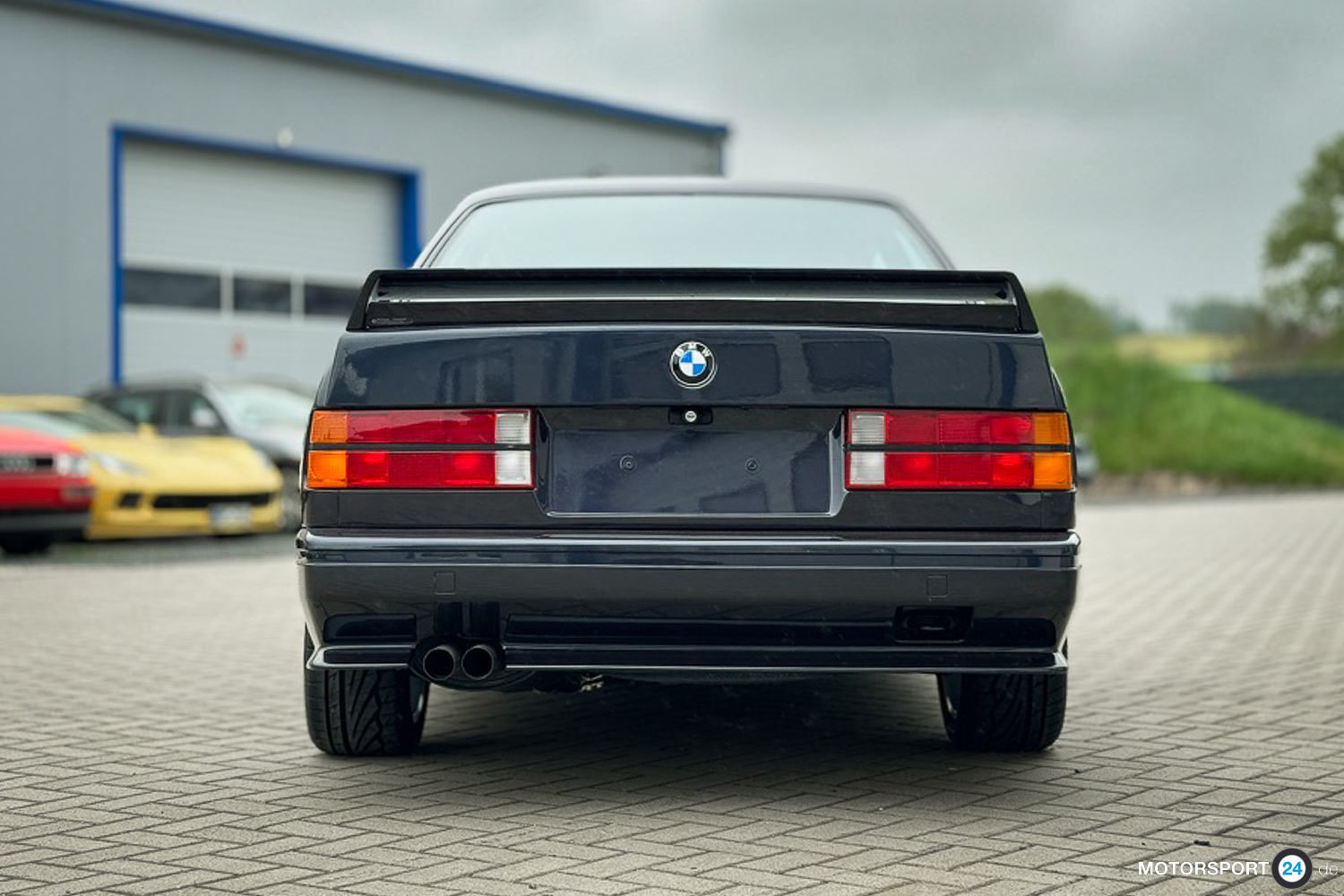
- Evolution II spoiler work, brake air ducts instead of fog lightsverified
- Motorraum
- Valve cover and air collector painted in body colourverified
- Plakette
- with Johnny Cecotto's signature in the interiorverified
- Motor
- S14B23 with catalytic converter, 215 PS — anticipating the later series outputverified
- Farben
- Misano Red, Macao Blue or Nogaro Silververified
- Fahrgestellnummern
- AE40337, AE40339, AE40341 as well as AE40367–AE40868 — mathematically exactly 505 vehicles, including the 25 Ravaglia models (BMW M GmbH service documentation)verified
09 · Other special editions
Other special editions
M3 with Evolution engine ("Evolution", 1987)
200 PS, externally at series specification — the quiet homologation stage from spring 1987.
To the sub-page →
M3 Evolution II (1988)
220 PS and, for the first time, its own aerodynamics, 500 units in three colours.
To the sub-page →
M3 Europameister (1988)
148 units in Macao Blue with printed Ravaglia signature — not to be confused with the Ravaglia.
To the sub-page →
M3 Ravaglia (1989)
The British edition of the Cecotto series, 25 right-hand drive.
To the sub-page →
M3 Sport Evolution (1990)
2.5 litres, 238 PS, adjustable spoilers — the closing point of the model line.
To the sub-page →
10 · M GmbH
The car that made the series stronger
Special editions are usually equipment packages. The Cecotto is the exception: with it, BMW introduced the catalytic-converter version of the S14 boosted to 215 PS, and from September 1989 every series M3 received it. The special edition was the trailblazer here, not the bonus.

11 · Motorsport
Two names, two drivers
Johnny Cecotto, previously a motorcycle world champion, drove the M3 in the DTM and in the Touring Car World Championship. Roberto Ravaglia took the World Championship drivers’ title in 1987, the European Championship in 1988, and the DTM in 1989. Both 1989 special editions bear their names.
For accuracy, a qualification is needed regarding the 1987 World Championship title: Ravaglia won the drivers’ title 269 to 268 points, while the teams’ title went to Eggenberger Motorsport in a Ford Sierra Cosworth. The series was also controversial — only those who paid a 60,000 US dollar registration fee received points — and it was discontinued after one season.
12 · Buying guide
What matters: the number on the plaque
With 505 examples, the Cecotto is not a one-off, but rare enough that a forgery would be worthwhile. The inspection therefore begins in the interior.
Numbered plaque with Cecotto's printed signature, the year 1989 and the BMW Motorsport GmbH lettering — present, original, consistent with the vehicle's history?
Paint finish: only Misano Red, Macao Blue and Nogaro Silver are documented from the factory.
Chequered M-Technic fabric in the interior, original condition.
Then the usual E30 points: gusset plates behind the front wheels, battery tray, rear wheel arches, sills, boot floor, windscreen frame.
M3-specific body parts: wide C-pillar, flat rear window, raised boot lid, five wheel bolts.
Service history of the S14, complete.
The order is: first plaque and papers, then colour and interior, then bodywork, then mechanics. With the Cecotto, identity can be verified better than with any other M3 — the number is in the car.
13 · The competition
The competition
Mercedes-Benz 190 E 2.5-16 Evolution II
The counterpart from Stuttgart, 1990, in 502 examples, 235 PS. Unlike the Cecotto, a genuine homologation model with far-reaching technical changes and the most striking aerodynamics of its time.
BMW M3 Europameister
One year older, 195 instead of 215 PS, but with 148 examples roughly three times rarer. Only in Macao Blue, with light-coloured leather and Ravaglia plaque.
BMW M3 Sport Evolution
The pinnacle of the model line from 1990: 2,467 cm³, 238 PS, 600 units, only in Diamond Black and Brilliant Red. Those seeking the performance will find it here — those seeking the driver's model, in the Cecotto.
14 · Galerie
Bilder
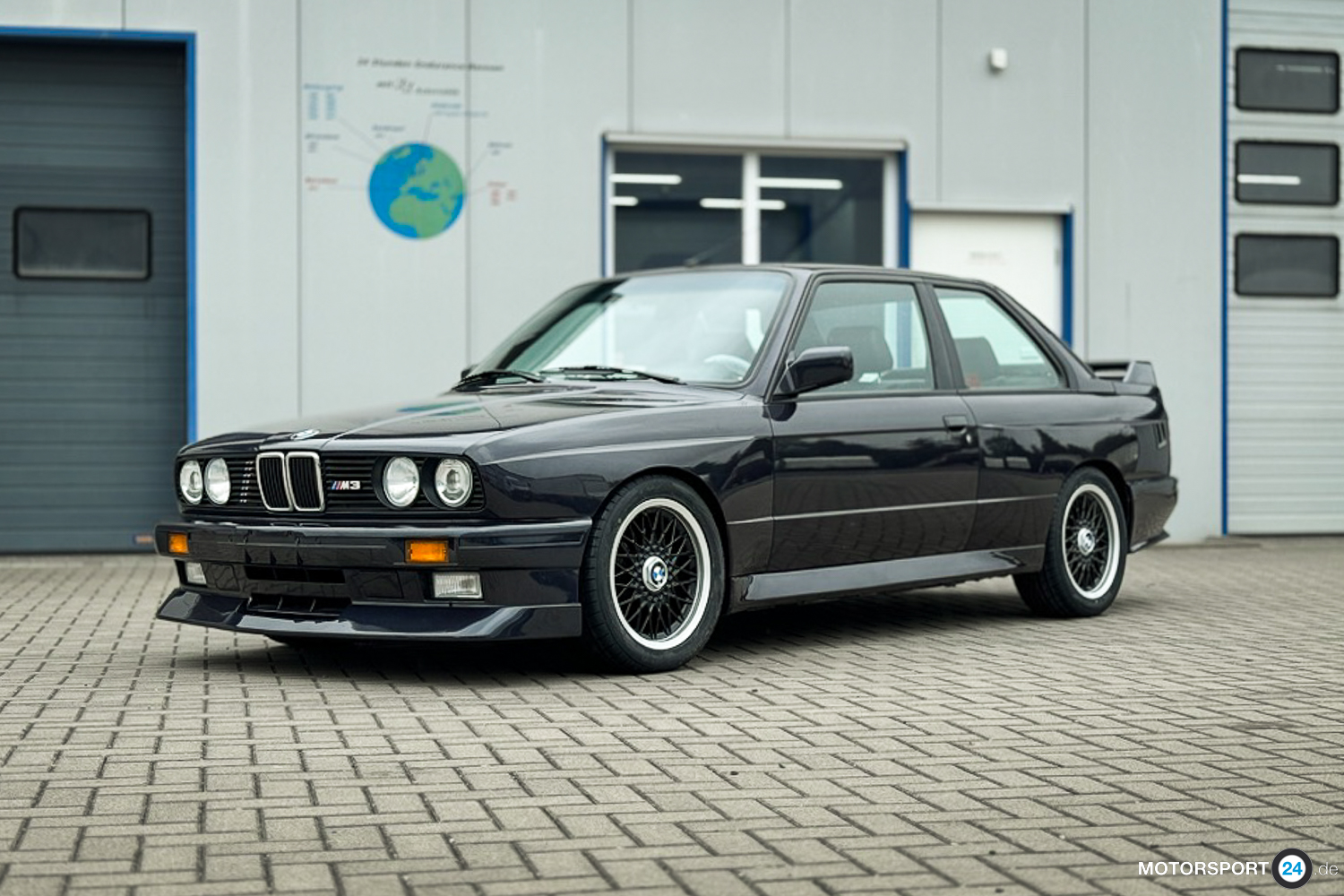
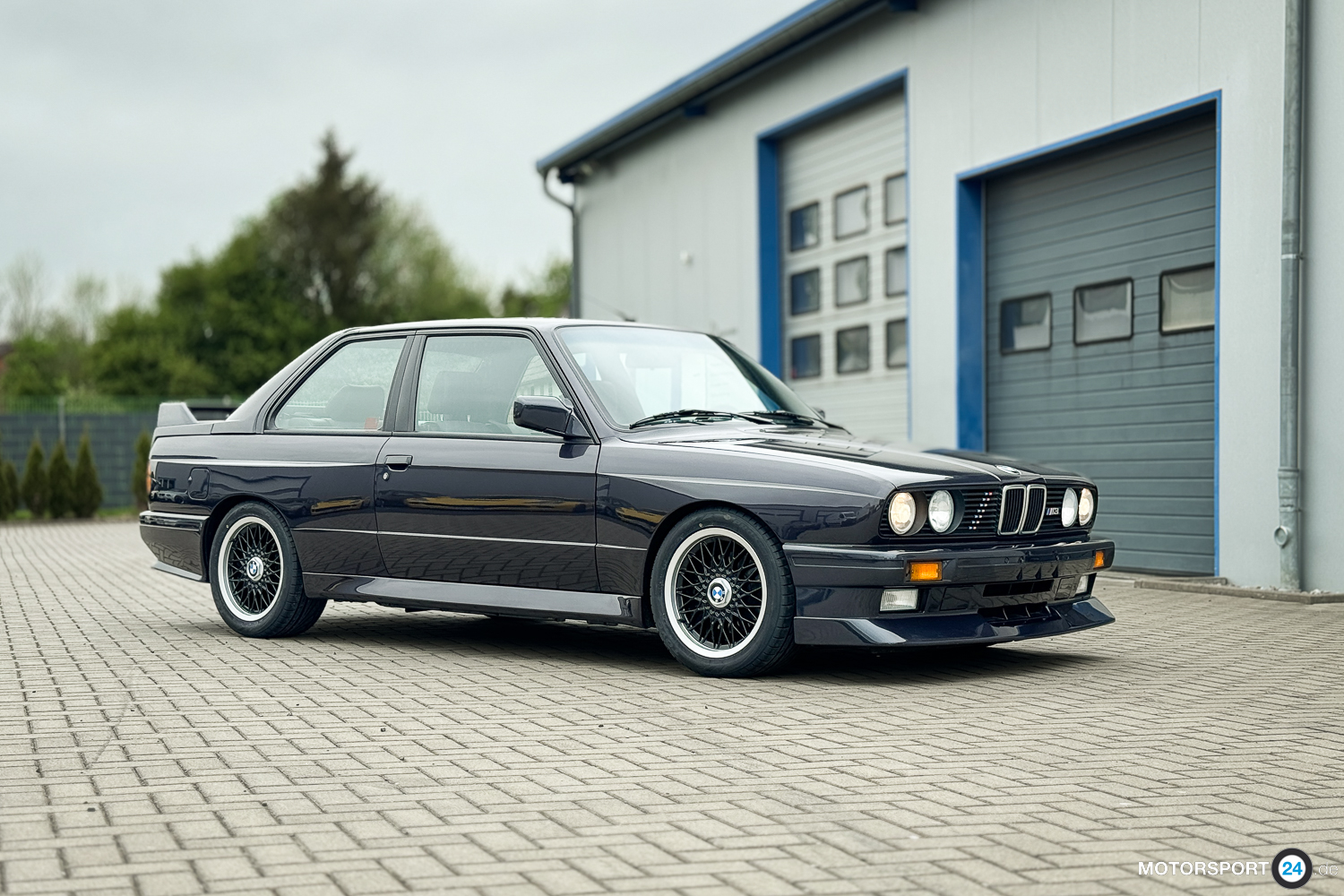
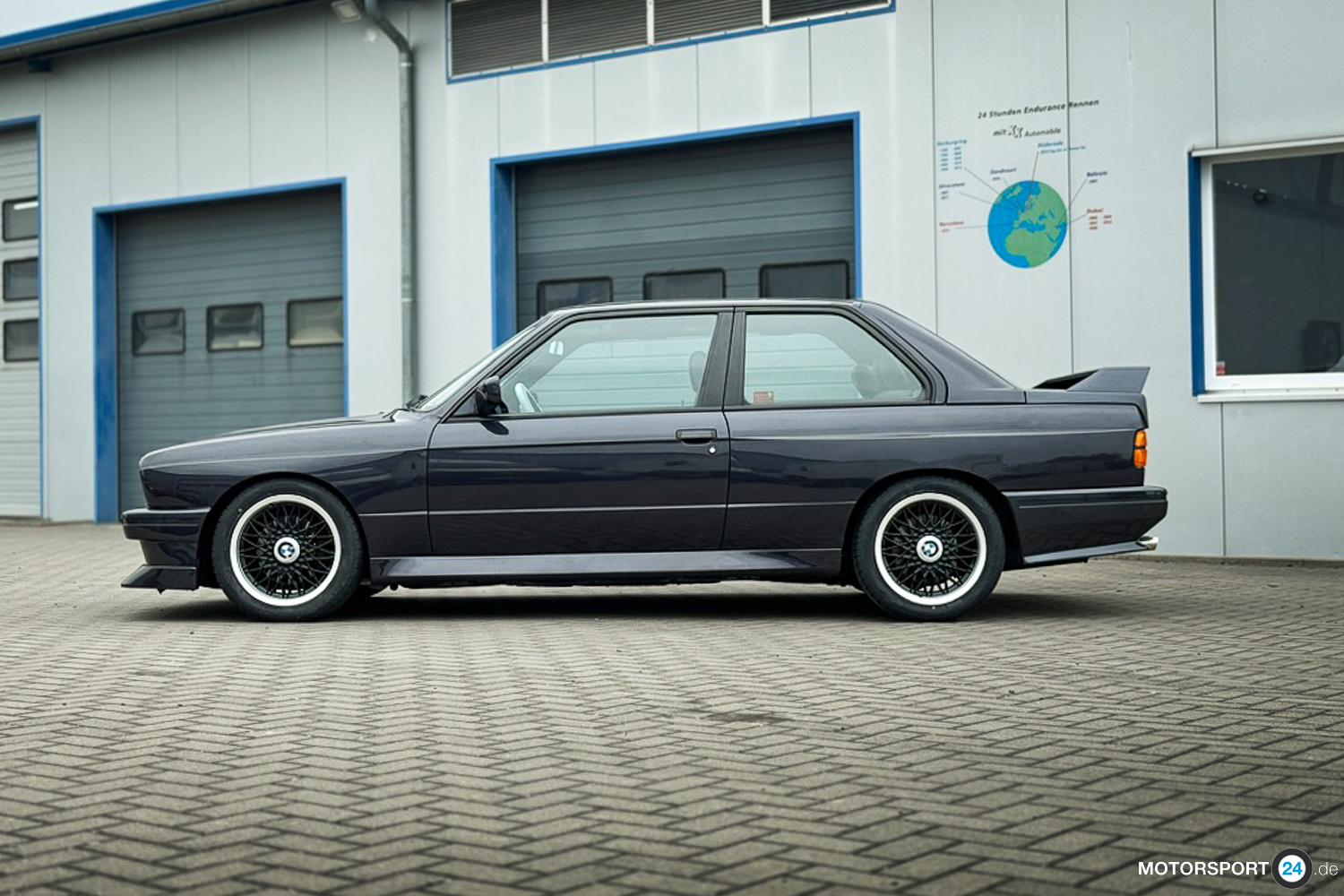
Cecotto number 265 of 505 in dark metallic paint. Own photographs. The strut brace in the engine bay is a retrofit.
15 · Sources
Belege & Literatur
Leading sources are BMW Group Classic, the BMW PressClub and Wikipedia. Where production numbers conflict, all counts are given in the text. Details on the vehicle shown are from our own documentation.
- BMW Group Classic — BMW M3 (E30), Cecotto edition and Ravaglia edition
- BMW Group Classic — BMW M3 (E30)
- Wikipedia (DE) — BMW E30 (M3), special editions
- Wikipedia (EN) — BMW M3 (E30)
- BMW 3er-Club E21 und E30 e.V. — Der M3
- bmw-m.com — BMW M3 E30 profile (505 Cecotto, 25 Ravaglia)
- BMW PressClub — La historia del BMW M3 (480 Cecotto)