

01 · Overview
The Shark from Karmann
In October 1975 the first E24 rolled off the line at Karmann in Osnabrück, and in March 1976 it stood on the Geneva Salon stand. It replaced the E9 — and broke with it: unlike the pillarless predecessor coupé, the E24 has a B-pillar. Only the front side windows are frameless; the rear windows can only be lowered by about twenty centimetres.
It was styled by Paul Bracq, BMW’s chief designer at the time. The driver-angled centre console he had introduced in the E12 was refined here — it remained a BMW hallmark for over twenty-five years thereafter. Until July 1977 Karmann built complete cars, after that only bare bodyshells; final assembly moved to Dingolfing.
The most important technical turning point came in May 1982: the E24 switched from the E12 floorpan to that of the E28 — around fifty kilograms lighter, stiffer, with a double-joint front axle and revised rear axle geometry. Anyone looking for an E24 to drive today is looking for a car built after this date. Anyone looking for one to collect tends to look before it: the complete Karmann production up to July 1977.
02 · History
Thirteen Years in Ten Steps
From the start of series production at Karmann in October 1975 to the last coupé in April 1989 — the longest BMW model line production run up to that point.
- 1975 In October, series production begins at Karmann in Osnabrück with the 630 CS and 633 CSi. The English Wikipedia gives a differing date of January 1976 — we follow the German source material.
- 1976 In March, public premiere at the Geneva Salon. The E24 replaces the E9 and, unlike it, is no longer a pillarless hardtop.
- 1976 In September, the 630 CSi launches in North America with a fuel-injected engine and the mandatory 5-mph bumpers — as a result the US version is 4,923 mm long instead of 4,755 mm.
- 1977 In August, BMW moves final assembly to Dingolfing; Karmann now supplies only bare bodyshells. Vehicles from the complete production run up to July 1977 are the most sought-after today.
- 1978 In June, the 635 CSi arrives with the M90 engine, 218 PS, rear spoiler, five-speed sports gearbox and firmer suspension. Price in August 1978: 49,400 Mark.
- 1979 In June, the 628 CSi replaces the carburettor-fed 630 CS — 2,788 cm³, 184 PS, the most economical engine in the model line.
- 1982 In May, the major facelift: switch to the E28 floorpan, double-joint front axle, Bosch Motronic, reduction of the three-and-a-half-litre's displacement from 3,453 to 3,430 cm³. Fuel consumption on the 635 CSi drops by almost eighteen percent. New: on-board computer, automatic Check Control, service interval display.
- 1983 In September, premiere of the M635 CSi at the IAA in Frankfurt — 286 PS from the M88/3 of the BMW M1, 255 km/h, 89,500 Mark. Series production and market launch follow in April 1984.
- 1987 In May, the second facelift: new bumpers with impact absorbers, larger front spoiler, triple ellipsoid headlights in the style of the E32, length increased to 4,815 mm. The 628 CSi is discontinued, the M30B35 arrives with 220 or 211 PS, and all models now have a catalytic converter as standard. New is the Highline trim.
- 1989 In February, production of the M635 CSi ends, and in April that of the model line. After more than thirteen years, the E24 is the longest-produced BMW model line to date. A successor does not arrive until 2003 with the E63.
03 · Model overview
From the 630 CS to the M635 CSi
Factory figures for Europe. Two pitfalls: the 635 CSi had the <strong>M90</strong> with 3,453 cm³ until April 1982 and the <strong>M30B34</strong> with 3,430 cm³ from May 1982 — same output, different engine. And the English Wikipedia lists several incorrect power figures for the E24; we follow the German data.
Source: factory and literature data · verified
Technische Daten anzeigen — komplette Modellmatrix
| Modell | Motor | Hubraum | Leistung | Bauzeit |
|---|---|---|---|---|
| 630 CS | M30 B30V · Solex carburettor | 2.985 cm³ | 185 PS (136 kW) | 1976–1979 |
| 628 CSi | M30 B28 · L-Jetronic, Motronic from 1982 | 2.788 cm³ | 184 PS (135 kW) | 06/1979–05/1987 |
| 633 CSi | M30 B32 · L-Jetronic | 3.210 cm³ | 200 PS (147 kW) | 1976–1982 |
| 635 CSi | M90 · L-Jetronic | 3.453 cm³ | 218 PS (160 kW) | 06/1978–04/1982 |
| 635 CSi | M30 B34 · Motronic | 3.430 cm³ | 218 PS (160 kW) | 05/1982–06/1987 |
| 635 CSi with catalytic converter | M30 B34 low compression | 3.430 cm³ | 185 PS (136 kW) | ab 1984 |
| 635 CSi | M30 B35 | 3.430 cm³ | 220 PS (162 kW) · with catalytic converter 211 PS | 05/1987–04/1989 |
| M635 CSi | M88/3 · Motronic | 3.453 cm³ | 286 PS (210 kW) | 04/1984–02/1989 |
| 630 CSi (North America) | M30 B30 · thermal reactor | 2.985 cm³ | 176 hp (131 kW) | 09/1976–07/1977 |
| 633 CSi (North America) | M30 B32 | 3.210 cm³ | 174–181 hp (128–135 kW) | 09/1977–1984 |
| 635 CSi (North America) | M30 B34 · compression ratio 8.0:1 | 3.430 cm³ | 182 hp (136 kW) | MJ 1985–1987 |
| 635 CSi (North America) | M30 B35 | 3.430 cm³ | 208 hp (155 kW) | MJ 1988–1989 |
| M6 (North America) | S38 B35 | 3.453 cm³ | 256 hp (191 kW) | MJ 1987–1989 |
04 · Body variants
Body variants
Coupé (E24)

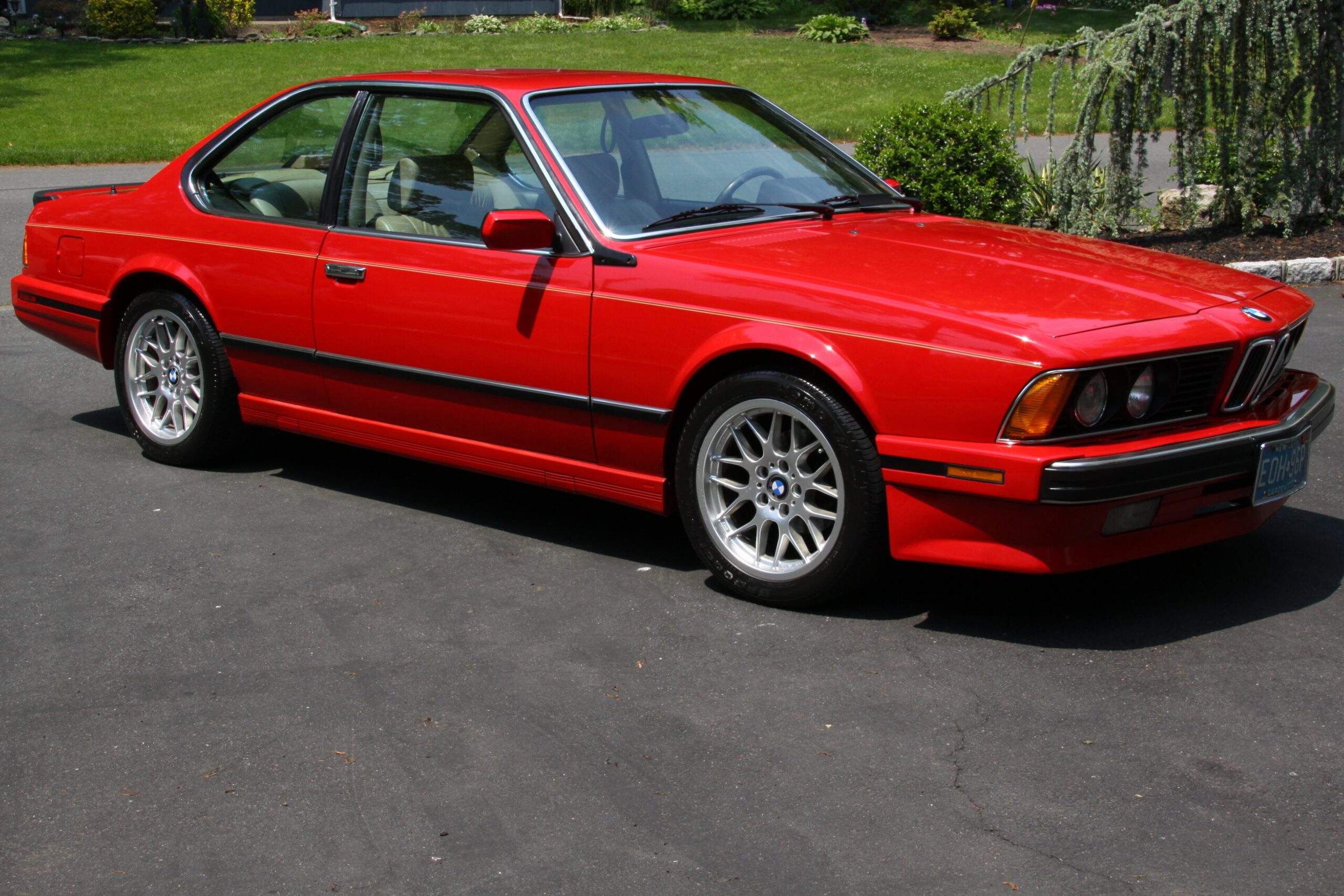
The only factory bodystyle — no Convertible, no four-door, no Targa. 4,755 mm long until 1987, 4,815 mm thereafter; 4,923 mm in North America due to the 5-mph bumpers. Width 1,725 to 1,740 mm, height around 1,360 mm, wheelbase 2,625 mm, boot capacity 335 litres, kerb weight 1,410 to 1,515 kilograms. Third-party convertible conversions exist, but they are not factory variants.
05 · Engines
One Family, Five Stages of Development — and Two M Engines
The E24 had exclusively straight-six engines. Five of them come from the M30 family, BMW's "big six"; the two M engines trace back to the M1.
M30B28 — 628 CSi verified
2,788 cm³, 184 PS, the most economical E24 engine. Smooth-running, eager to rev and very robust, but only just adequate for the car's weight. The early L-Jetronic ages: air flow meter, cold start valve and connectors cause trouble.
M30B30 — 630 CS and 630 CSi verified
2,985 cm³. In Europe as a carburettor variant with 185 PS, in North America as a fuel-injected version. Mechanically simple and forgiving, but the Solex 4A1 is sensitive to adjustment and ageing, and parts are scarce. The American thermal reactor exhaust system of the 1976 and 1977 model years is prone to heat damage.
M30B32 — 633 CSi verified
3,210 cm³, 200 PS, the most balanced torque delivery of the early phase. Significantly throttled in North America to 128 to 135 kW.
M90 and M30B34 — 635 CSi until 1987 verified
Until April 1982 the M90 with 3,453 cm³, thereafter the M30B34 with 3,430 cm³ and Motronic — both with 218 PS. With Motronic, the M30B34 is the smoothest-running and most durable engine in the model line; 300,000 kilometres are realistic with proper care. Note: the 10.0:1 compression ratio requires good fuel and a functioning knock sensor.
M30B35 — 635 CSi from May 1987 verified
3,430 cm³ with 9.0:1 compression, 220 PS without and 211 PS with a catalytic converter. The most mature development stage: catalytic-converter capable, without any notable loss of power compared to the B34.
M88/3 — M635 CSi verified
3,453 cm³, two overhead camshafts, 24 valves, six individual throttle butterflies, compression ratio 10.5:1, 286 PS at 6,500 rpm and 340 Nm at 4,500 rpm. The engine comes directly from the BMW M1 — only the Kugelfischer injection gave way to Bosch Motronic. Rev-happy, powerful sounding, 255 km/h. And sensitive: spirited cold starts, neglected valve clearance checks and skipped oil changes take an expensive toll.
S38B35 — M6 North America verified
Same bore and stroke as the M88/3, but 9.8:1 instead of 10.5:1, a regulated catalytic converter, a simplified manifold and shorter camshafts — 256 hp instead of 286 PS. The reason was the catalytic converter and the lower octane rating of American fuel. One advantage remains: the S38's duplex timing chain is considered more durable than that of the M88/3.
06 · Weak points
Reliability & Weak Points
- Rust is the dominant issue with the E24, and the cause is well known: factory cavity protection was inadequate, especially in the early production years. BMW only tackled the issue seriously in the second half of the eighties.
- Critical and expensive are the front wings along with their mounting supports — replacement panels are hard to find —, the front strut towers and the mounts for the rear subframe and differential.
- Also affected: sills, door bottom edges and door cavities when water drain holes are blocked, rear wheel arches and wheel housings, rear valance and tail ends, boot floor and spare wheel well, the area around the rear window seal, and the front longitudinal members in the engine bay.
- Timeline: vehicles up to around 1982 are significantly more prone to rust. From the 1982 facelift onward, with the E28 floorpan and better rust protection, the substance improves noticeably. It is precisely the most collectible phase — the complete Karmann production up to July 1977 — that is the most critical in terms of rust.
- On the engine side, leaking valve stem seals are typical of all M30 units, recognisable by blue smoke on lift-off, along with piston ring wear and the cylinder head gasket. The most common cause of failure, however, is the cooling system.
- Electrics: headlight beam adjustment, the anti-theft alarm and the door lock heating are the classic fault sources. Check Control and the on-board computer fail with age, and replacements are expensive and scarce. ABS faults occur regularly and are difficult to fix.
- On the suspension, the trailing arm bearings wear out, and struts and strut mounts deteriorate — the car then feels loose. In addition, there are leaks in the power steering and play in the steering box.
- The biggest everyday problem today is parts: trim and chrome strips as well as add-on parts are barely obtainable anymore, especially in rare colours and specifications. With poor substance, restoration costs regularly exceed the vehicle’s value.
07 · Engineering
Floorpan, Axles, Gearbox, On-board Electronics
Bodengruppe
Vorderachse
Hinterachse
Brakes and ABS
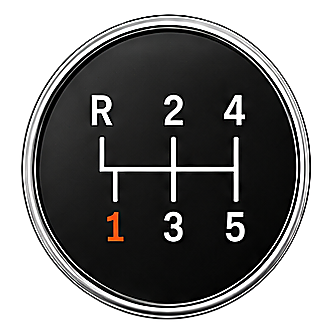
Getriebe
On-board Computer and Check Control
Catalytic Converter and Highline
Technical data — final drive ratios & gearboxes
- Gearbox 628 CSi
- Getrag 262 four-speed until May 1982, then Getrag 260 five-speed with overdrive; automatic ZF 3HP22, ZF 4HP22 from 1983
- Gearbox 630 CS and 633 CSi
- Getrag 262 four-speed as standard, Getrag 265/5 five-speed sports gearbox optional, ZF 3HP22 automatic optional
- Gearbox 635 CSi
- Getrag 265/5 five-speed sports gearbox standard until May 1982, then Getrag 260 with overdrive; automatic ZF 4HP22 from 1983
- Gearbox M635 CSi
- exclusively Getrag 280/5 five-speed sports gearbox, no factory automatic option
- Final drive ratio 628 CSi and 630 CS
- 3.45 (38:11)
- Final drive ratio 633 CSi
- 3.25 (39:12)
- Final drive ratio 635 CSi
- 3.07 (40:13) until May 1982 and continuing on non-catalytic versions, 3.64 (40:11) on catalytic converter models from June 1987
- Final drive ratio M635 CSi
- 3.73 (41:11) with 25 percent limited-slip differential as standard
- When the five-speed became standard is disputed
- the German Wikipedia states 1979, the English Wikipedia states model year 1982, and the parts catalogue lists the Getrag 260 for the 628 CSi only from September 1982.
The final drive ratios come from parts catalogues and are organised there by model and model year rather than by gearbox type — a separate figure for manual and automatic gearboxes is therefore not possible. Gear ratios cannot be verified from permissible sources.
08 · Top models
Top models
The M model in two versions, plus the 635 CSi in its two engine stages and the trim level that turns the late E24 into a luxury coupé.
M635 CSi (US: M6)
M1 engine with 286 PS, 5,855 units — North American M6 version with the S38 on the same page.
To the sub-page →
635 CSi (all stages)
M90, M30B34 and M30B35 — eleven years as the flagship model on one page.
To the sub-page →
Highline
From May 1987, the E24's luxury trim: full leather including dashboard and door panels, electric seat adjustment, rear air conditioning. Additional cost around 11,275 to 12,500 Mark — a fortune then, and a value factor today.
To the sub-page →
09 · M & special editions
M635 CSi and M6 — an M1 Engine in a Coupé
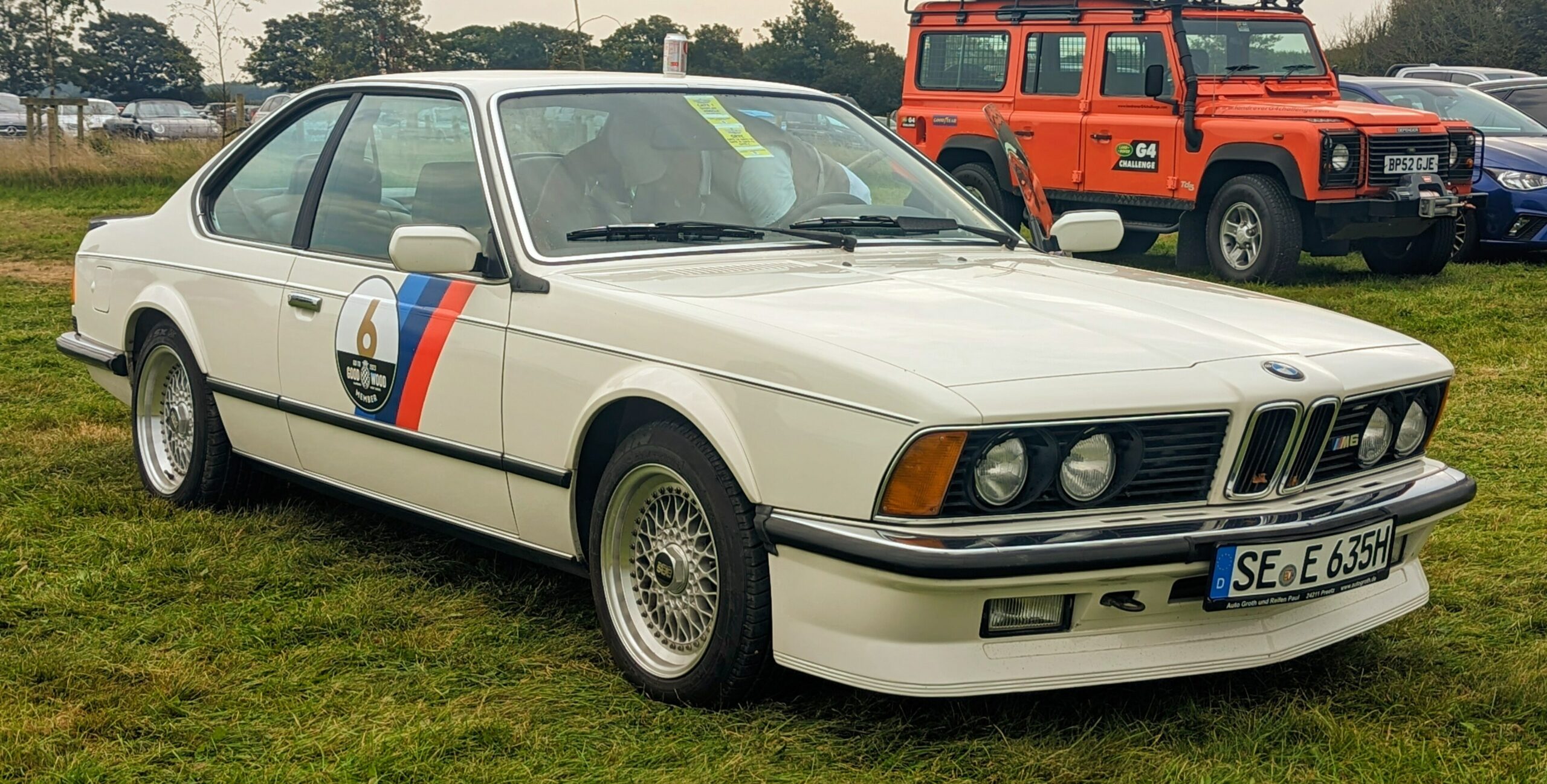
At the IAA in September 1983, BMW presented the M635 CSi, with series production starting in April 1984. Its M88/3 is the engine from the BMW M1: 3,453 cm³, 24 valves, six individual throttle butterflies, compression ratio 10.5:1 — only the Kugelfischer injection gave way to Bosch Motronic. 286 PS at 6,500 rpm, 340 Nm at 4,500 rpm, 255 km/h. The price: 89,500 Mark.
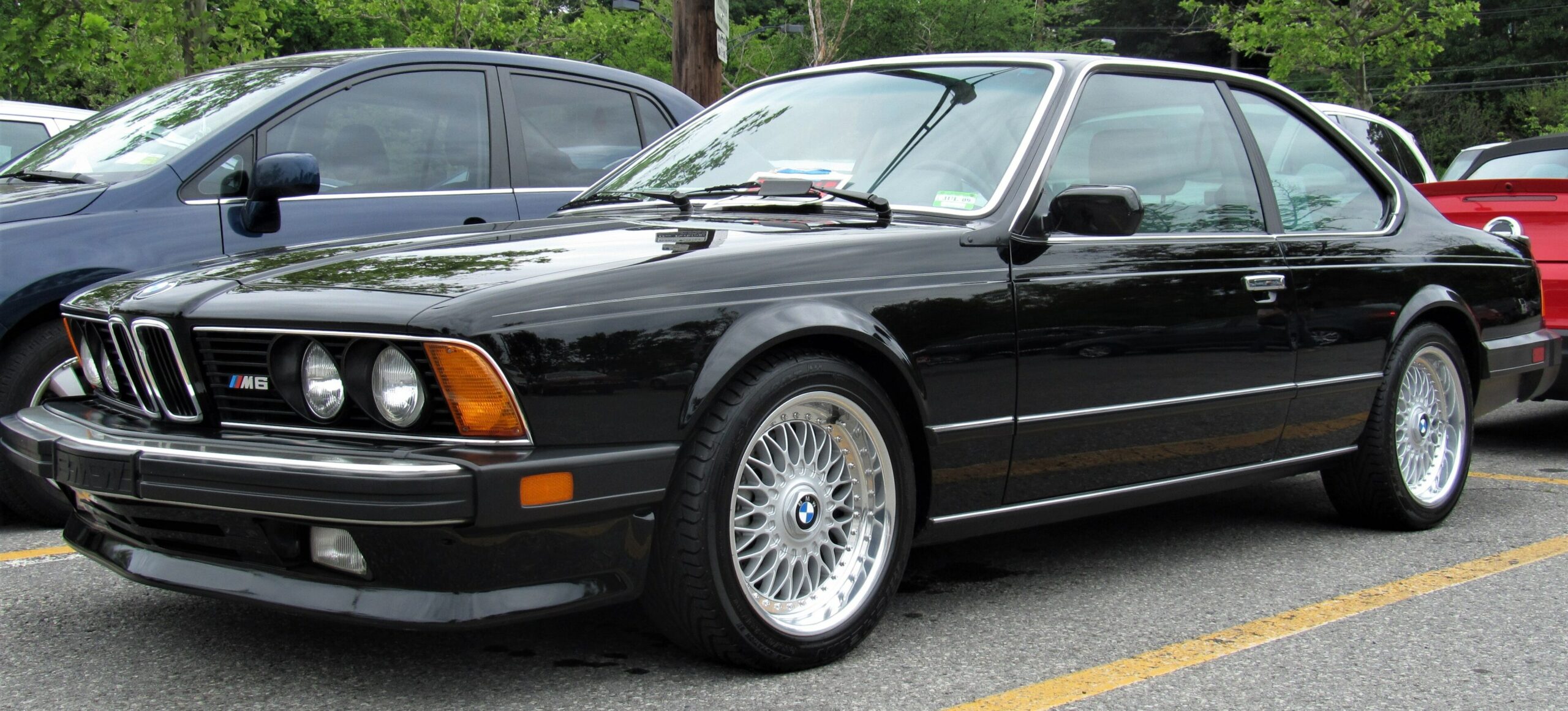
Important for buyers: from the 1987 model year, North America received the M6 with the S38B35. Same bore, same stroke — but 9.8:1 instead of 10.5:1, a regulated catalytic converter, a simplified exhaust manifold and shorter camshafts. 256 hp instead of 286 PS. The reason was emissions regulations and the lower octane rating of American fuel. In return, the S38 has the more durable duplex timing chain.
Together, 5,855 M coupés were built: 1,767 for North America, 524 as right-hand-drive cars for the UK, the rest for Europe and Japan. And a warning: the M88/3 does not forgive maintenance neglect. Without a valve clearance record and an unbroken oil change history, a four-figure reserve belongs in the calculation.
10 · Motorsport
Three European Touring Car Titles, Two Wins at Spa, Two at the Nürburgring — and the First DTM Champion
The 635 CSi is the most successful touring car BMW had before the M3. Until 1981 it raced in Group 2, from 1983 in Group A. The racing engine produced just under 290 to 300 PS from 3,475 cm³ at around 6,200 rpm — the weakest engine in the field. The Jaguar XJ-S had around 420 PS, the Volvo 240 Turbo around 350. The BMW still won, through durability, tyre conservation and pit strategy.
The division of labour is often told incorrectly: Alpina supplied the works racing engines, Schnitzer Motorsport built and ran the cars, and Eggenberger Motorsport was the dominant customer team. Between 1983 and 1985, BMW Motorsport built around fifty Group A chassis. A kit cost 120,000 Mark in 1983, with the Alpina engine adding a further 35,000.
The titles: in 1981 Umberto Grano and Helmut Kelleners won the European Touring Car Championship for Eggenberger — still in Group 2. In 1983, the first Group A year, Dieter Quester took the title for Schnitzer. 1986 followed with Roberto Ravaglia. In addition, three wins at the 24 Hours of Spa: 1983 Hahne, Heyer and Tassin, 1985 Berger, Ravaglia and Surer, 1986 Quester, Heger and Tassin in the Schnitzer car. And two overall wins at the 24 Hours of Nürburgring: 1984 and 1985, both for Auto Budde Racing.
The most remarkable title fell in Germany in 1984: Volker Strycek became the first champion of the DTM — then still called the Deutsche Produktionswagen Meisterschaft — in a 635 CSi, and without a single race win, through consistency alone. In Australia, Jim Richards won seven of ten rounds of the touring car championship for the JPS Team BMW in 1985, six of them in succession.
What the 635 CSi did not win: the Bathurst 1000. The best result at Mount Panorama was a fourth place for Richards and Longhurst in 1985. From 1987, the E30 M3 took over the works role.
The 635 CSi had the weakest engine in Group A — and used it to win three European championships, three times at Spa, and the first DTM title.
11 · Buying guide
What Matters: Wings, Strut Towers, Rear Axle Mounts
With the E24, rust determines everything else. A mechanically worn but dry car is the better investment than a perfectly running one with soft wing mounting supports — replacement panels and trim parts are simply barely obtainable anymore.
Front wings and wing mounting supports
Front strut towers — safety-relevant
Mounts for the rear subframe and differential
Sills, door bottom edges and door cavities
Rear wheel arches and wheel housings
Tail ends and rear valance
Boot floor and spare wheel well
Area around the rear window seal
Front longitudinal members in the engine bay
First feel the front wings from the inside and expose the strut towers in the engine bay — both are areas where an E24 can die economically. Then check the mounts for the rear subframe and differential from below; this is the most expensive rust damage in the model line. After that, check the sills, door bottom edges, tail ends, boot floor and spare wheel well; test the water drain holes in the doors for blockages. Start the engine cold: blue smoke on lift-off points to valve stem seals. On the M88/3, additionally demand the valve clearance record and an unbroken oil change history. Check the cooling system thoroughly — radiator, expansion tank, water pump, oil traces in the coolant. Test Check Control and the on-board computer fully, all warning fields, the fuel consumption display and the ice warning; replacement parts for these are rare. Watch the ABS light at start-up and afterwards. On the test drive, listen for knocking at the rear — that points to the trailing arm bearings — and for imprecise steering caused by the steering box and strut mounts. Finally, cross-check the identity: build date before or after August 1977 for the complete Karmann production, before or after May 1982 for E12 or E28, from May 1987 the CS/2 with ellipsoid headlights. Check the engine code: M90 with 3,453 cm³ or M30B34 with 3,430 cm³, and on the M model M88/3 or S38B35. And Highline plus an unbroken service history are worth real money.
12 · The competition
What the E24 Had to Compete Against
Mercedes-Benz SEC (C126, 1981–1991)
Better in build quality, rust protection, long-distance comfort and the effortlessness of the V8 engines. Worse in agility and driver focus — the SEC is a grand tourer, the E24 a sports coupé, and there was no factory equivalent to the M635 CSi.
Jaguar XJ-S (1975–1996)
Better in ride comfort, V12 refinement and — in the TWR race version with around 420 PS — outright power; in 1984 it took the ETCC title against BMW. Worse in build quality, electrical reliability and everyday usability.
Porsche 928 (1977–1995)
Better in chassis balance thanks to the transaxle layout, and in traction, brakes and high-speed stability. Worse in rear-seat space, running costs and maintenance effort — it is not a genuine four-seater.
Mercedes-Benz SLC (C107, 1971–1981)
Better in robustness and, in the form of the 450 SLC 5.0, in the value development of the rally versions. Worse in engine modernity and dynamics; by the end of the E24's early phase it was already dated.
Ferrari 400, 400i and 412 (1976–1989)
Better in exclusivity, V12 prestige and current collector status. Worse in performance relative to price, in fuel consumption, reliability and workshop availability — the M635 CSi was faster and more usable day to day.
13 · Galerie
Bilder
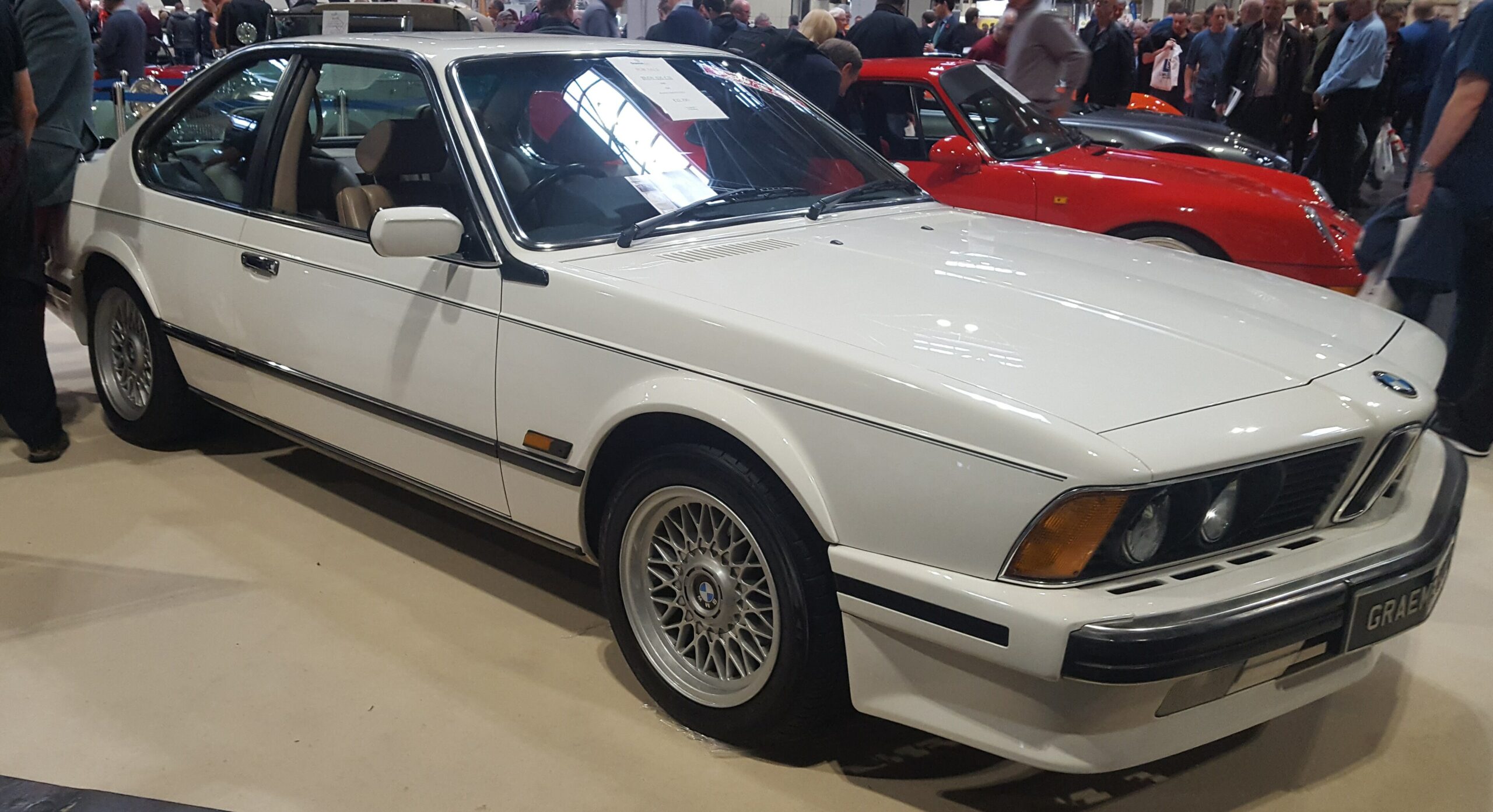
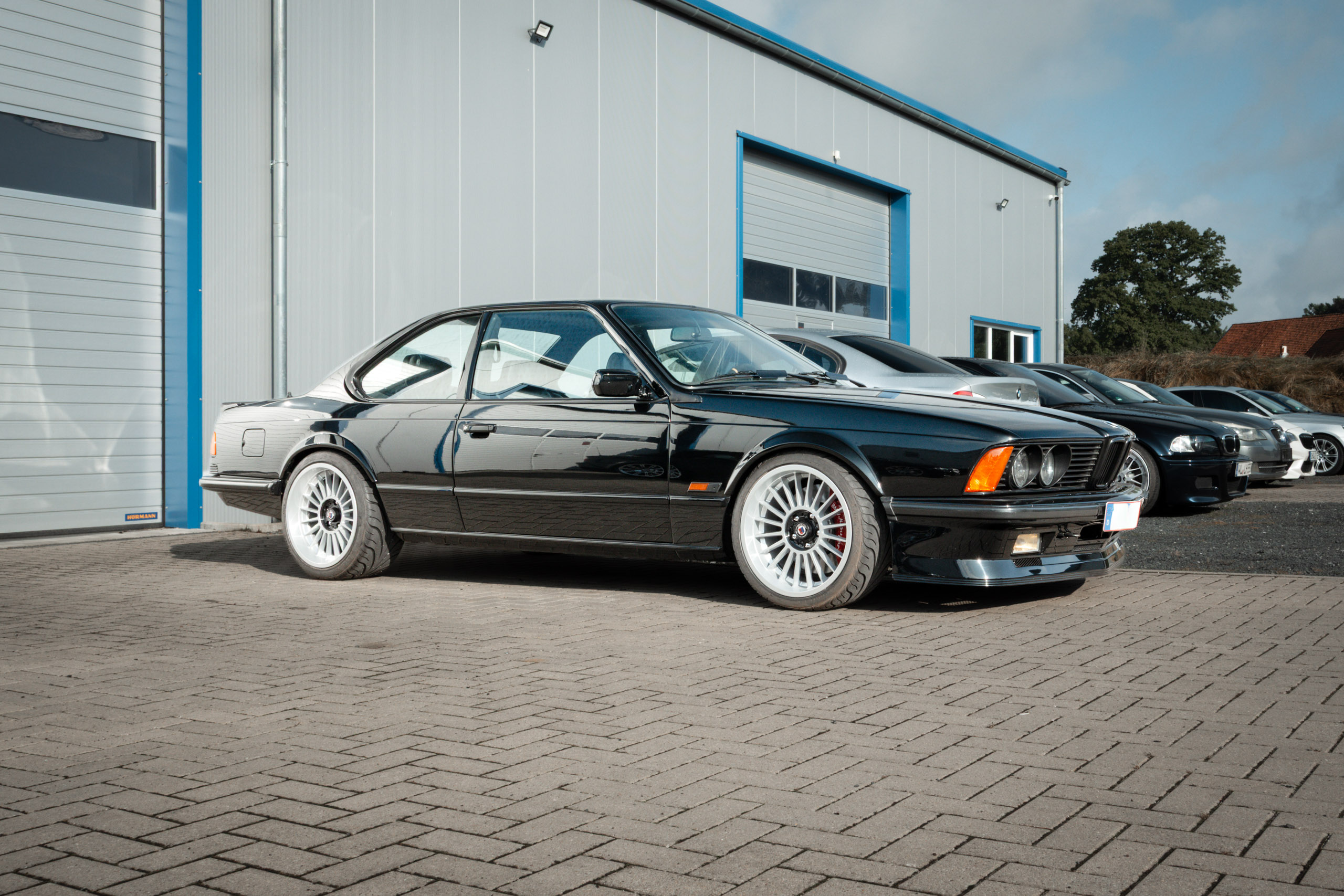
Other BMW 6er generations
2 model lines with an E-number, from 1976 to 2010.

14 · Sources
Belege & Literatur
Leading sources are BMW Group Classic, the BMW PressClub, bmw-m.com and Wikipedia; everything else is only considered verified once two independent sources agree. Two points that are frequently reported incorrectly and which we explicitly correct here: the E24 has <strong>never</strong> won the Bathurst 1000 — the best result was a fourth place in 1985. And the 1981 ETCC title did not go to Kelleners or Grano alone, but to both jointly as a driver pairing; the German and English Wikipedia each name only one of the two. Not verifiable and therefore omitted: drag coefficient, Servotronic, European production figures for the 628 CSi and 633 CSi.
- BMW Group Classic — BMW 635CSi (E24) and BMW M635 CSi (E24)
- bmw-m.com — BMW M635 CSi, top model of the E24 series
- Wikipedia (DE) — BMW E24
- Wikipedia (EN) — BMW 6 Series (E24), BMW M30, BMW M88, BMW S38
- Wikipedia (EN) — European Touring Car Championship, JPS Team BMW, Volker Strycek, Helmut Kelleners, Eggenberger Motorsport
- Wikipedia (DE) — 24-hour race at the Nürburgring 1984 and 1985
- auto motor und sport — buying guide BMW 630 CS to M 635 CSi
- Classic Trader — buying guide BMW 6 Series E24
- Octane — BMW 6-Series buying guide
- StanceWorks — The Group A BMW 635CSi
- motorsportwinners.com — 24 Hours of Spa and ETCC 1963–2004
- RM Sotheby's — 1986 BMW 635CSi Group A, Munich auction 20 Nov 2026
- CLASSIC.COM — BMW 6 Series E24, M6, M635 CSi and 635CSi, accessed August 2026
- Classic Trader — listing observation BMW 6 Series E24, accessed 5 Aug 2026
- Walloth & Nesch — parts catalogue BMW E24, sections manual gearbox and rear axle