

01 · Overview
The model line of firsts
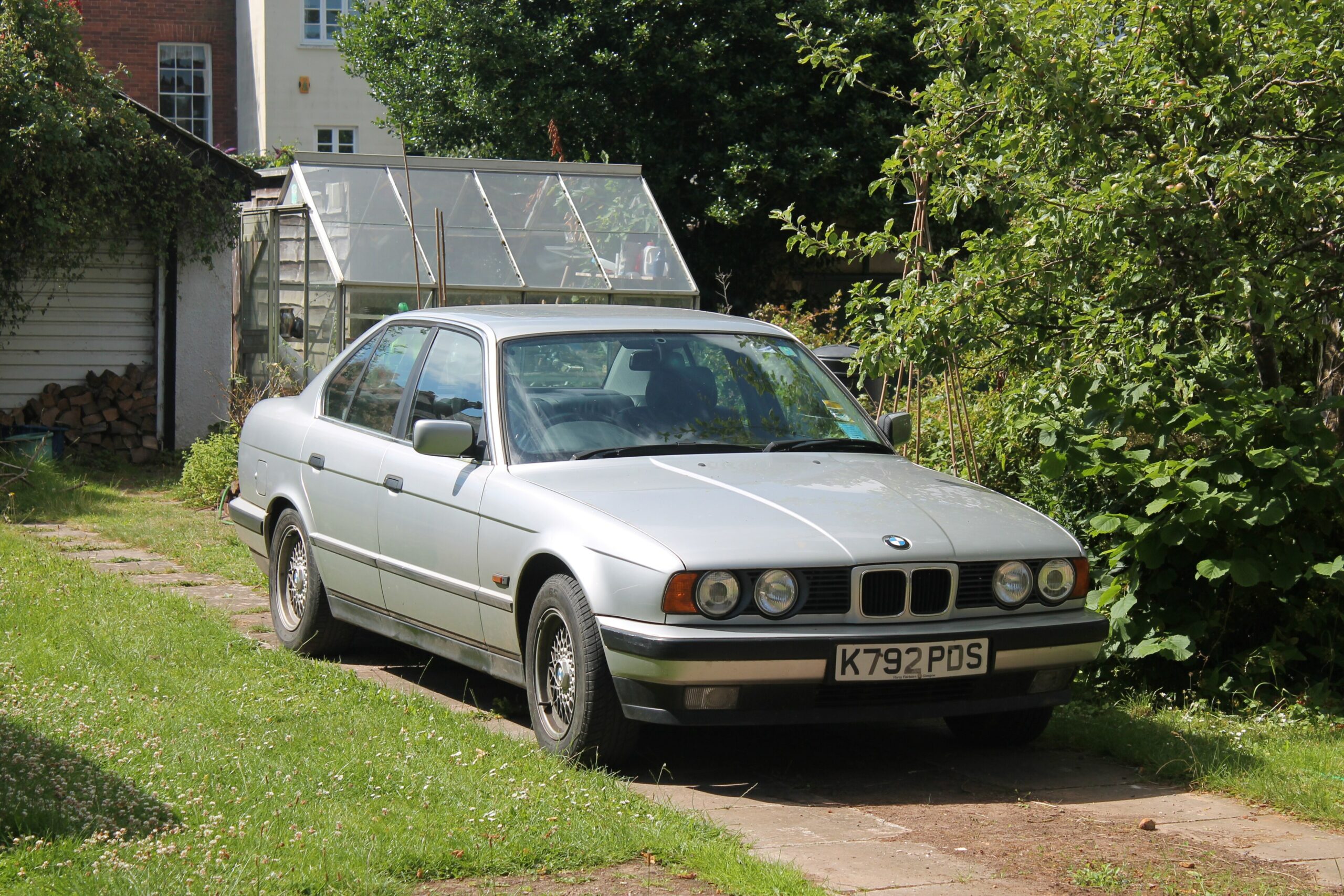
The E34 went into production in November 1987 and reached dealers in January 1988. It was styled by Ercole Spada under design chief Claus Luthe — closely related to the 7 Series E32 that appeared at the same time, and an aerodynamic leap: the drag coefficient dropped from 0.45 on the E28 to 0.30, around eighteen percent better.
More important than the shape is everything the E34 had for the first time. In September 1991, the Touring arrived as the first estate version of a 5 Series — with a separately opening rear window. The same day saw the debut of the 525iX, the first 5 Series with all-wheel drive. A year later came the first V8 engines in a 5 Series, the 530i and 540i. And with the M5 Touring of 1992, BMW M built a car with a tailgate for the first time.
Then there were the first four-valve six-cylinder engines in the 5 Series: from May 1990 the M50 replaced the M20, and from September 1992 the VANOS version followed. Five engine families, two body styles, one all-wheel-drive model — the E34 is the most diverse 5 Series generation there has ever been.
02 · History
Nine years in ten steps
From the start of production in November 1987 to the last Touring in June 1996.
- 1987 In November, the Sedan begins production in Dingolfing. The German Wikipedia states December instead — we follow BMW Group Classic.
- 1988 In January, official presentation and market launch with the 520i, 525i, 530i and 535i. In March follows the 524td, the first E34 diesel.
- 1988 In September, the M5 debuts with the 315 PS S38B36 — hand-assembled at BMW M GmbH in Garching. In October, North American sales begin with the 525i and 535i.
- 1990 In May, the four-valve six-cylinder M50 replaces the M20 engines: the 520i rises from 129 to 150 PS, the 525i from 170 to 192 PS. Timing chain instead of timing belt.
- 1991 In September, a triple premiere at the IAA: the Touring as the first 5 Series estate, the 525iX as the first 5 Series with all-wheel drive, and the 525tds. Plus the first facelift with door reinforcements and headlight range control.
- 1992 In March comes the M5 3.8 with the S38B38 and 340 PS — and the M5 Touring, the first M car with a tailgate. bmw-m.com states 15 September 1992 as the premiere date, BMW Group Classic states the start of production in March; the two key sources contradict each other.
- 1992 In May, ABS becomes standard across all E34 models.
- 1992 In September, the second facelift: VANOS for the six-cylinders, the V8 models 530i and 540i, driver's airbag as standard, wider kidney grille and E36 exterior mirrors. Sources give either 1992 or 1993 for the V8 launch.
- 1994 The Getrag 420G six-speed gearbox arrives for the 540i and M5 — the first six-speed gearbox in a 5 Series. From May, all E34 models get the wide kidney grille.
- 1996 From January 1995, the passenger airbag becomes standard. In August 1995, M5 production ends, and Sedan production ends in December 1995 or January 1996. The Touring runs last until June 1996; its successor is the E39.
03 · Model overview
From the 518i to the M5 3.8
Factory figures for Europe. Two pitfalls: despite its name, the 535i has only 3,430 cm³, and the 3.8-litre M5 engine is called the <strong>S38B38</strong> with 3,795 cm³ — the German Wikipedia incorrectly lists it as the S38B40 with 3,982 cm³.
Source: factory and literature data · verified
Technische Daten anzeigen — komplette Modellmatrix
| Modell | Motor | Hubraum | Leistung | Bauzeit |
|---|---|---|---|---|
| 518i | M40 B18 | 1.796 cm³ | 113 PS (83 kW) | 03/1993–04/1994 |
| 518i | M43 B18 | 1.796 cm³ | 115 PS (85 kW) | 04/1994–12/1995 |
| 520i | M20 B20 | 1.990 cm³ | 129 PS (95 kW) | 01/1988–05/1990 |
| 520i | M50 B20 | 1.990 cm³ | 150 PS (110 kW) | 05/1990–09/1992 |
| 520i | M50 B20TU · VANOS | 1.990 cm³ | 150 PS (110 kW) | 09/1992–12/1995 |
| 525i | M20 B25 | 2.494 cm³ | 170 PS (125 kW) | 01/1988–05/1990 |
| 525i | M50 B25 | 2.494 cm³ | 192 PS (141 kW) | 05/1990–09/1992 |
| 525i | M50 B25TU · VANOS | 2.494 cm³ | 192 PS (141 kW) | 09/1992–12/1995 |
| 525iX · all-wheel drive | M50 B25 · M50 B25TU | 2.494 cm³ | 192 PS (141 kW) | 09/1991–1996 |
| 530i | M30 B30 | 2.986 cm³ | 188 PS (138 kW) | 01/1988–09/1992 |
| 530i V8 | M60 B30 | 2.997 cm³ | 218 PS (160 kW) | 1992/93–12/1995 |
| 535i | M30 B35 | 3.430 cm³ | 211 PS (155 kW) | 01/1988–09/1992 |
| 540i | M60 B40 | 3.982 cm³ | 286 PS (210 kW) | 1992/93–06/1996 |
| 524td | M21 D24 · turbodiesel | 2.443 cm³ | 115 PS (85 kW) | 03/1988–1991 |
| 525td | M51 D25 · without intercooler | 2.497 cm³ | 115 PS (85 kW) | 03/1993–1996 |
| 525tds | M51 D25 · intercooler | 2.497 cm³ | 143 PS (105 kW) | 09/1991–1996 |
| M5 3.6 | S38 B36 | 3.535 cm³ | 315 PS (232 kW) | 09/1988–03/1992 |
| M5 3.8 | S38 B38 | 3.795 cm³ | 340 PS (250 kW) | 03/1992–08/1995 |
04 · Body variants
Body variants
Sedan

November 1987 to December 1995 or January 1996 — here too the key sources disagree by a month. 4,720 mm long, 1,750 mm wide, 1,412 mm high, 2,761 mm wheelbase, 460-litre boot. Compared to the E28, it is 100 mm longer, 50 mm wider and 3 mm lower.
Touring

September 1991 to June 1996, around 124,700 units — the first estate in the 5 Series line. Its special feature: the rear window can be opened independently of the tailgate to load smaller items from above. As the last E34 body style, it continued production for a year and a half after the Sedan ended.
05 · Engines
Five families, from four-cylinder to V8
No 5 Series generation before or since had such a wide engine range: four-cylinders, two six-cylinder families, two diesels, a V8, and the hand-assembled M engine from the M1 line.
M40 and M43 — 518i verified
The entry-level model, only added to the range from March 1993. The M40 uses a timing belt and is known for camshaft and rocker arm wear; the M43 from April 1994 has a timing chain and is significantly lower-maintenance. Both are economical and affordable, but underpowered for around one and a half tonnes. The 518i is also the only E34 with rear drum brakes.
M20 — 520i and 525i until May 1990 verified
The small six-cylinder with a single camshaft and twelve valves: silky-smooth, simple, cheap on parts. Its issue is the timing belt — replace at the latest every four years, or risk engine damage. Also cylinder head cracks and camshaft and connecting rod bearing wear.
M30 — 530i and 535i until September 1992 verified
The large six-cylinder in its final stage of development: timing chain instead of timing belt, enormous torque, very high mileages. Weaknesses are oil leaks, the cylinder head gasket, and fuel consumption from another era.
M50 and M50TÜ — 520i, 525i, 525iX verified
From May 1990, the first four-valve six-cylinder in the 5 Series: 24 valves, two overhead camshafts, timing chain. From September 1992 with intake VANOS — same rated power, but significantly more torque in the mid-range. The base engine is considered one of the most durable BMW has ever built; problems arise almost exclusively from peripheral parts: water pump, radiator, crankcase ventilation, valve cover gasket, and VANOS rattling with age.
M60 V8 — 530i and 540i verified
The first V8 in the 5 Series: aluminium block, 32 valves, 218 or 286 PS respectively. Smooth-running, powerful, praised in the trade press for mileages beyond 500,000 kilometres. Two things to know: the Nikasil liners of the early engines — details below — and the oil pump bolts, which can come loose and then cost the engine. Plus chain tensioners, guide rails and a sensitive cooling system.
M21 and M51 — the diesels verified
Both are prechamber six-cylinders. The 524td from 1988 came without an intercooler, the 525tds from September 1991 came with one — 143 PS, respectable for its time. From March 1993, the 525td without intercooler filled out the range below. The most common weakness is defective injection pumps; the emissions standard only reaches Euro 2.
S38B36 and S38B38 — the M5 verified
Inline six-cylinder with individual throttle bodies and four-valve technology, derived from the M1 line and deliberately without VANOS. The S38B36 produces 315 PS from 3,535 cm³, and the S38B38 from March 1992 produces 340 PS from 3,795 cm³ — with individual ignition coils, a dual-mass flywheel and larger valves. Eager to rev to 7,000 rpm, but maintenance-intensive: replacing the connecting rod bearings after around 100,000 kilometres is considered standard, and adjusting the valve clearance is labour-intensive.
06 · Weak points
Reliability & Weak Points
- Rust begins at the fuel filler flap recess, the lower door edges and door seams, and on the front wings behind the wheel arch. The edge of the boot lid is often the first visible corrosion point, and on the Touring it’s the tailgate.
- The jacking points and sill area are the structurally critical spots. Also check the brake lines, which often corrode from the outside, and the wiring harness grommets, where rust can cause cable breaks.
- The load-bearing parts are only partially copper-coated. From 1993, BMW switched to water-based paints — later model years are therefore considered more prone to rust than earlier ones, which contradicts the usual rule of thumb.
- The M60 V8 of the early production phase has Nikasil cylinder liners, which are attacked by sulphur-rich fuel. This mainly affected the US, UK and South America; for German vehicles this is largely a non-issue. Identifiable by the casting number on the right side of the block.
- Also on the M60: the oil pump bolts can come loose. If this has happened, the engine is usually lost. Proof that the bolts have been secured is a genuine selling point.
- The automatic transmission causes problems at higher mileages, especially in the 540i. Regular flushing and oil changes are essential — the often-cited lifetime fluid effectively does not exist.
- The electronically adjustable EDC damping is the most expensive single item on the suspension: replacement dampers are barely obtainable anymore. A defective EDC noticeably reduces the value.
- Typical for its age: sagging headliner, leaking sunroof especially on the Touring, porous driveshaft boots, oil loss at the rear differential, brittle coolant hoses and plastic parts, hardened engine mounts. Plus failures of the central locking, rear wiper and rear window lifter.
07 · Engineering
Axles, all-wheel drive, brakes, gearbox
Vorderachse
Hinterachse
Lenkung
All-wheel drive of the 525iX
Bremsen
Getriebe
Fahrhilfen
Technical data — final drive ratios & gearboxes
- Gearbox 518i
- Getrag 240 five-speed, later ZF S5D 200G
- Gearbox 520i and 525i with M20
- five-speed ZF S5-16 or Getrag 240, four-speed ZF automatic
- Gearbox 520i and 525i with M50
- five-speed ZF S5D 310Z, four-speed ZF automatic, five-speed from 1992
- Gearbox 530i and 535i with M30
- Getrag 260/6 five-speed, ZF 4HP22 or 4HP24 EH automatic
- Gearbox 530i with M60
- five-speed ZF S5D, five-speed ZF automatic
- Gearbox 540i
- five-speed ZF automatic as standard, Getrag S6S 420G six-speed gearbox as an alternative from 1993/94
- Gearbox 524td, 525td and 525tds
- five-speed manual, automatic optional
- Gearbox M5 3.6
- Getrag 280 five-speed only, no automatic
- Gearbox M5 3.8
- Getrag S6S 420G six-speed from 1994, no automatic
- Final drive ratio 540i
- 2.93 (44:15), same for manual and automatic
- Final drive ratio M5 3.6
- 3.91 (43:11) with limited-slip differential
- Final drive ratio M5 3.8
- 3.23 (42:13) with limited-slip differential
- Sources disagree on the 518i
- the English Wikipedia states manual only, while the parts catalogue lists an automatic.
- The gearbox assignment for M50 models is disputed
- Wikipedia states ZF S5D 310 and Getrag 250G, the parts catalogue states Getrag 260/5/50.
Only the final drive ratios of the 540i and M5 3.6 are reliably double-sourced. All other figures appear only in the BMW parts catalogue and are therefore not listed here.
08 · Top models
Top models
Two M models, a V8, an all-wheel-drive version — and the Alpina family, which was unusually broad for the E34.
M5 (3.6 and 3.8 litre, also Touring)
315 to 340 PS, hand-built in Garching — all stages and the first M estate on one page.
To the sub-page →
540i
M60B40 with 3,982 cm³ and 286 PS, from 1992/93. As the 540i M-Sport in the US, only around 200 units; as the M540i in Canada, 32 units; as the 540i Limited Edition in Australia, 70 units — all sought-after special editions.
To the sub-page →
Alpina B10
The B10 3.5 was built 572 times between 1988 and 1992, the B10 BiTurbo with 360 PS 507 times, and the B10 4.6 in 27 sedans and 19 Tourings. For a model line without factory motorsport, this is effectively its sporting department.
To the sub-page →
09 · M & special editions
M5 3.6 and 3.8 — and the first M with a tailgate
In September 1988, the second M5 arrived. Its S38B36 is derived from the M1 line: inline six-cylinder, 3,535 cm³, four-valve technology, individual throttle bodies, 315 PS. As with the E28, it was hand-assembled, this time at BMW M GmbH in Garching.
In March 1992 came the S38B38 with 3,795 cm³ and 340 PS — individual ignition coils, dual-mass flywheel, Inconel manifold, larger valves, Motronic 3.3. Neither engine had VANOS. From 1994, the Getrag 420G six-speed gearbox was available, and the 3.8 received composite brake discs on the front axle.
The true milestone, however, is the M5 Touring: 891 units built between 1992 and 1995, the first M car with a tailgate and still one of the most sought-after today. North America, incidentally, only received the 3.6, and only in model years 1991 to 1993 — the 3.8 failed to meet emissions and safety regulations there.
Important for buyers: replacing the connecting rod bearings after around 100,000 kilometres is considered standard on the S38. Without proof of this, and of the valve clearance having been adjusted, a four-figure reserve should be budgeted.
10 · Buying guide
What matters: sills, casting number, gearbox oil
The E34 is considered a durable long-distance runner with forgiving, CAN-bus-free electronics and good parts availability. It becomes expensive in three areas: rusted-through load-bearing sections, a neglected automatic gearbox, and — in the case of the V8 — an engine that was not identified beforehand.
Tankdeckelmulde
Lower door edges and door seams
Front wings behind the wheel arch
Jacking points and sill area
Edge of the boot lid
On the Touring, also the tailgate
Brake lines and wiring harness grommets
First from underneath: tap the jacking points and sills, then check the fuel filler flap recess, lower door edges, boot lid edge and — on the Touring — the tailgate and the surround of the separately opening rear window. The front wings behind the wheel arch are often still intact from the outside but rusted through from the inside. Engine-specific: for the M20 and the M40-equipped 518i, get written proof of the timing belt change, with date and mileage. For the <strong>M60 V8, check the casting number on the right side of the block</strong>, at the level of the third cylinder: Nikasil numbers are 1 725 970 and 1 741 212 for the B30, and 1 725 963 and 1 742 998 for the B40; Alusil numbers are 1 745 871 and 1 745 872. With a Nikasil block, a leak-down test is advisable — for German cars the risk is low, but not for US and UK imports. Also on the V8: check the service book for confirmation that the oil pump bolts have been secured. Then run the automatic through its gears when warm and under load, and ask for proof of gearbox oil changes; missing changes on the 540i are a bargaining point. On the M5, ask for the connecting rod bearing history and the valve clearance record. If EDC is fitted, check all four dampers for function — replacements are barely available anymore. Finally, check the control arms, bushings and ball joints for play, the brake lines for corrosion, the differential and driveshaft boots for oil loss, plus test the headliner, sunroof drain, central locking and rear wiper for proper function.
11 · The competition
What the E34 had to compete with
Mercedes-Benz W124 (1984–1995)
Better in bodyshell substance and build quality, in variant diversity with the Coupé, Convertible and estate, and in resale value stability on the German market. Worse in handling dynamics and steering feel — with the four-valve six-cylinders, the E34 is the clearly sportier car.
Audi 100 and A6 C4 (1990–1997)
Better in traction and winter capability thanks to the widely available quattro drivetrain, which the E34 only had in the single 525iX model, plus the fully galvanised body. Worse in axle load distribution and cornering balance — the front-heavy longitudinal engine layout cannot match the balanced design of the E34.
Opel Omega A and Omega 3000 (1986–1993)
Better in value for money and interior space; the Caravan clearly beats the E34 Touring on load volume. Worse in material quality, engine refinement and value retention — outside the Lotus Omega, barely collectible today.
Volvo 940 and 850 (1990–1998)
Better in estate practicality and passive safety; the 850 T-5R was a direct rival to the M5 Touring as an estate, at a fraction of the price. Worse in chassis finesse and six-cylinder refinement — the E34's rear-wheel-drive character is entirely absent.
Alfa Romeo 164 (1987–1997)
Better in design and engine character; the three-litre V6 is emotionally superior to the M30 and even the M60. Worse in build quality, corrosion protection and service accessibility — a far more demanding classic to run day-to-day.
12 · Galerie
Bilder
Other BMW 5er generations
5 model lines with an E-number, from 1972 to 2010.


13 · Sources
Belege & Literatur
Key sources are BMW Group Classic, the BMW PressClub, bmw-m.com and Wikipedia; everything else is considered verified only once two independent sources agree. There was never a factory motorsport programme for the E34 — during this period BMW competed with the E30 M3 and, from 1993, the E36. The E34 was never homologated for any touring car series; that is why this page has no motorsport section. Worth mentioning instead is an M5 3.8 that served as an early Ring Taxi at the Nürburgring, covering over 650,000 kilometres, and is now part of the BMW Group Classic collection; whether it was the first Ring Taxi could not be verified. We were also unable to verify any use as an official safety car, and therefore do not claim it.
- BMW Group Classic — BMW 5 Series (E34) model line, plus individual pages on the 5 Series Touring, 525i touring, 525iX touring, 540i touring and M5 touring
- bmw-m.com — The BMW M5 Touring E34
- BMW PressClub Germany — The BMW 5 Series Touring (E34), image archive
- Wikipedia (DE) — BMW E34
- Wikipedia (EN) — BMW 5 Series (E34), BMW M5, BMW M60, BMW S38
- bimmertoday — production figures for the BMW M5 E34, BMW 540i E34 and the 5 Series Touring generations
- Garagistic — Picking the right M60 engine (Nikasil and Alusil casting numbers)
- Bavarian Machine Specialties — I Could've Had a V8 (casting numbers, independent confirmation)
- auto motor und sport — buying guide BMW 5 Series (E34): strengths and weaknesses
- AUTO ZEITUNG — BMW E34 buying guide and weak points
- CLASSIC.COM — BMW 5 Series E34, M5 E34, M5 Touring E34 and 540i E34, accessed August 2026
- The Classic Valuer — BMW 5 Series (E34) M5 Touring, auction history since 2020
- Classic Trader — listings observation BMW 5 Series E34, accessed August 2026
- bmwfans.info — BMW parts catalogue E34, sections on rear axle drive and gearbox