

01 · Overview
A car as a means to an end
The M3 is not an upgraded 3 Series. It is a race car that BMW had to build in sufficient numbers to be allowed to enter it in Group A. Everything about it follows from that.
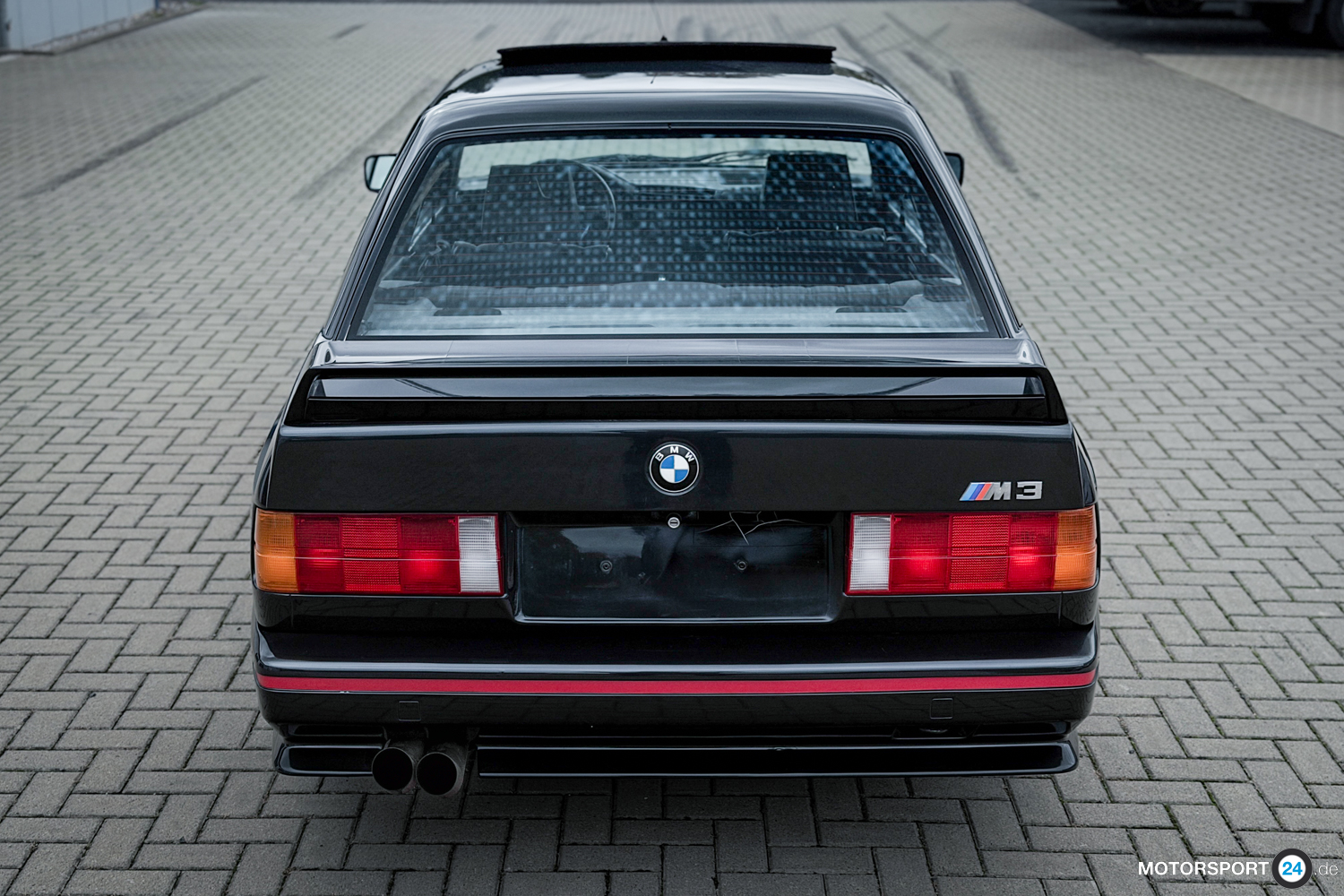
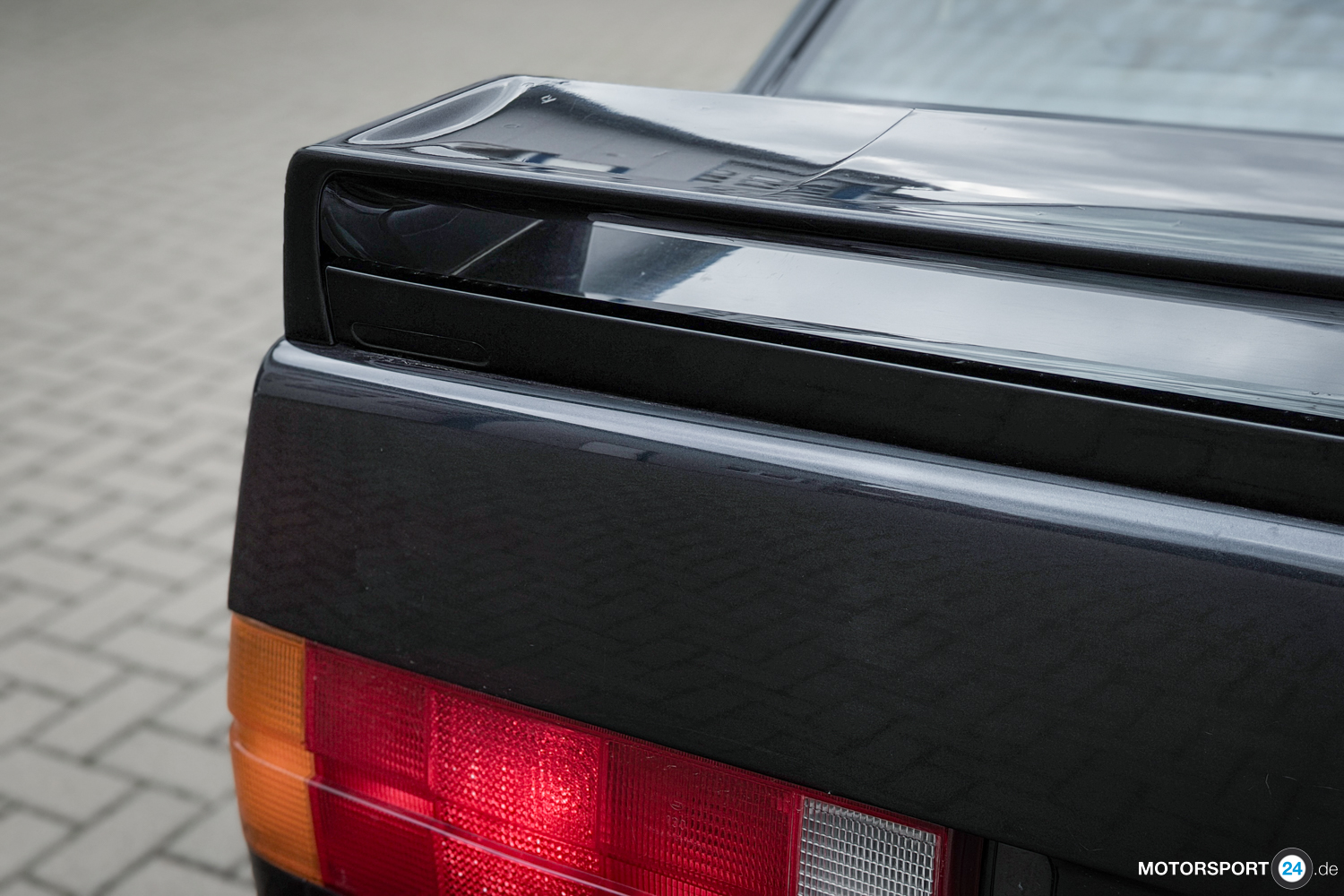
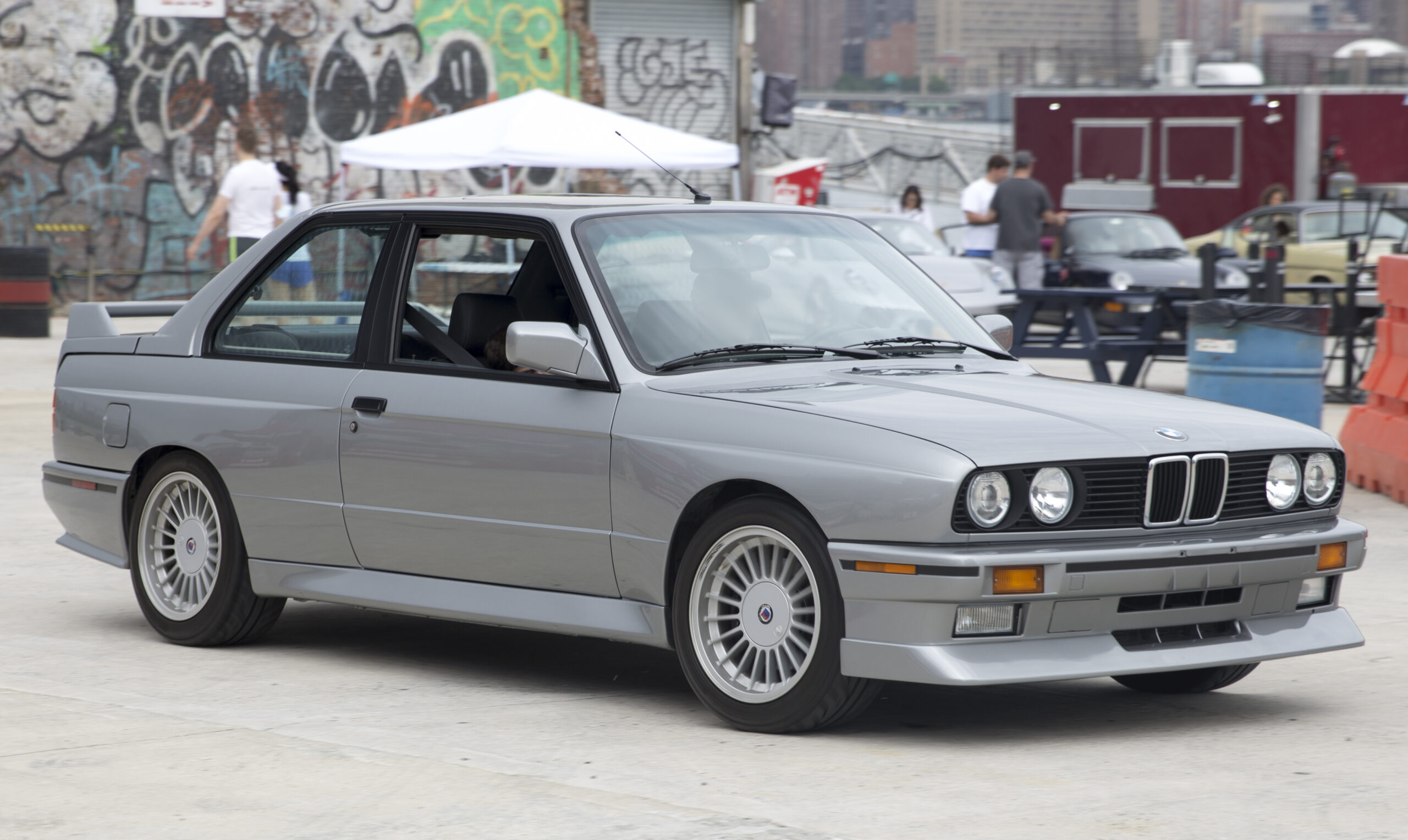
Little remained of the production body. According to Wikipedia EN, the M3 shares only the bonnet, roof panel and sunroof with the standard E30. New are the widened fenders, the aerodynamically shaped skirts, the sill covers, the boot lid raised by around 40 mm and made of glass-fibre reinforced plastic, and the more steeply raked rear window with the wider C-pillar. The windscreen is bonded in rather than set in rubber. This reduces the drag coefficient from 0.38 to 0.33.
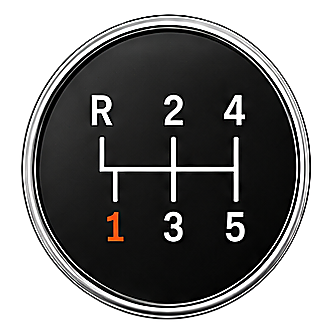
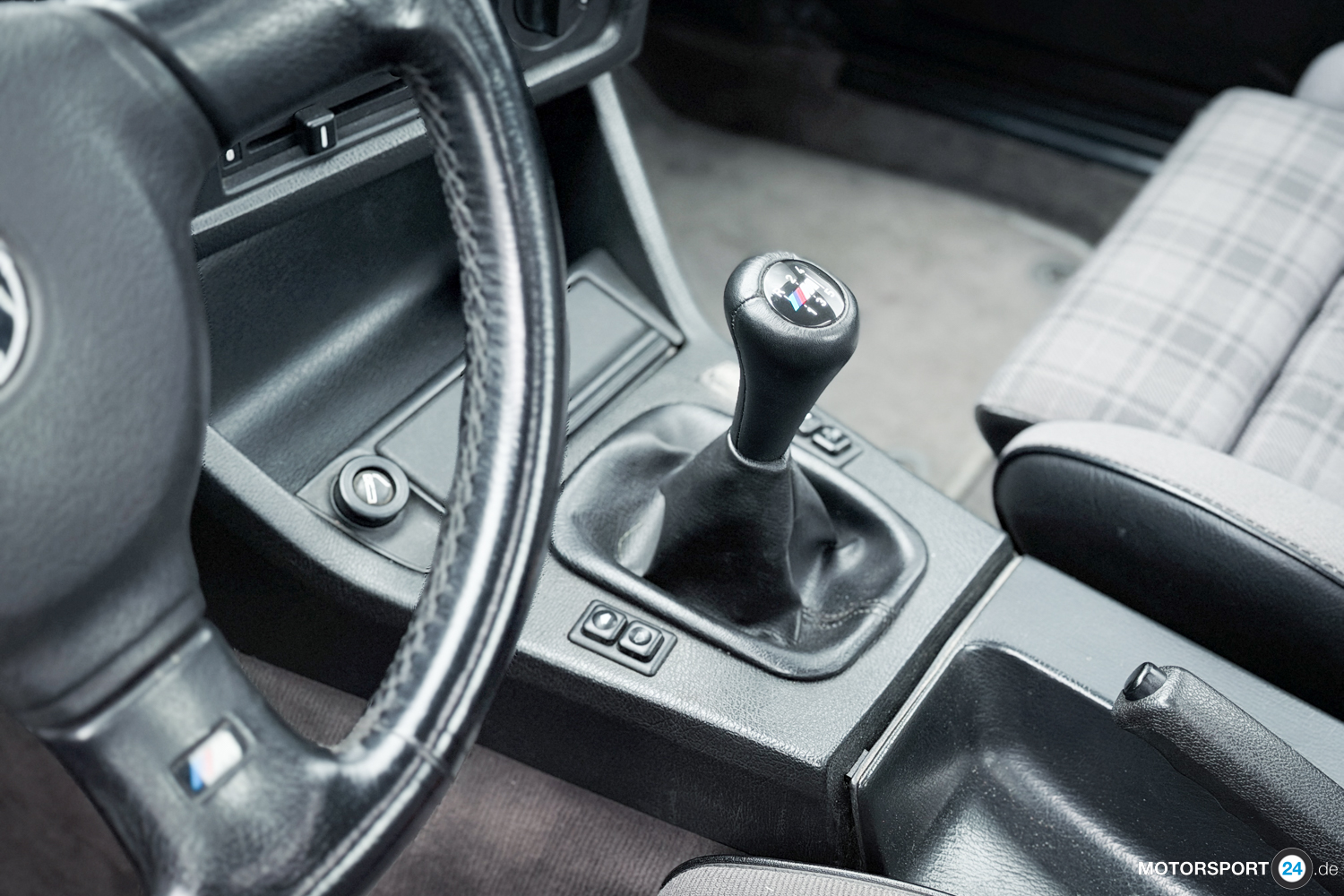
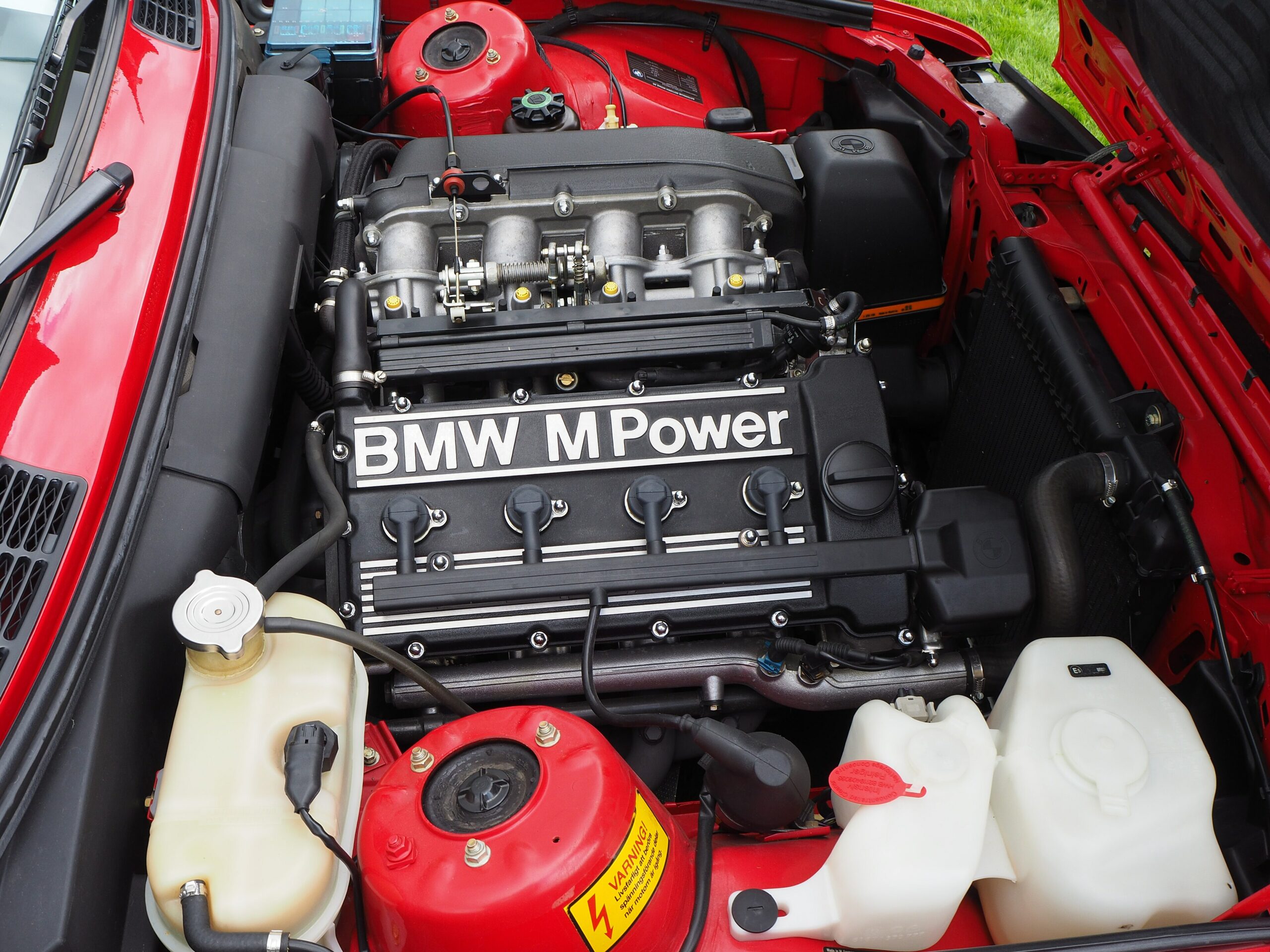
Under the bonnet works the S14: block from the M10 family, four-valve head in the design line of the M88. 2,302 cc, 195 PS with catalytic converter, 200 PS without. From September 1989 it is 215 PS. Paired with a Getrag five-speed gearbox with a dogleg shift pattern — first gear sits down to the left, because in racing second through fifth are meant to lie on one plane. In North America, by contrast, BMW supplied the conventional H-pattern.
A total of 17,970 cars were built, including 786 Convertibles. BMW Group Classic gives 17,184 for the closed body — the figures do not contradict each other, they simply count different things: 17,184 plus 786 equals exactly 17,970.
02 · History
Six years in seven dates
From the IAA premiere to the last Convertible.
- 1985 Announcement in August, premiere at the IAA in Frankfurt in September.
- 1986 Market launch in the middle of the year. Price 59,800 Mark.
- 1987 The year of the titles: Roberto Ravaglia wins the Touring Car World Championship, Eric van de Poele the DTM, Bernard Béguin the Tour de Corse. In February, production begins of the M3 with Evolution engine, the homologation series for Group A. BMW does not state how many were built.
- 1988 The Evolution II with 220 PS arrives in a limited run — 500 units according to BMW Group Classic. In June, the Convertible launches. Ravaglia wins the Touring Car European Championship, and BMW builds 148 special "Europameister" models to mark it.
- 1989 From September, the production M3 produces 215 PS. The Cecotto Edition appears in 505 examples, sold in the UK as the Ravaglia Edition. Ravaglia wins the DTM, and at the 24-hour race at the Nürburgring BMW takes a one-two finish.
- 1990 The Sport Evolution with 2,467 cc and 238 PS appears in 600 examples — the final and most powerful stage.
- 1991 In June, Convertible production ends. The successor, the E36 M3, arrives in 1992 with a six-cylinder engine.
03 · Model overview
All development stages
One engine in five stages of development, plus the special editions. Production periods follow BMW Group Classic. Where unit numbers diverge, the sources disagree — the discrepancies are noted under the respective sections.
Source: factory and literature data · verified
Technische Daten anzeigen — komplette Modellmatrix
| Modell | Motor | Hubraum | Leistung | Bauzeit |
|---|---|---|---|---|
| M3 (without catalytic converter) | S14B23 | 2.302 cm³ | 200 PS (147 kW) | 1986–1989 |
| M3 (with catalytic converter) | S14B23 | 2.302 cm³ | 195 PS (143 kW) | 1986–1989 |
| M3 (ab 09/1989) | S14B23 | 2.302 cm³ | 215 PS (158 kW) | 1989–1991 |
| M3 with Evolution engine ("Evolution") | S14B23 | 2.302 cm³ | 200 PS (147 kW) | 02/1987–05/1987 |
| M3 Evolution II | S14B23 | 2.302 cm³ | 220 PS (162 kW) | 04/1988–06/1988 |
| M3 Sport Evolution | S14B25 | 2.467 cm³ | 238 PS (175 kW) | 12/1989–03/1990 |
| M3 Europameister | S14B23 | 2.302 cm³ | 195 PS (143 kW) | 10/1988–11/1988 |
| M3 Cecotto / Ravaglia | S14B23 | 2.302 cm³ | 215 PS (158 kW) | 1989 |
| M3 Convertible | S14B23 | 2.302 cm³ | 195, 200 and 215 PS | 06/1988–06/1991 |
04 · Body variants
Body variants
Coupé

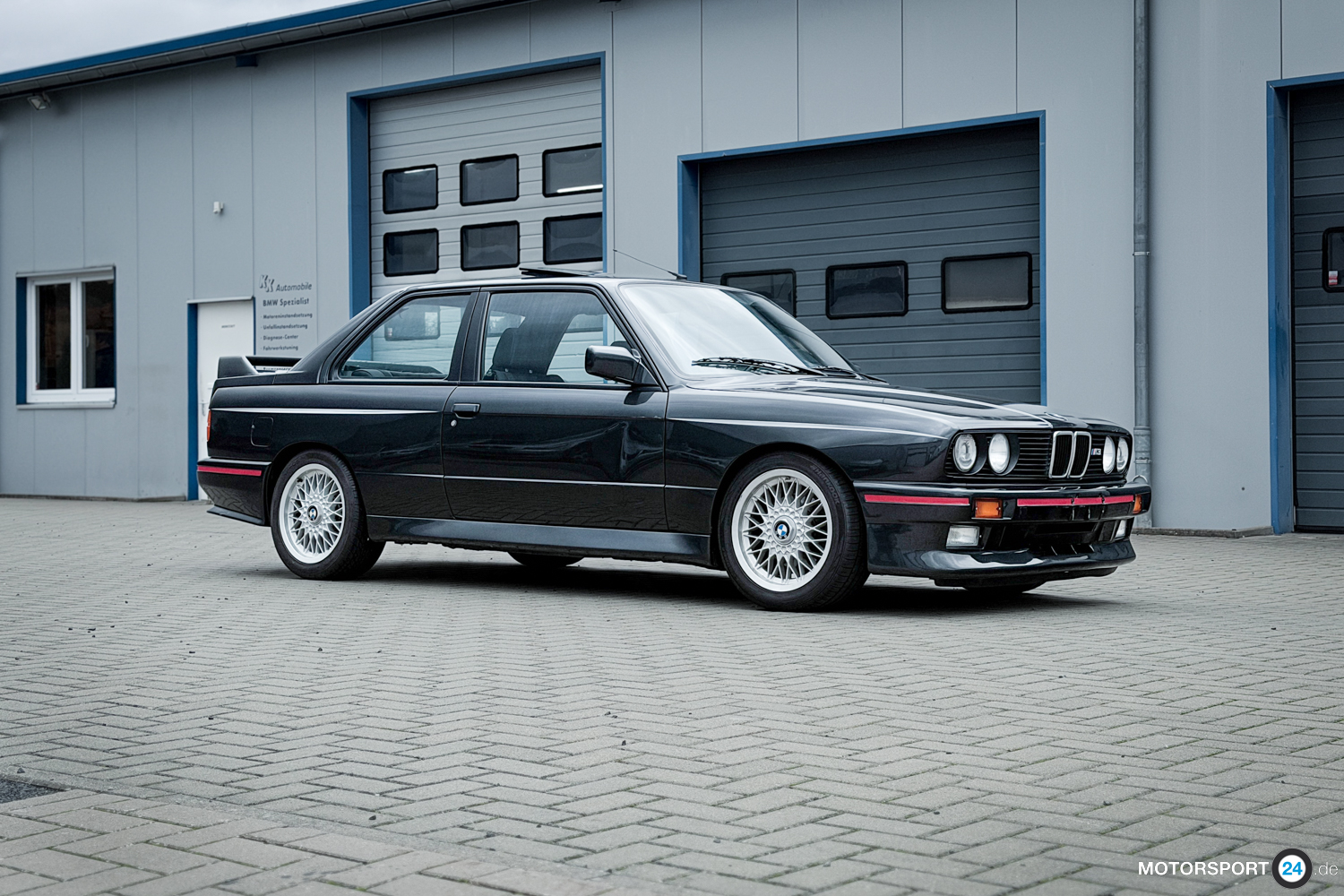
The main body shape. Length 4,346 mm, width 1,680 mm, height 1,370 mm, wheelbase 2,562 mm, kerb weight per factory specification 1,200 kg. Drag coefficient 0.33 versus 0.38 for the standard E30. M3-specific are the fenders, skirts, sills, boot lid, rear spoiler and the more steeply raked rear window.
Convertible

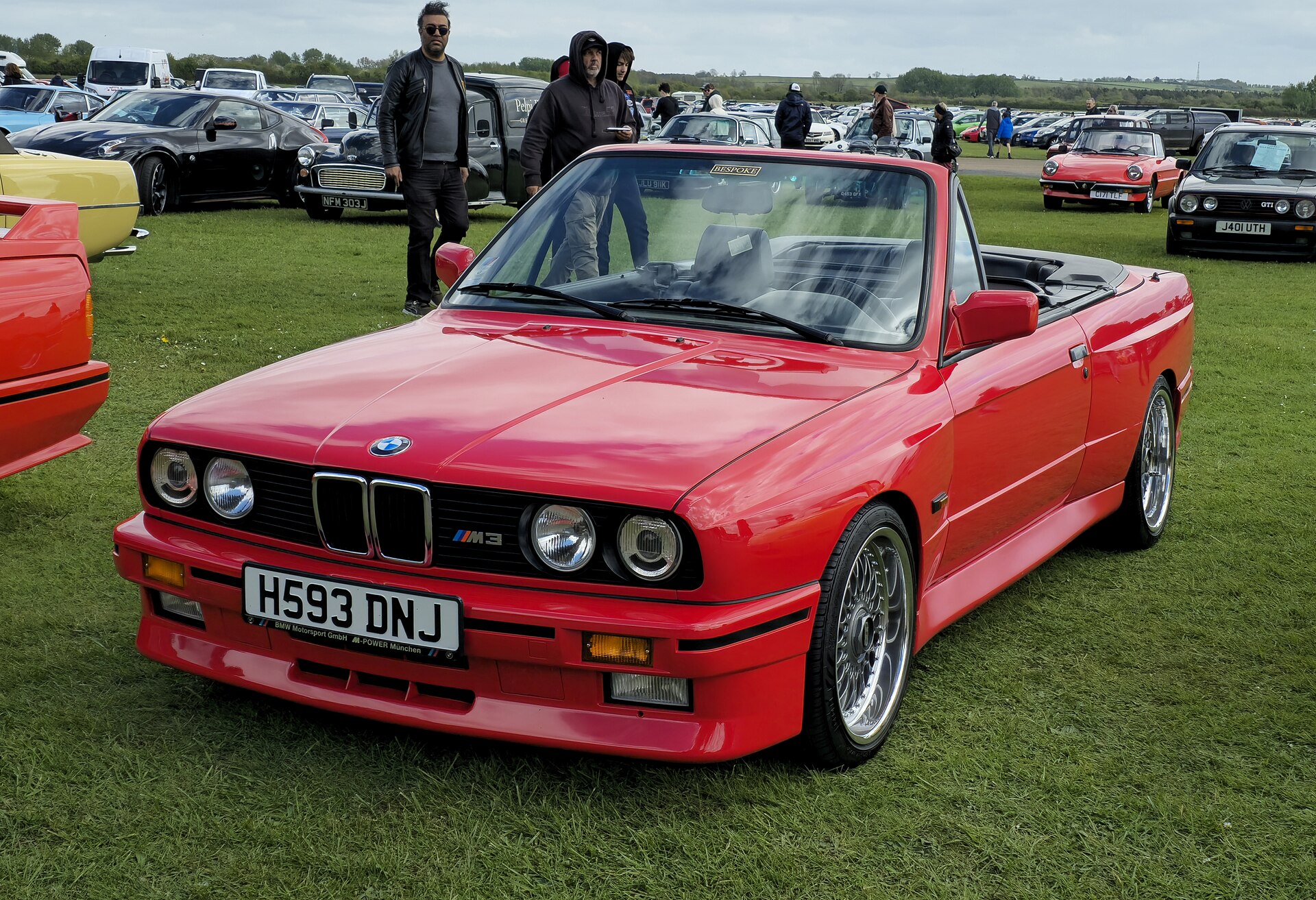
Presented at the IAA 1987, built from June 1988 to June 1991 in Regensburg. 786 examples, around 160 kg heavier than the Coupé, 235 km/h. From March 1990 the roof mechanism worked electromechanically instead of electrohydraulically. Only ten customers ordered the optional hardtop.
The Evolution stages

Three homologation series in four years. The first, from February to May 1987, is the least conspicuous: BMW Group Classic lists it as "M3 with Evolution engine" and describes it as externally unchanged — 200 PS, no dedicated aerodynamics, no badge, no special colours. It can be identified by a stamped E on the cylinder head, the two-piece tubular exhaust manifold and a white dot on the throttle body spacer plate. A power upgrade kit to 220 PS was available on request. The Evolution II, from April to June 1988, brought 220 PS at an 11.0:1 compression ratio, a longer final drive ratio of 3.15:1, and for the first time dedicated aerodynamics: a lower front spoiler with brake cooling ducts instead of fog lights, and a rear spoiler with an additional lip. Available only in Macau Blue, Misano Red and Nogaro Silver. 500 units — confirmed by BMW Group Classic and, more definitively, by the "414/500" badge on an auctioned vehicle. This rules out the widely cited figures of 501 and 505. The final stage is the Sport Evolution, from December 1989 to March 1990: 2,467 cc, 238 PS, front and rear spoilers adjustable in three stages, Recaro seats with red belts, numbered badge, 600 units, only in Jet Black and Brilliant Red.
Why the 1987 Evolution exists
The answer lies in the regulations, not in the brochure. For Group A, the FIA required 5,000 identical vehicles within twelve consecutive months; an evolution variant of an already homologated base model only needed 500 vehicles. The FIA database lists the M3 under homologation number 5327, valid from 2 March 1987, and records the first evolution extension "4/1ET" dated 2 May 1987 for body and engine. Production period and purpose thus align exactly: the car was a regulatory procedure, not a sales product. Precisely for that reason it received neither a name nor a badge — and precisely for that reason it is so hard to identify today. On the unit numbers: 505 vehicles is the commonly cited figure. BMW states none. The earliest traceable mention of the 505 figure dates from 2007 — an article in CAR Magazine, from which Wikipedia EN also takes it. No mention prior to 2000 could be found in any accessible source. The chassis numbers are worth a closer look. Two ranges circulate, and they only contradict each other at one point: both end at 2190787, they simply start differently. The wider range, 2190005 to 2190787, comes from the customer service documentation of BMW M GmbH and from Service Information 11 12 87 (756) — the more factory-authoritative source. It covers 783 numbers. The narrower range, 2190283 to 2190787, comes from the BMW E30 M3 Register and covers exactly 505. This is precisely how the widely cited unit number comes about. The 783 numbers from the factory source suggest that this range also included regular M3s, with the Evolution-engined cars distributed within it, whereas the register counts only the last 505 as Evolution cars. This cannot be proven, and so both accounts stand side by side. What can be stated, however, is this: the 505 figure is a count derived from number ranges, not a production figure reported by the factory. It is counted, not reported — which explains why BMW Group Classic lists a production period for this model but no unit number. The figure is plausible, since Group A required 500 vehicles for an evolution variant, and 500 plus a small pre-production buffer yields exactly such a value. It is not documented. One detail fits: the 3er Club does not write of 505 cars built, but that 505 chassis numbers received an Evolution engine kit. That would explain why BMW Group Classic lists a model here without a unit number.
05 · Engines
Der S14
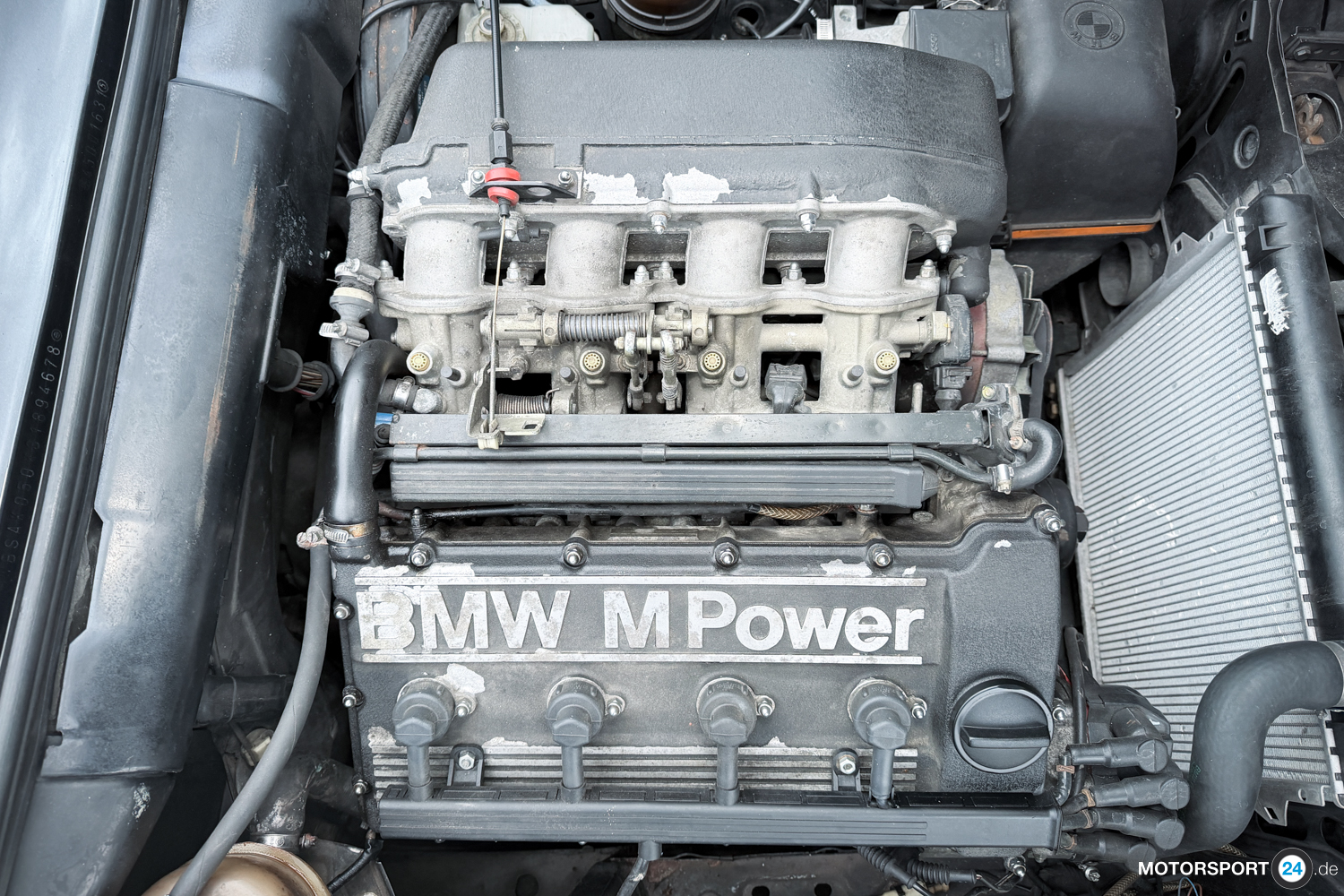
A four-cylinder with four valves per cylinder, two overhead camshafts and manifold injection. The block comes from the M10 family, the cylinder head follows the design line of the six-cylinder M88.
S14B23 · 2,302 cc · 195, 200 and 215 PS verified
The M3's production engine. Bore 93.4 mm, stroke 84.0 mm, compression ratio 10.5:1. Without catalytic converter, 200 PS and 240 Nm; with catalytic converter, 195 PS and 230 Nm — so the catalyst version costs 5 PS. From September 1989, BMW raises the output of the catalyst version to 215 PS. On the engine management: Wikipedia DE names only "DME". Two independent secondary sources refer to a Bosch Motronic from the ML series; the precise version number could only be confirmed by a single source and is therefore not included in the list.
Technische Daten anzeigen
| Bauart | Inline four-cylinder S14, four valves per cylinder, two overhead camshafts |
| Hubraum | 2.302 cm³ |
| Bore × stroke | 93,4 × 84,0 mm |
| Verdichtung | 10,5:1 |
| Output without catalytic converter | 200 PS (147 kW) at 6,750 rpm |
| Output with catalytic converter | 195 PS (143 kW) at 6,750 rpm |
| Output from 09/1989 | 215 PS (158 kW) at 6,750 rpm |
| Torque without catalytic converter | 240 Nm at 4,750 rpm |
| Torque with catalytic converter | 230 Nm at 4,750 rpm |
| Gemischaufbereitung | Manifold injection with digital engine management |
Sources: Wikipedia DE (BMW S14), BMW Group Classic. Wikipedia EN cites a bore of 95 mm — which would calculate to 2,381 cc and cannot be correct.
S14B23 Evolution II · 2,302 cc · 220 PS verified
For the second homologation stage, BMW raised the compression ratio to 11.0:1. 220 PS at 6,750 rpm, top speed 243 km/h. The final drive ratio was lengthened to 3.15:1 so the increased power translated into higher top speed as well.
Technische Daten anzeigen
| Hubraum | 2.302 cm³ |
| Verdichtung | 11,0:1 |
| Leistung | 220 PS (162 kW) at 6,750 rpm |
| Höchstgeschwindigkeit | 243 km/h |
| Achsübersetzung | 3,15:1 |
| Units built | 500 according to BMW Group Classic and Wikipedia DE, 501 according to Wikipedia EN |
Sources: BMW Group Classic, Wikipedia DE and EN. Torque figures diverge between sources: 240 Nm at 4,740 rpm (DE) versus 245 Nm at 4,750 rpm (EN) — for this reason it is not included in the list. The production period is also disputed: BMW Group Classic states 04–06/1988, Wikipedia EN March to May 1988, Wikipedia DE 10/1988 to 10/1990.
S14B25 Sport Evolution · 2,467 cc · 238 PS verified
The final stage. BMW increased the bore to 95.0 mm and lengthened the stroke to 87.0 mm — 2,467 cc, 238 PS at 7,000 rpm. The car is 25 kg lighter than the production M3 and came only in Jet Black and Brilliant Red. 600 examples.
Technische Daten anzeigen
| Hubraum | 2.467 cm³ |
| Bore × stroke | 95,0 × 87,0 mm |
| Verdichtung | 10,2:1 |
| Leistung | 238 PS (175 kW) at 7,000 rpm |
| Drehmoment | 240 Nm at 4,750 rpm |
| Höchstgeschwindigkeit | 248 km/h according to BMW Group Classic, 250 km/h according to Wikipedia EN |
| Units built | 600 |
| Bauzeit | 12/1989 to 03/1990 |
Sources: BMW Group Classic, Wikipedia DE (BMW S14), Wikipedia EN.
06 · Weak points
Reliability & Weak Points
- The most important point with the M3 is not a defect, but originality. Without the wide C-pillar with its large rear window, the widened fenders and the distinctive boot lid, it is not an M3, but a modified E30.
- Parts supply is good: the M3 is registered with BMW Classic, and parts relevant to operation and safety are available. M3-specific body parts, however, are expensive.
- Rust is the same issue on the M3 as on any E30 — see the buying guide further below. The condition of the body is what matters, not the mileage.
- Many claims about specific S14 failure patterns circulate in forums. None of them could be confirmed by a second source, so none are listed here. Anyone buying an M3 should have the engine inspected independently.
- The S14 is a high-revving engine with a correspondingly tight maintenance schedule. A complete service history is not a luxury on this car, but the basis of any valuation.
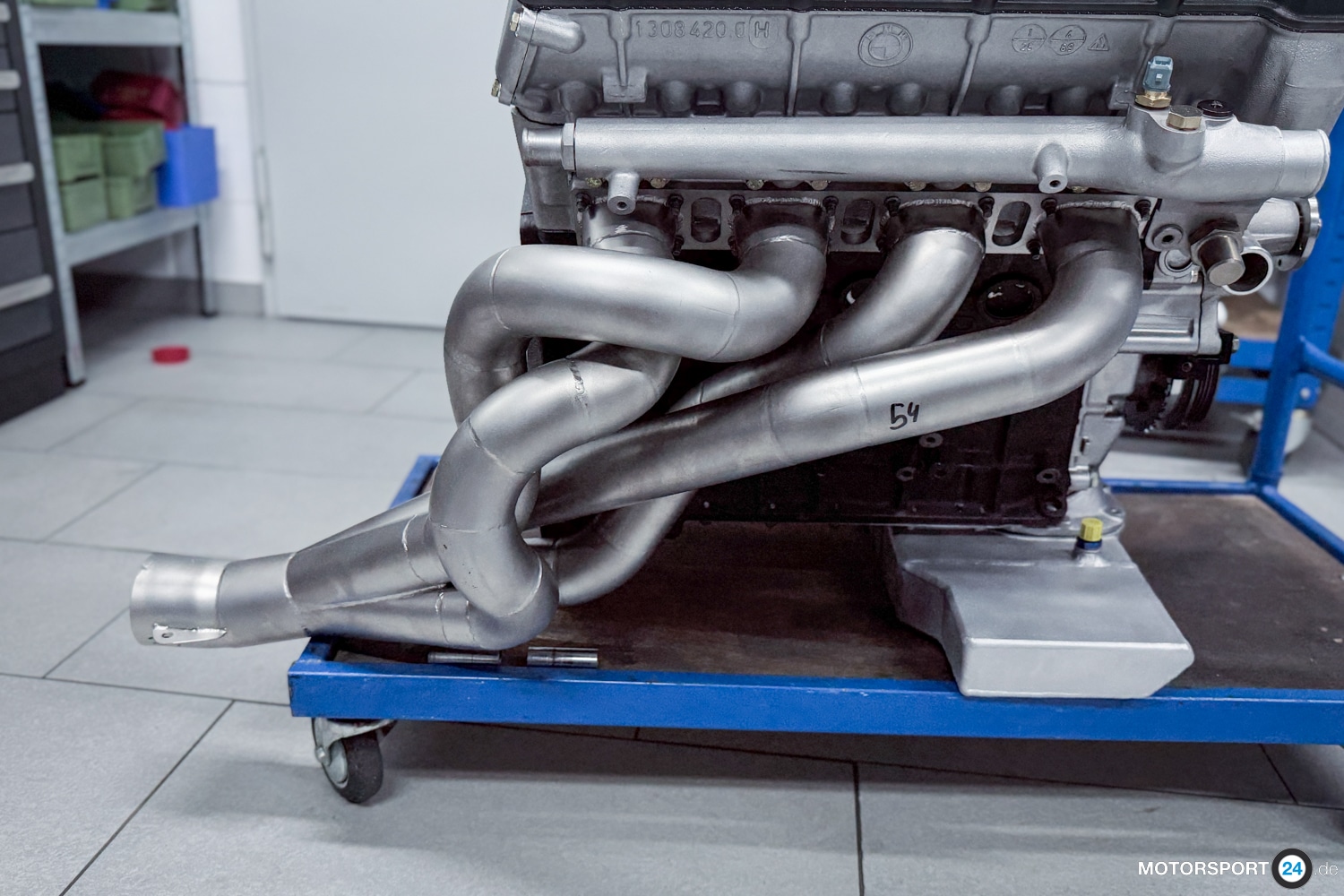
- With the 1987 Evolution, identification is the real challenge. The stamped E on the cylinder head, the two-piece tubular exhaust manifold and the white dot on the throttle body spacer plate are the documented features — but the head and manifold can be swapped. They prove an Evolution engine, not an Evolution car. Without a vehicle history report from BMW Group Classic, it remains circumstantial evidence.
07 · Engineering
Suspension, brakes, transmission
Body and dimensions
Radaufhängung
Bremsen
Transmission and axle
Technical data — final drive ratios & gearboxes
- Length
- 4,346 mm
- Width
- 1,680 mm
- Height
- 1,370 mm
- Wheelbase
- 2,562 mm
- Kerb weight
- 1,200 kg per factory specification
- Drag coefficient
- 0.33
- Fuel tank capacity
- 70 litres
- Boot capacity
- 404 litres
- Front axle
- strut suspension with offset control arm mounts, aluminium control arms from 1989
- Rear axle
- semi-trailing arm axle
- Wheel hubs
- five bolts
- Tyres
- 225/45 R16
- Front brakes
- internally vented discs 280 × 25 mm
- Rear brakes
- solid discs 282 × 12 mm
- ABS
- standard
- Transmission
- Getrag 265/5 with five speeds, dogleg shift pattern in Europe
- Final drive ratio
- 3.25:1, Evolution II 3.15:1
- Limited-slip differential
- standard
- Top speed
- 230 km/h with catalytic converter, 235 km/h without
- 0–100 km/h acceleration
- 6.7 s per factory specification, 7.2 s in a test by auto motor und sport
- Not verifiable and therefore not listed
- steering ratio, individual gear ratios of the Getrag 265/5, track widths, and the kerb weights of individual variants. The differential's limited-slip value (commonly cited as 25 percent) also does not come from any authoritative source.
08 · Top models
Top models
Six special editions in four years, in chronological order. The names are less clear-cut than they sound — what BMW actually called each one is noted alongside.
M3 with Evolution engine ("Evolution", 1987)
The least conspicuous of the series and the only one without special equipment: outwardly a normal M3, 200 PS, no dedicated aerodynamics, no badge. Built from February to May 1987 as a homologation series. The name "Evo 1", common in enthusiast circles, does not come from BMW.
To the sub-page →
M3 Europameister (1988)
148 units, exclusively in Macau Blue metallic, light full leather, badge with Roberto Ravaglia's printed signature. 195 PS. After the Ravaglia Edition, the rarest of the named special editions.
To the sub-page →
M3 Evolution II (1988)
220 PS at an 11.0:1 compression ratio, 243 km/h, final drive ratio 3.15:1. Dedicated aerodynamics for the first time: lower front spoiler with brake cooling ducts instead of fog lights, rear spoiler with additional lip. Only in Macau Blue, Misano Red and Nogaro Silver. 69,900 Mark.
To the sub-page →
M3 Cecotto (1989)
505 units, named after Johnny Cecotto. It introduced the catalyst version boosted to 215 PS, which entered series production from September 1989. Three paint finishes, numbered badge.
To the sub-page →
M3 Ravaglia (1989)
Only 25 examples for the UK, making it the rarest M3 variant of all. Technically identical to the Cecotto.
To the sub-page →
M3 Sport Evolution (1990)
The pinnacle: 2,467 cc, 238 PS at 7,000 rpm, front and rear spoilers adjustable in three stages, Recaro seats, red belts, numbered badge. 600 units, only in Jet Black and Brilliant Red. 85,000 Mark. The name "Evolution III" is enthusiast terminology.
To the sub-page →
09 · M GmbH
The first road-going series production car from M GmbH
Before the M3, BMW Motorsport GmbH built the M1 and enhanced production models. The M3 is the first model for which the division brought a complete body and its own engine into large-scale production — and thus the template for everything sold afterwards as an M model.

10 · Motorsport
What the M3 actually won
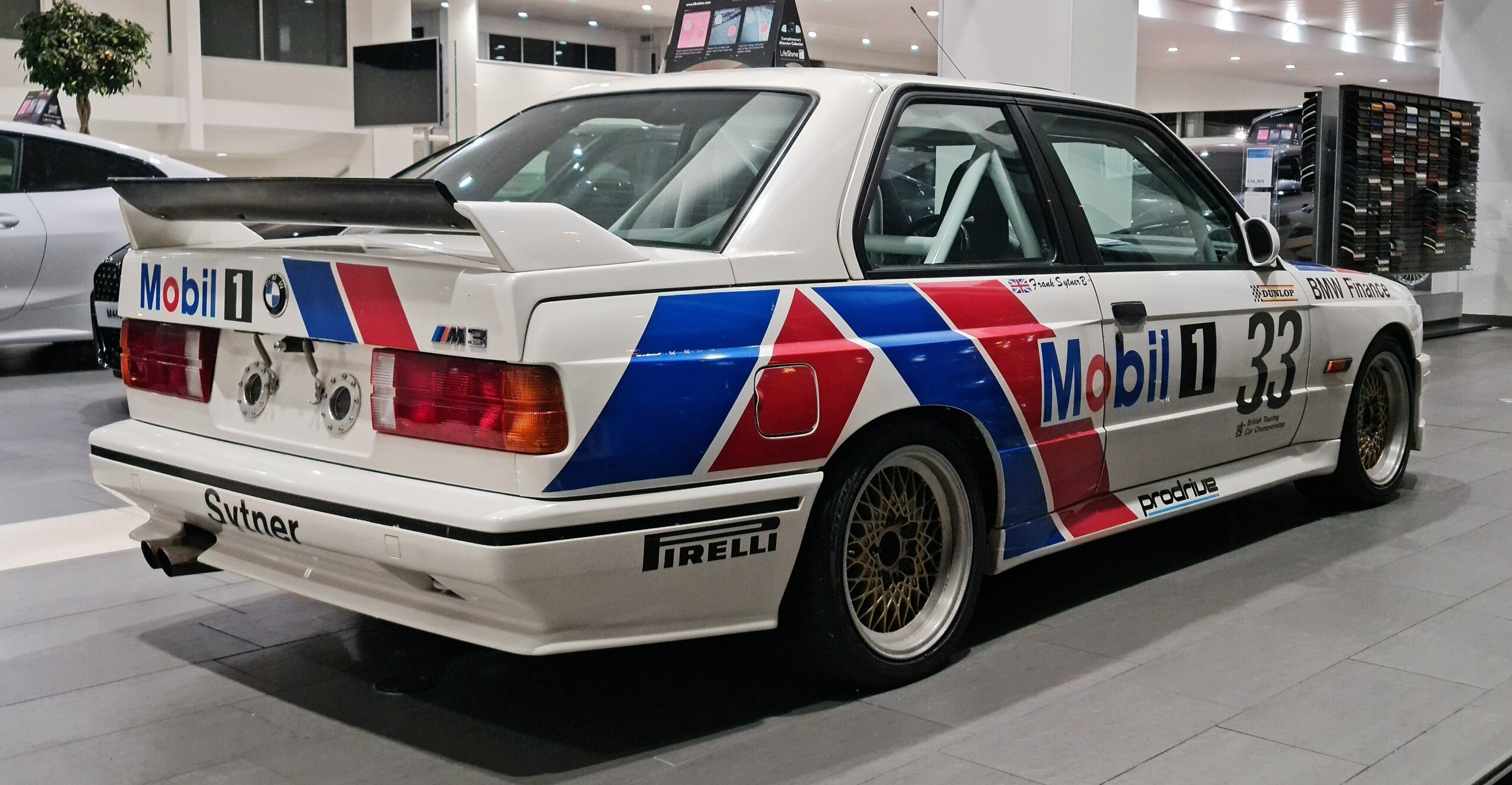
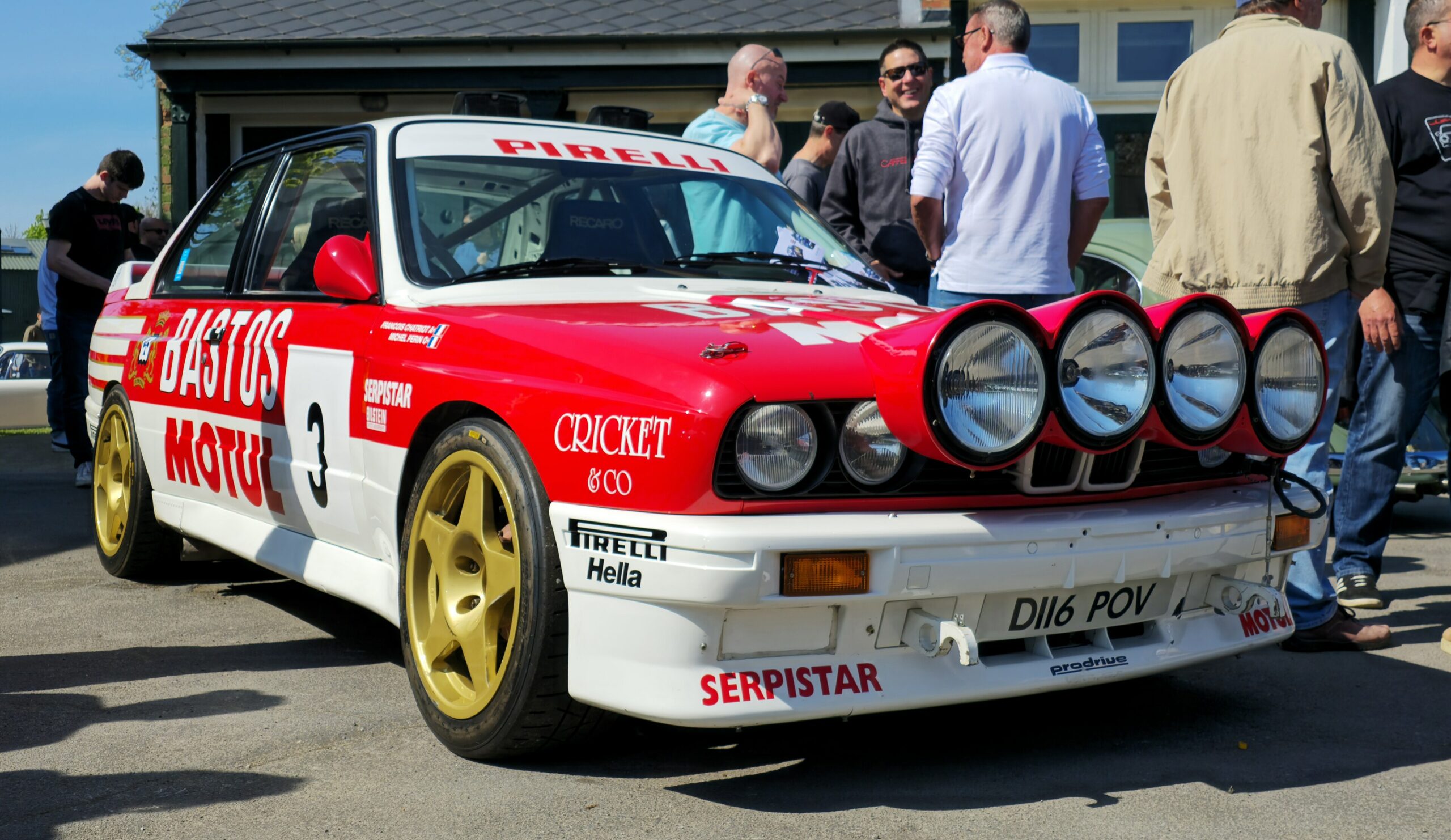
1987 was the year everything hinges on. Roberto Ravaglia won the Touring Car World Championship, Eric van de Poele the DTM, Winfried Vogt the Touring Car European Championship, and at the Tour de Corse Bernard Béguin took BMW’s first World Championship rally win in fourteen years. 1988 brought the ETCC title for Ravaglia, 1989 the DTM and a one-two finish at the 24-hour race at the Nürburgring.
One caveat belongs here: in 1987 Ravaglia won the drivers’ title, 269 points to 268. The teams’ title went to Eggenberger Motorsport in a Ford Sierra Cosworth. The blanket claim “BMW won the World Championship” is common but imprecise. The championship was contentious anyway — points were only awarded to those who paid a $60,000 registration fee; Tom Walkinshaw Racing boycotted it as a result, and after one season the series was discontinued.
The race engines: BMW Group Classic states 2,332 cc and 300 PS at 8,000 rpm for the 1987 DTM M3, while the PressClub states 300 PS at 8,200 rpm. For the 2.5-litre version of 1990, figures range from 355 PS (PressClub) to 360 PS (bmw-m.com) to 375 PS (Wikipedia DE) and around 379 PS (Wikipedia EN). Four sources, four figures.
The frequently cited “over 1,500 individual wins” and “60 national championships” come from BMW’s own count and have not been independently verified. We reproduce them as a BMW claim, not as fact. The total number of 24-hour race victories is likewise disputed: Wikipedia DE and the BMW Group Classic Museum state eight, while Wikipedia EN lists nine individually.
11 · Buying guide
What matters: originality and sheet metal
With the M3, two checks run in parallel. One concerns the substance and is the same as for any E30. The other concerns whether the car is actually an M3 at all — replicas built from standard E30s are numerous and some are made very well.
Gusset plates behind the front wheels, the transition from A-pillar to sill — the most critical point on the E30. Rusts from the inside out and stays invisible for a long time. Caused by dirt accumulation behind the wheel arch liners.
Battery tray, in advanced stages extending as far as the bulkhead to the interior.
Rear wheel arches.
Sills and jacking points, usually due to blocked drain channels.
Boot: spare wheel well, area behind the tail lights, rear closing panel — especially below the rear tow eye.
Windscreen frame. On the M3, the added factor is that the glass is bonded in, which makes repair more involved.
On the suspension side: worn rear axle mounting bushes (clunking on load changes), lower ball joints, and perished rubber bushings at the front.
The order is: identity first, then bodywork, then mechanicals. Check the registration documents and chassis number against the M3-specific body features — wide C-pillar, flat rear window, raised boot lid, five wheel bolts. Only once that checks out is a closer look worthwhile.
12 · Market & Values
Value development
Preisentwicklung
Für diese Baureihe liegen 18 dokumentierte Auktionsergebnisse vor.
Die Preisentwicklung ist nur für angemeldete Nutzer sichtbar.
13 · The competition
The competition
Mercedes-Benz 190 E 2.3-16
The direct conceptual rival from September 1983: 2,299 cc, Cosworth four-valve head, 185 PS at 6,200 rpm, 230 km/h. Same idea, different execution — Mercedes built for long-distance stability, BMW for agility. The answer to the Sport Evolution came in 1990 as the 190 E 2.5-16 Evolution II with 235 PS, likewise in 500 examples.
Ford Sierra RS Cosworth
On the racetrack, the true rival, and technically the opposite approach: turbocharging and straight-line power instead of a naturally aspirated engine and cornering dynamics. At least 204 PS in production form, the RS500 produced 227 PS. This exact matchup decided the 1987 World Championship — Ravaglia took the drivers' title, Eggenberger in the Sierra took the teams' title.
Alfa Romeo 75 3.0 V6
The Italian rival offering in the same price bracket: 2,959 cc, 188 PS, transaxle layout with the gearbox at the rear axle. Similar weight distribution and similar character, but without a homologation background.
14 · Galerie
Bilder
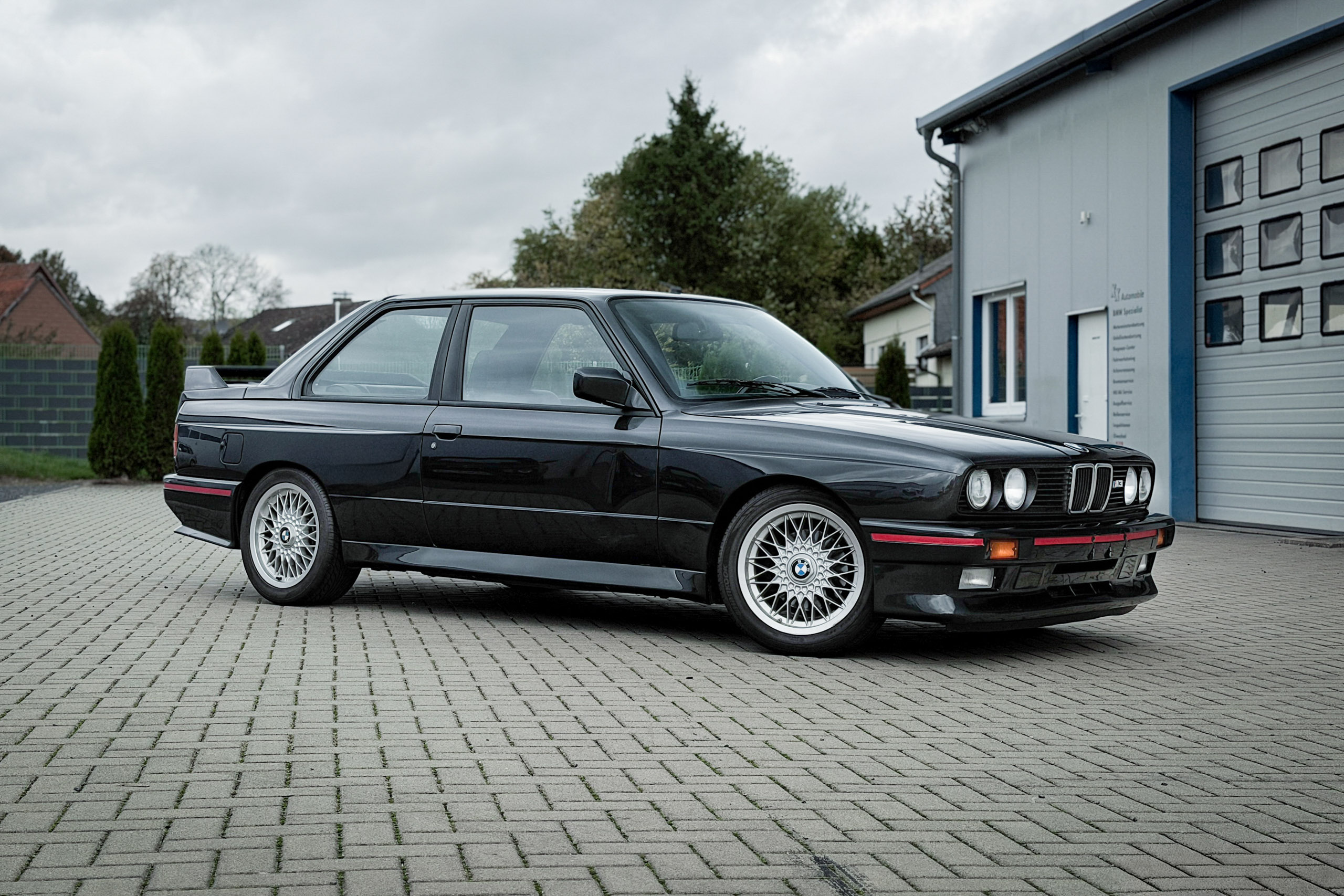
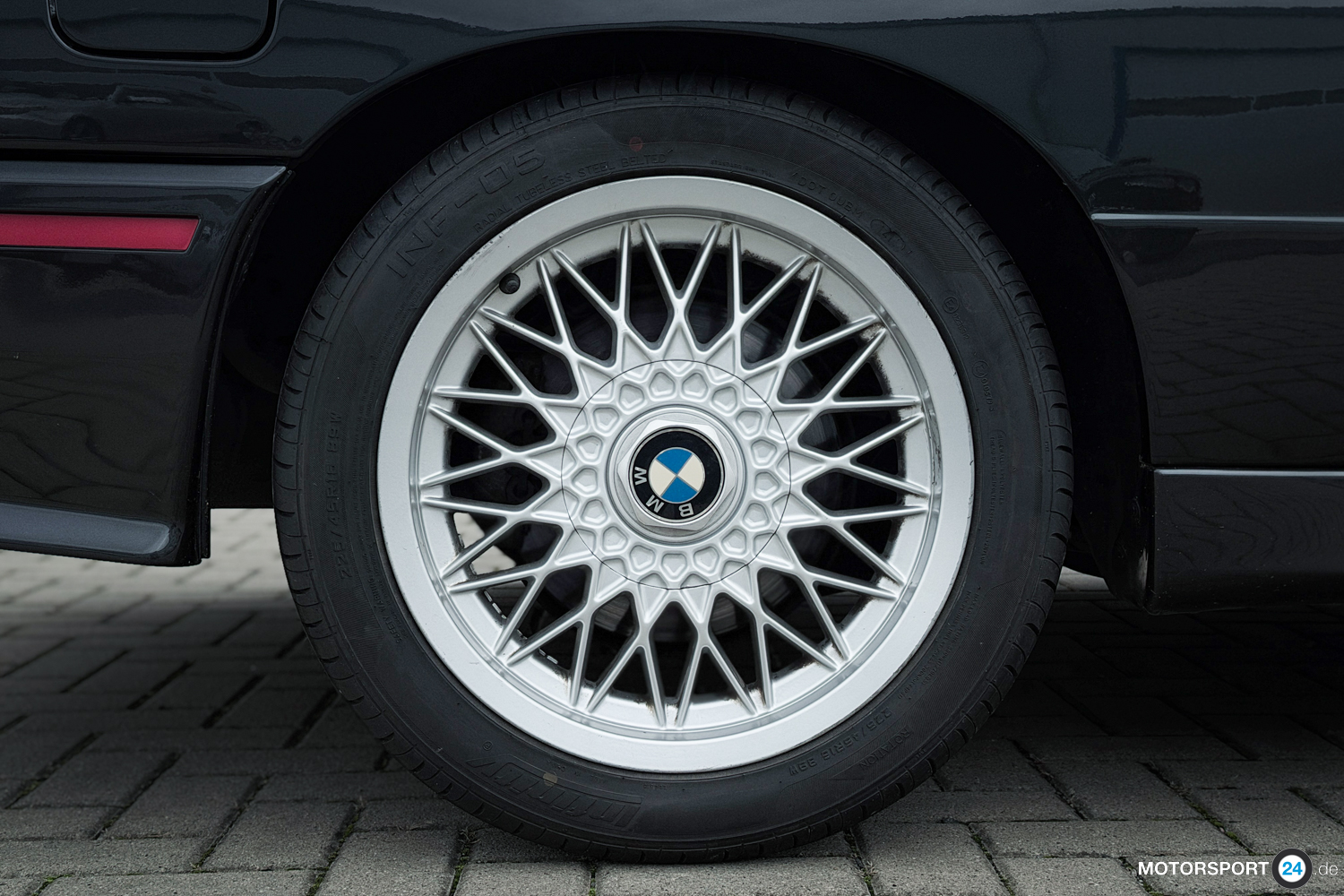
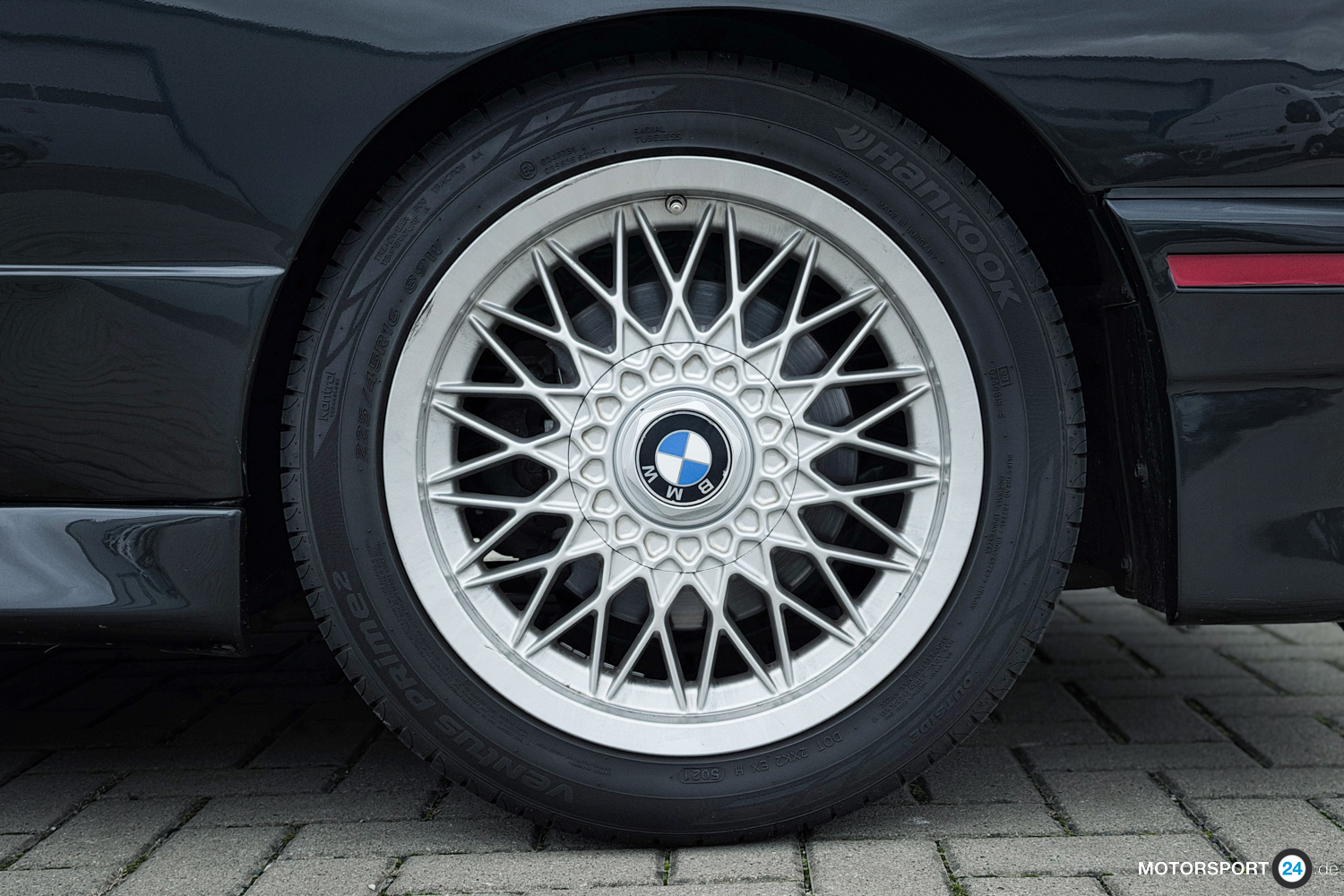
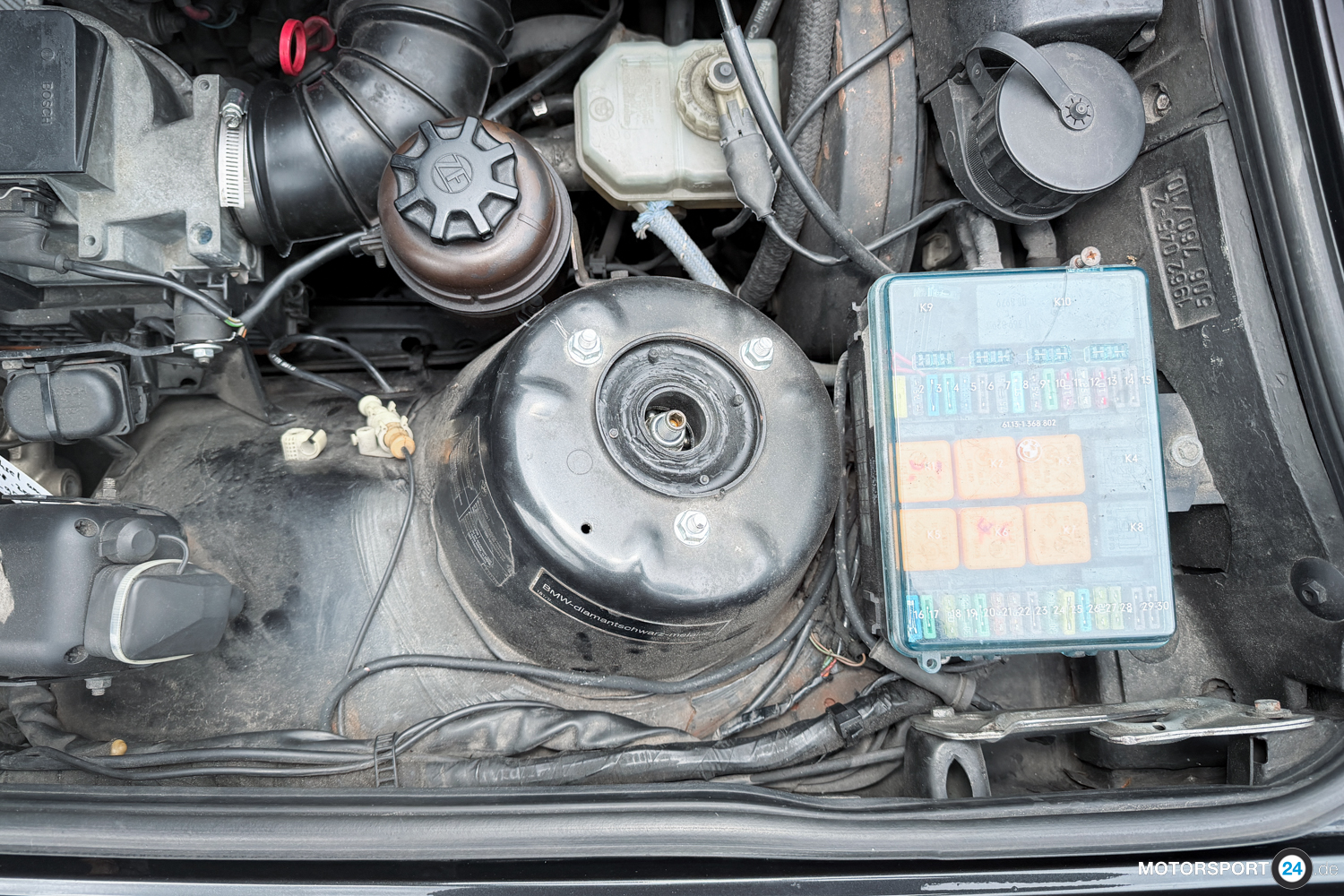
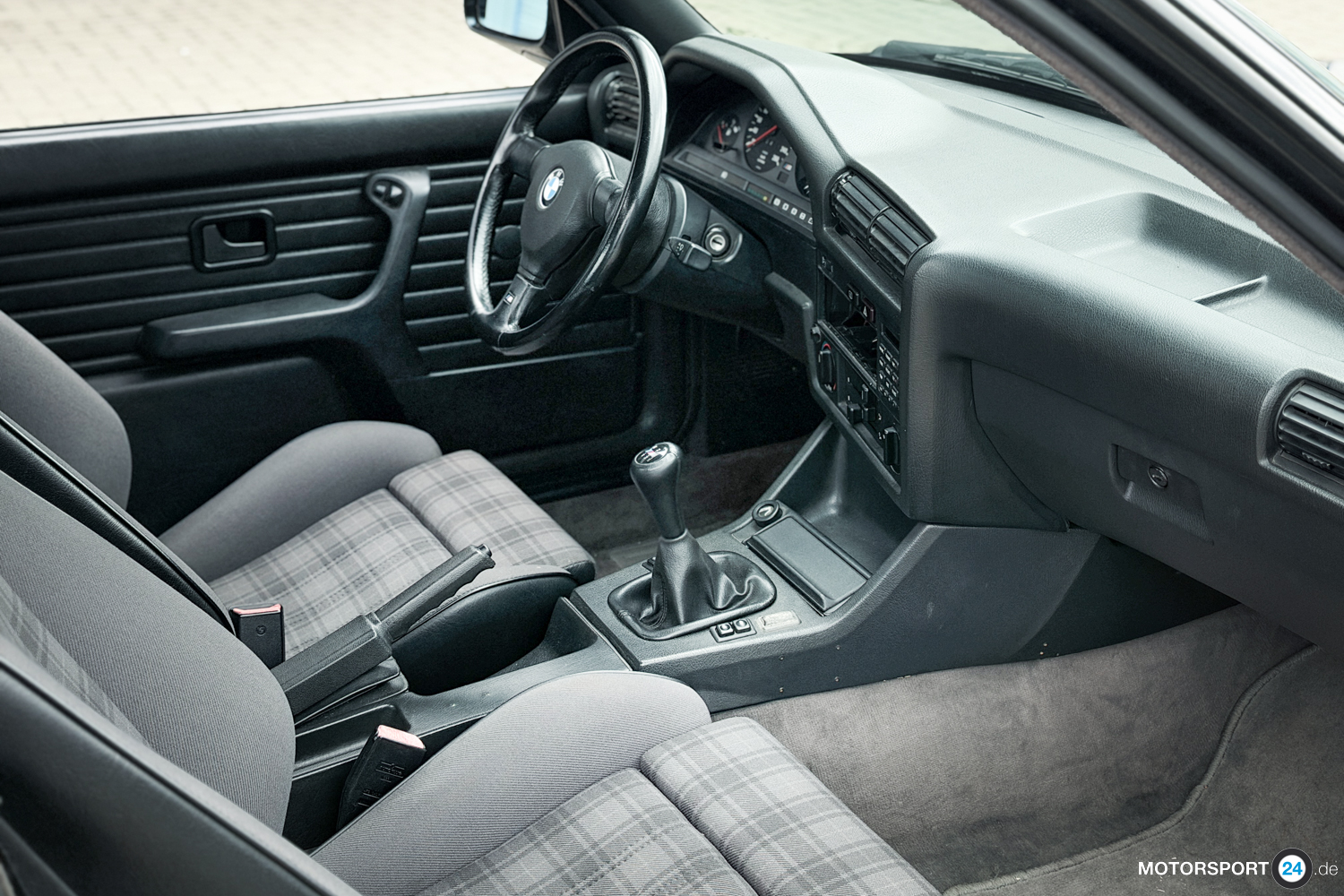
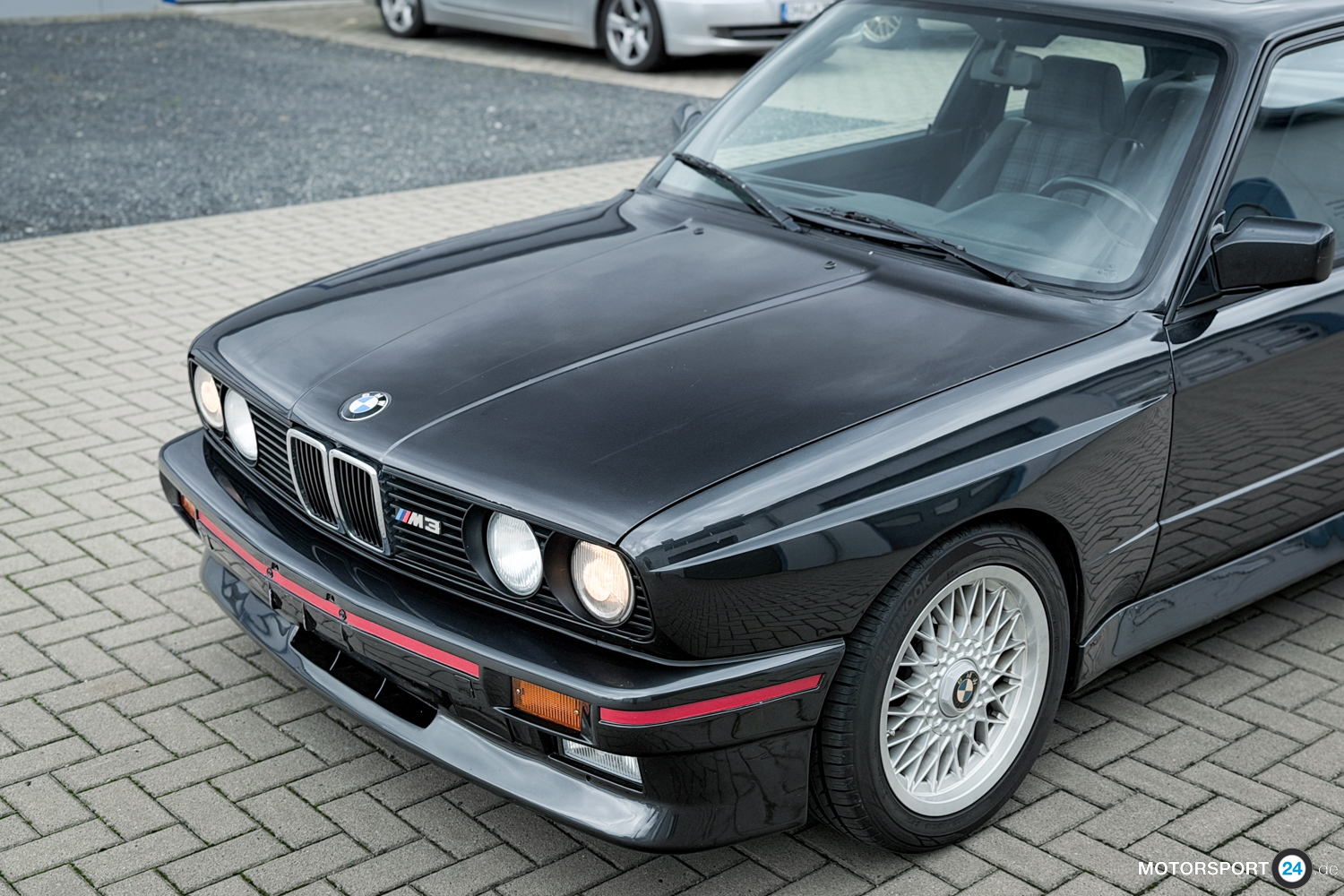
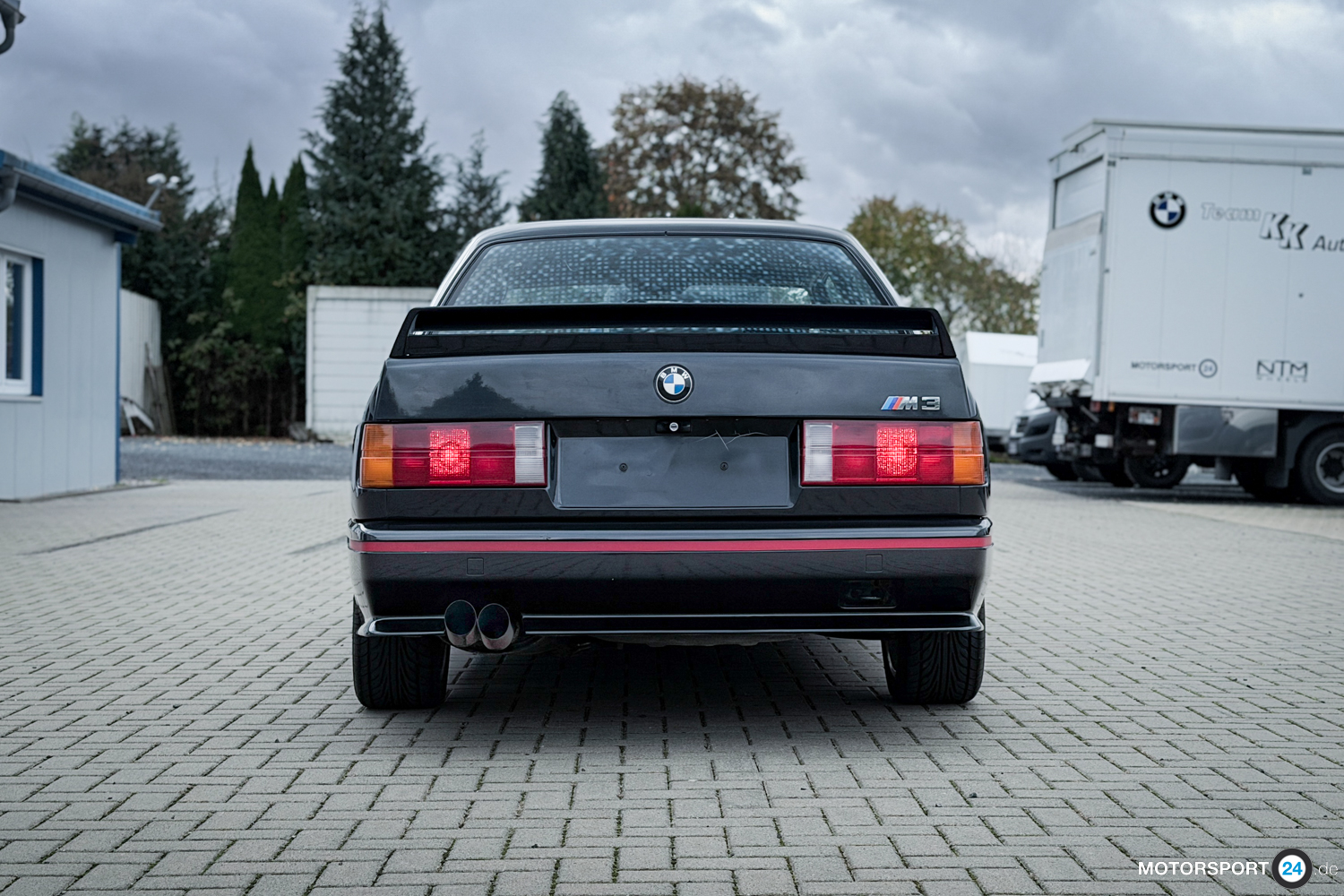
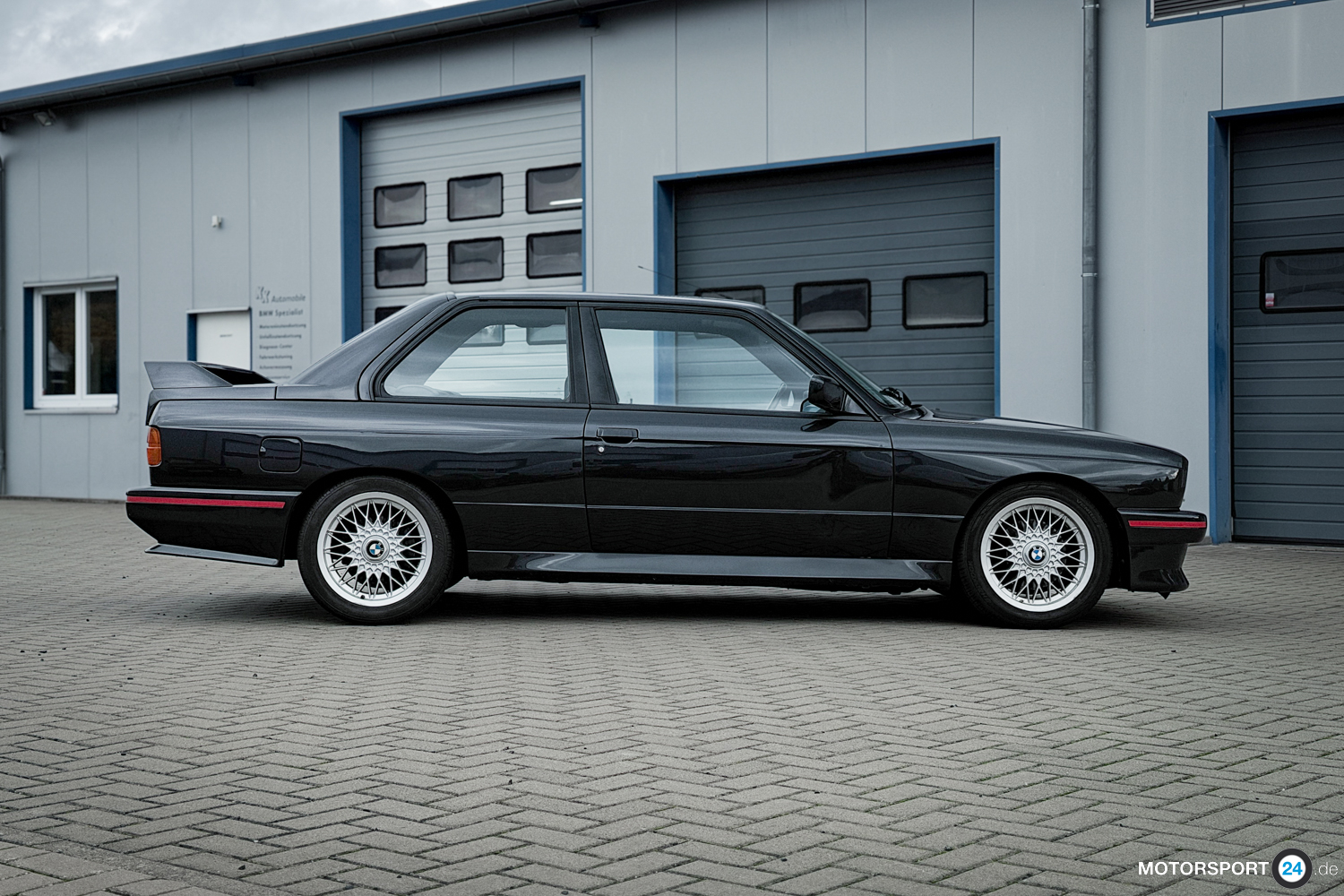
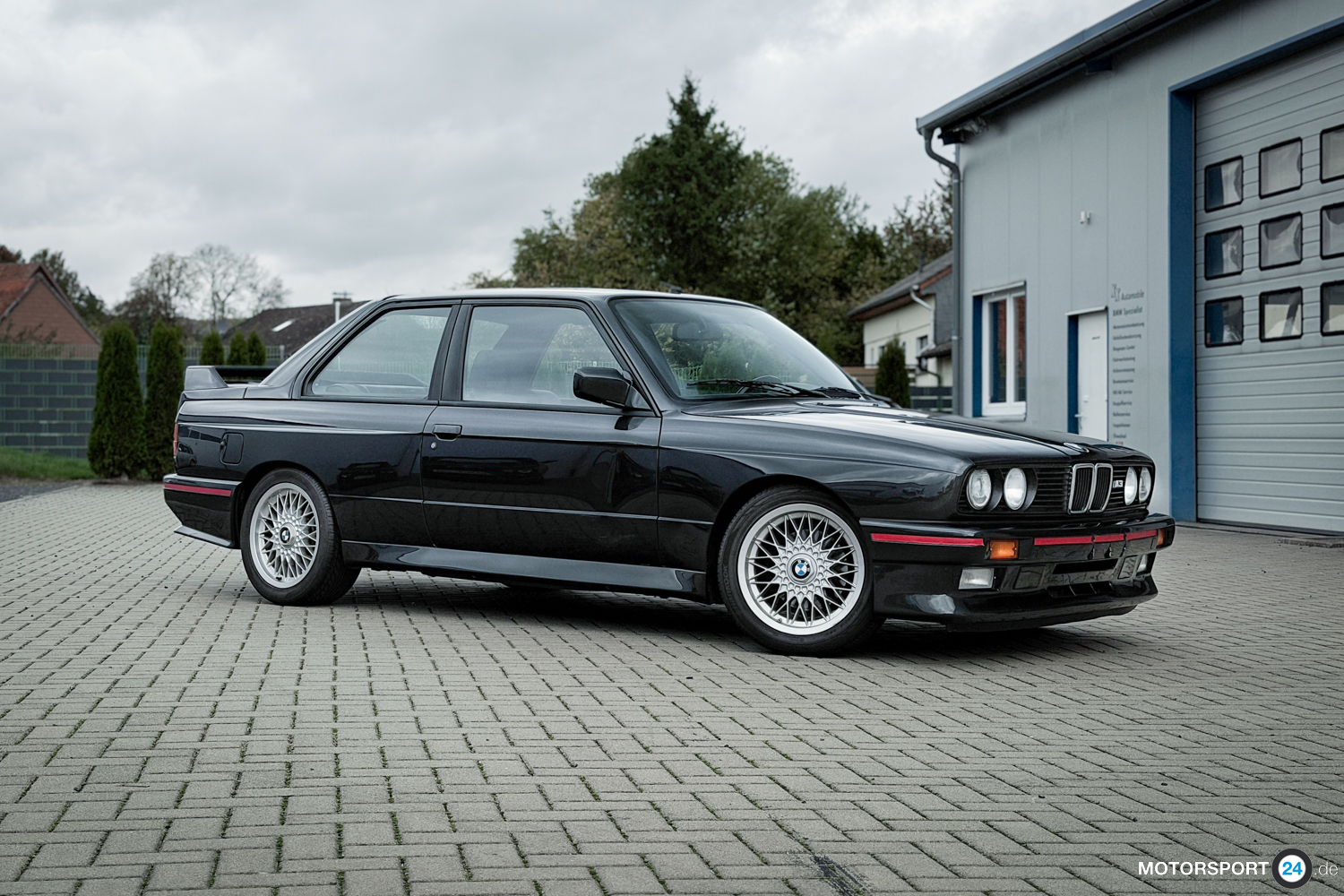
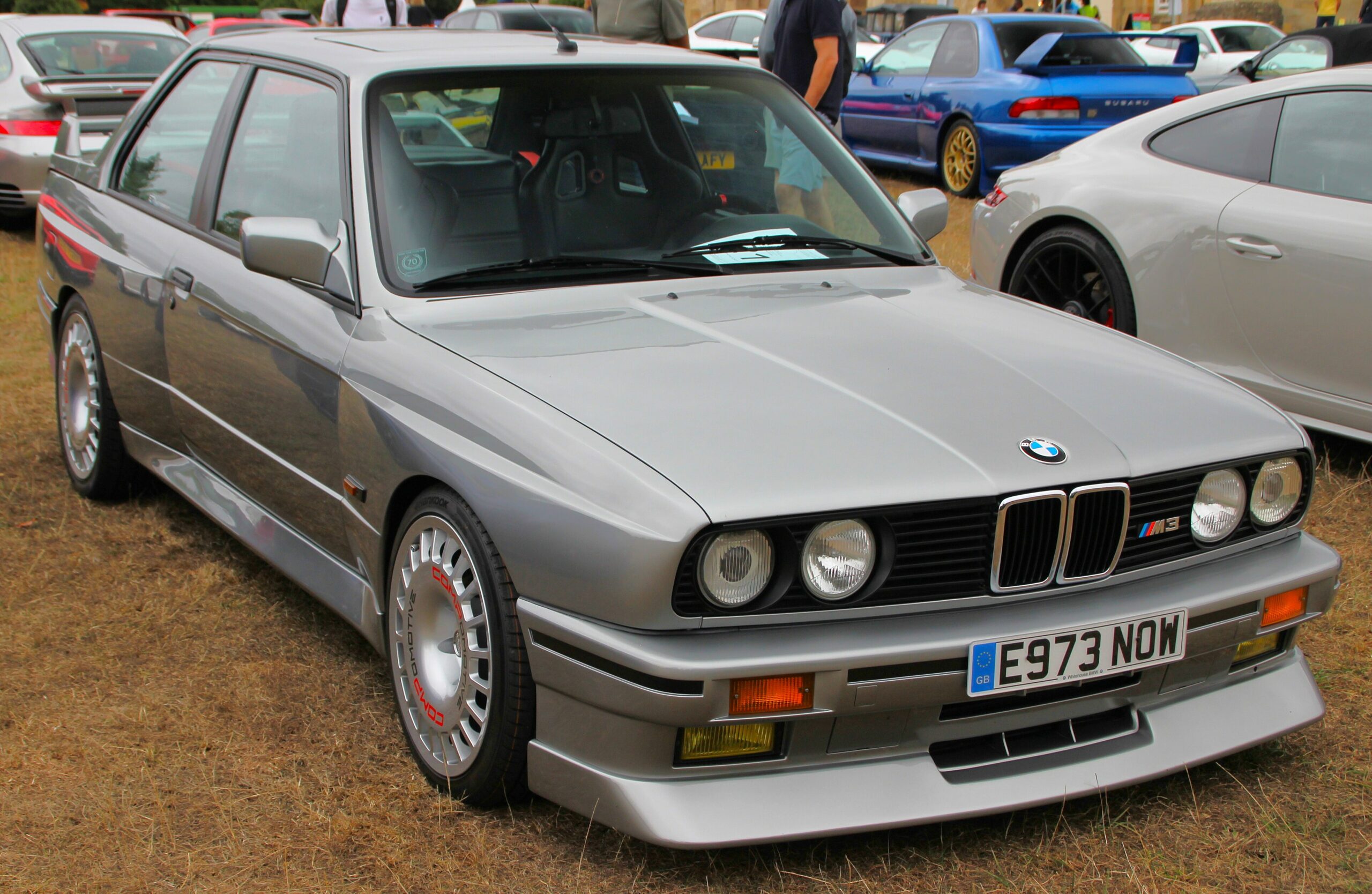
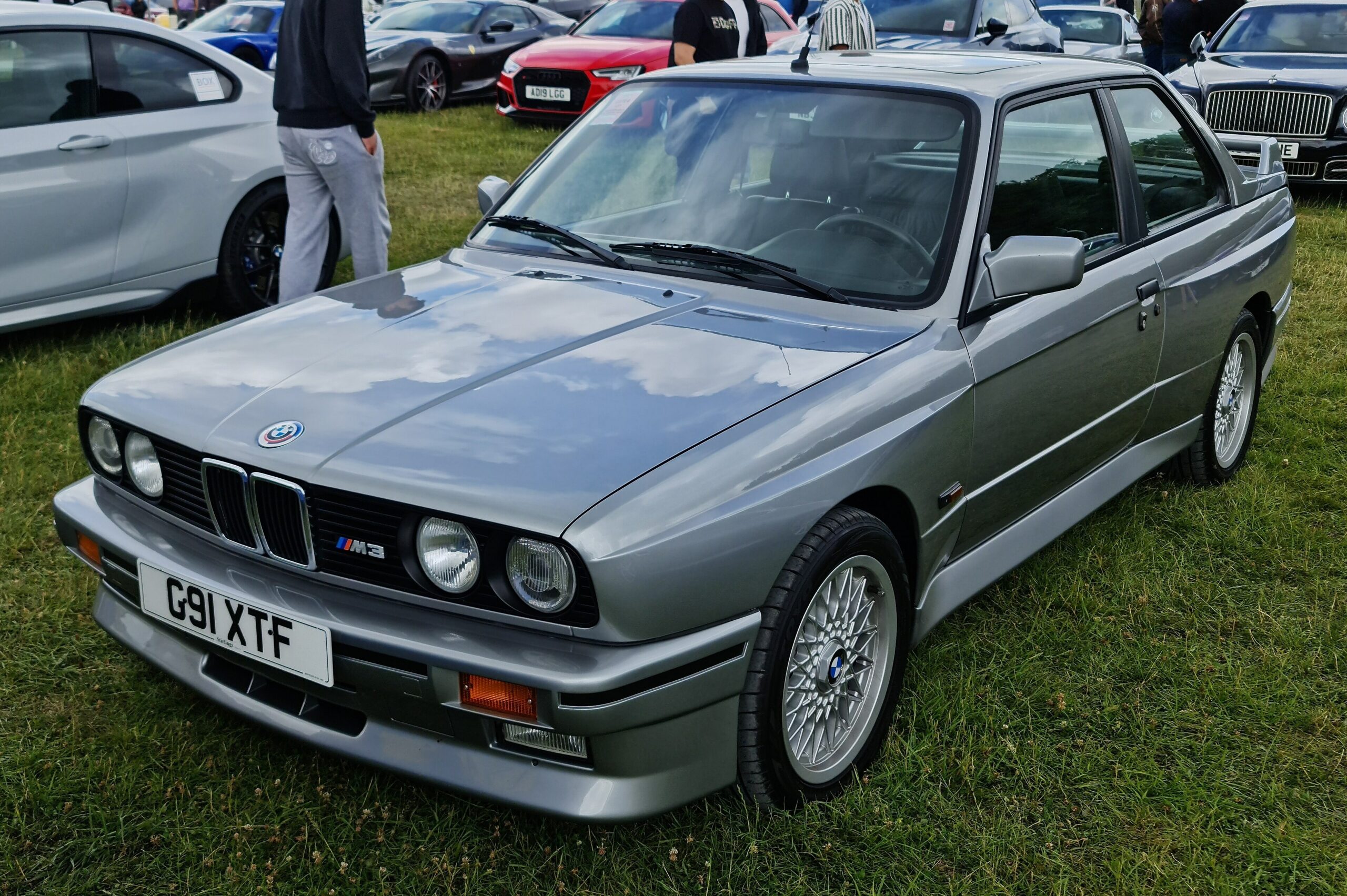
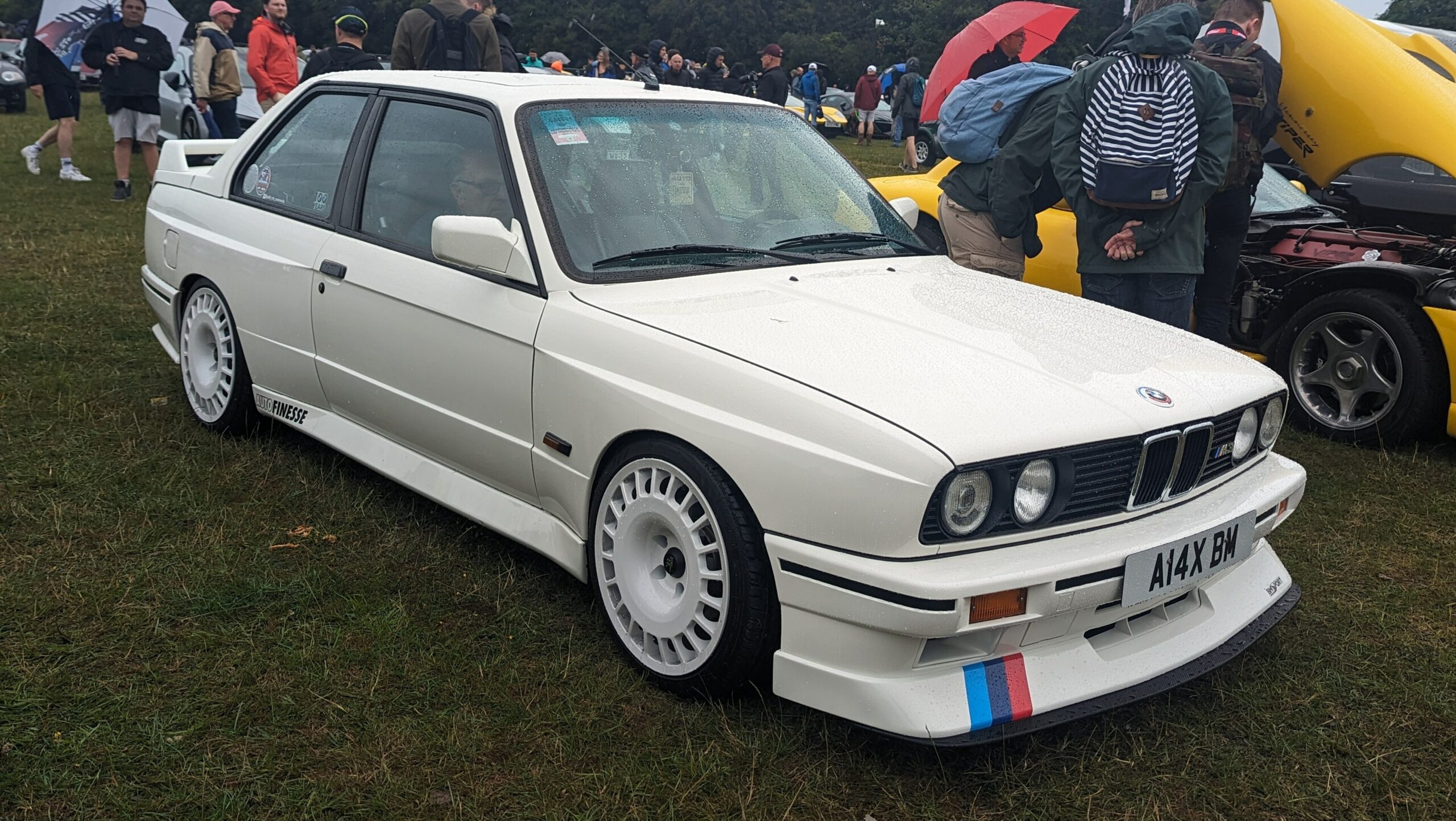
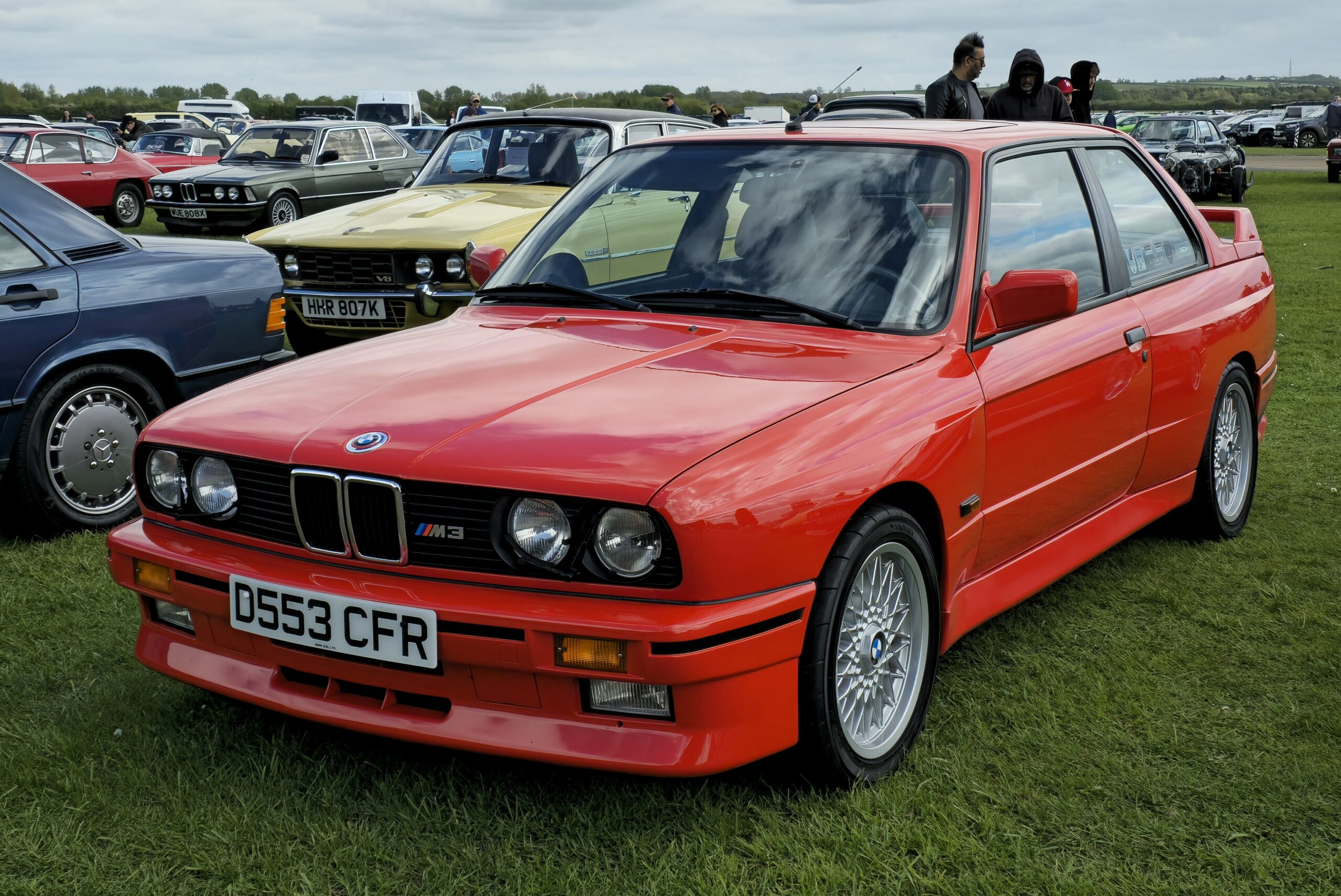
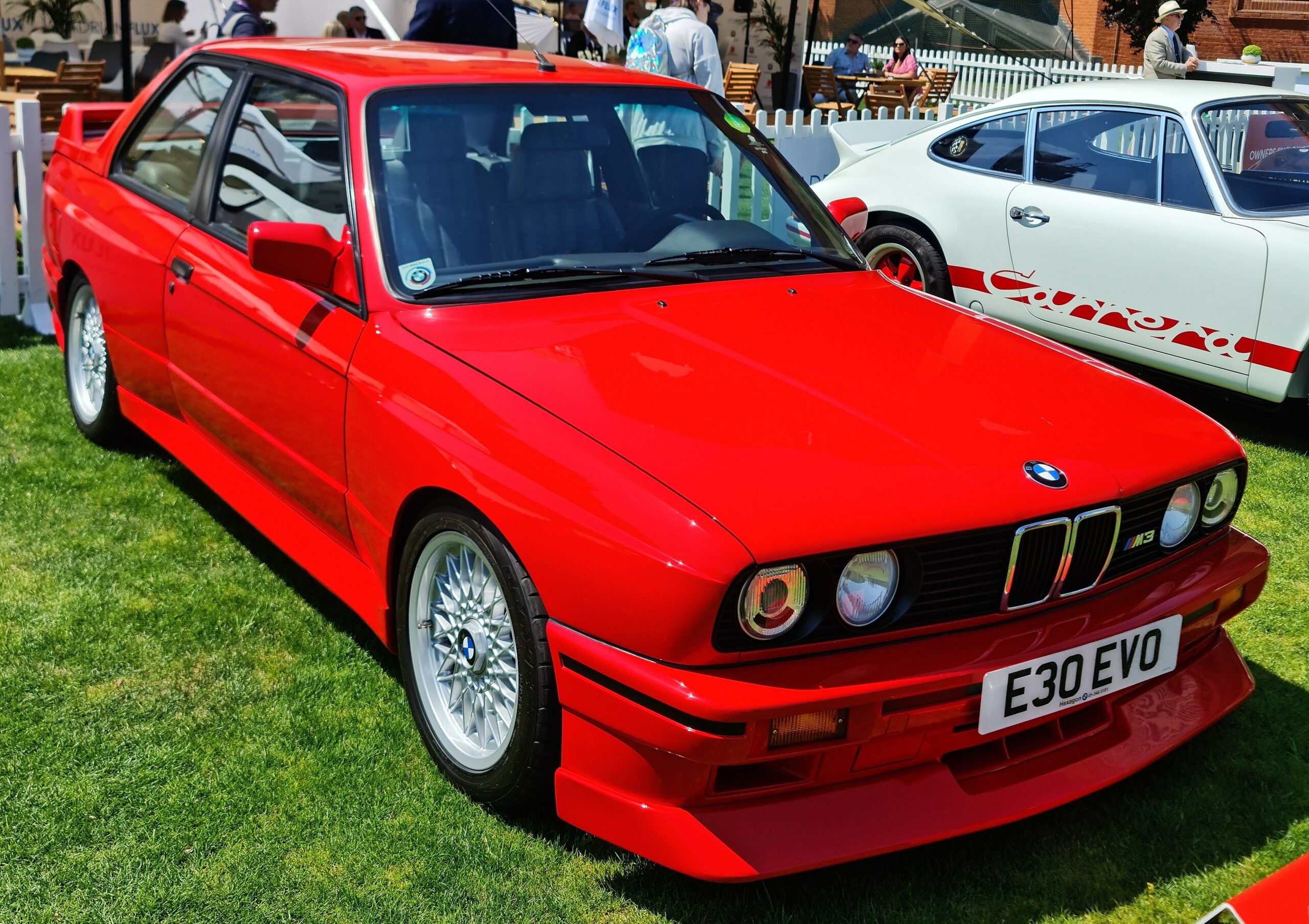
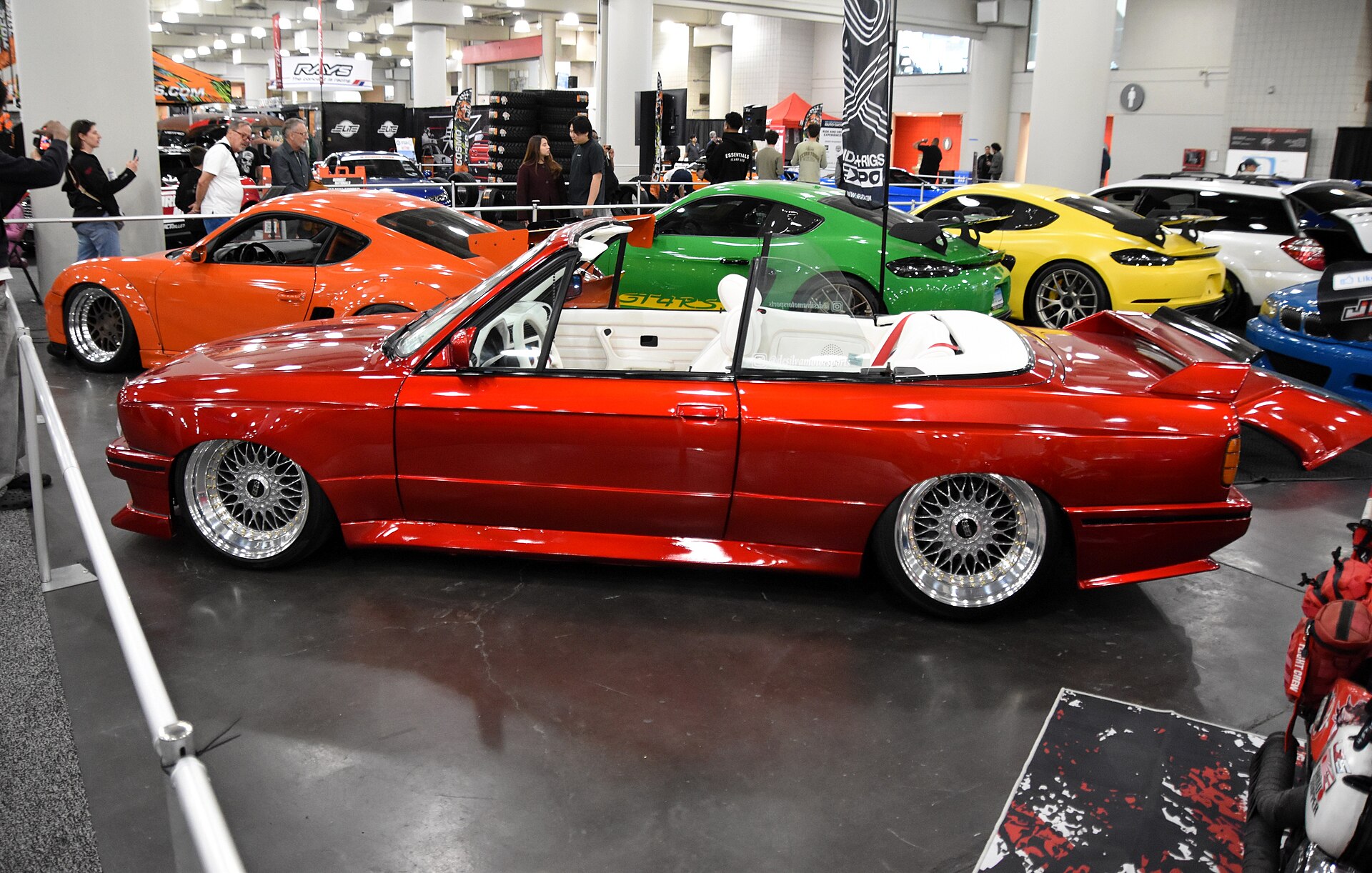
The Diamond Black M3 from the 1989 model year stood in our hall — these are our own photographs. What follows are photographs of further vehicles from the model line.
15 · Sources
Belege & Literatur
Primary sources are BMW Group Classic, the BMW PressClub, bmw-m.com and Wikipedia. Information from other sources has been cross-checked at least twice. Where sources contradict each other, the discrepancy is noted in the text.
- BMW Group Classic — BMW M3 (E30)
- BMW Group Classic — M3 Evolution II
- BMW Group Classic — M3 Sport Evolution
- BMW Group Classic — M3 Convertible
- BMW PressClub — 30 Years of the BMW M3
- bmw-m.com — BMW M3 E30 Profile
- Wikipedia (DE) — BMW E30 (M3)
- Wikipedia (DE) — BMW S14
- Wikipedia (EN) — BMW M3 (E30)
- BMW Group Classic — BMW M3 (E30) with Evolution engine ("Evolution")
- FIA Historic Database — BMW M3, homologation no. 5327 (Group A)
- FIA Appendix J, Article 255 (1985 edition) — Group A unit number regulation