

01 · Overview
Seven years, one body shell, six European Championship titles
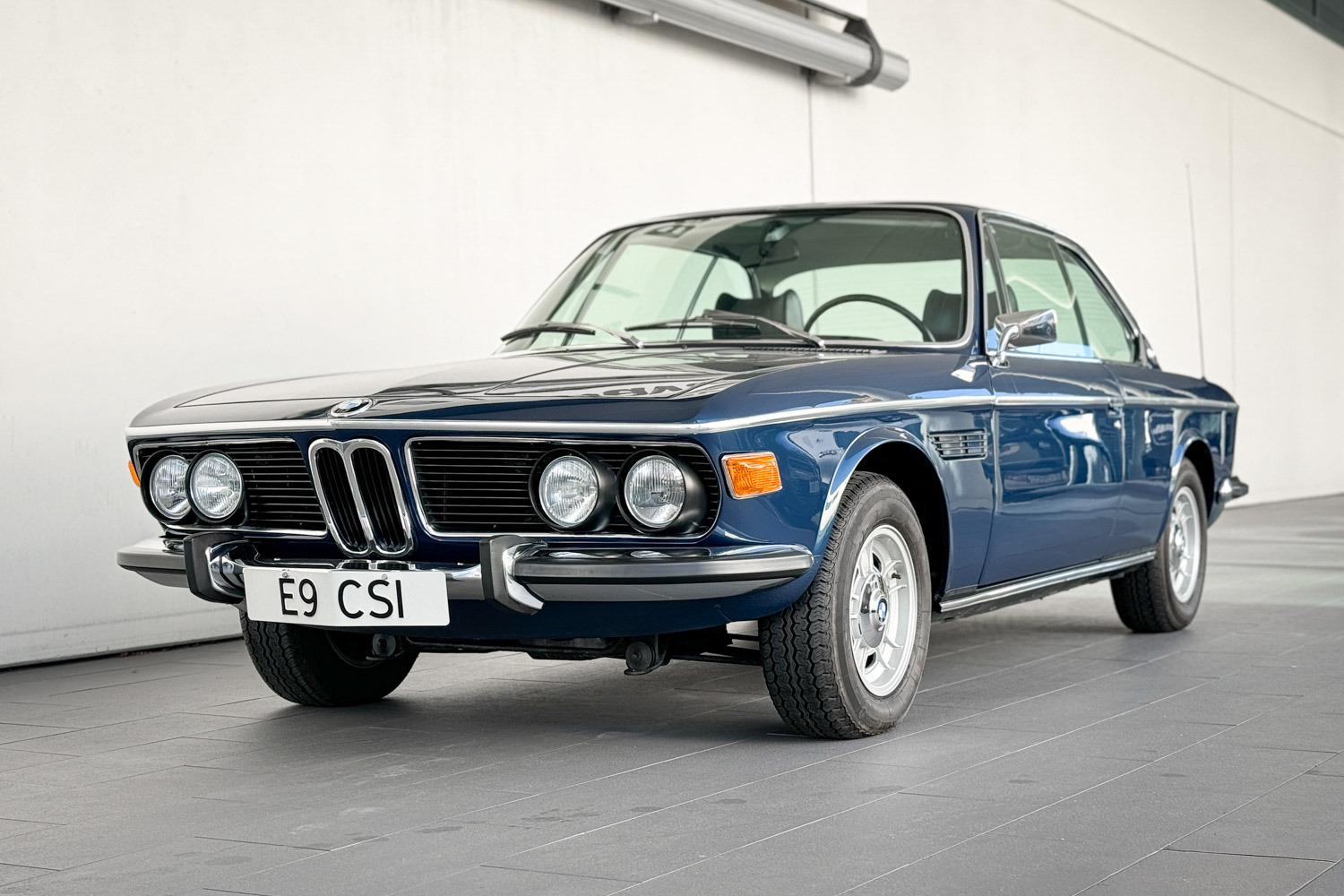
The E9 is the coupé with which BMW finally arrived at the top after its near-bankruptcy of the early sixties. The 2800 CS entered production in December 1968 — technically the extended front end of its predecessor, the 2000 C/CS, to fit the large straight-six M30, plus the front section of the new six-cylinder Sedans with twin-kidney grille and twin headlights. The body was designed by Wilhelm Hofmeister and built by Karmann at its Rheine plant; final assembly took place in Munich.
There was exactly one body style: the two-door, pillarless coupé. No factory Convertible, no four-door, no Touring. The variants differ almost exclusively under the bonnet — from the 150 hp economy model, the 2.5 CS of the oil crisis years, to the 3.0 CSi with Bosch injection and 200 hp.
Its real significance lies in motorsport. The 3.0 CSL, a lightweight homologation model developed by Alpina on BMW’s behalf, became the core project of BMW Motorsport GmbH, founded on 1 May 1972. Six drivers’ titles in the European Touring Car Championship, overall wins at Sebring and Daytona, and, with the Calder CSL, the first BMW Art Car are to its credit. A total of 30,546 E9s were built.
The E9 was not built in Munich. The body shell was made by Wilhelm Karmann at its Rheine plant — Osnabrück is often cited instead, but that is the company’s headquarters, not the E9’s manufacturing site. From Rheine, the bodies went to Munich for final assembly. The high proportion of manual labour explains both: the quality of the fits and the price. In 1972, a 3.0 CSi cost around twice as much as a well-equipped 2002 Sedan.
02 · History
From 2800 CS to Batmobile
Seven model years, three displacement stages and one homologation model that outshines the model line.
- 1968 Production of the 2800 CS begins in December. Body by Karmann, 2,788 cc, 170 hp, two Zenith twin-choke carburetors.
- 1969 The E9 finally replaces the 2000 CS. Four-speed manual as standard, ZF three-speed automatic optional.
- 1971 Displacement jump to 2,985 cc: 3.0 CS with carburetor and 180 hp from April, 3.0 CSi with Bosch D-Jetronic and 200 hp from July. Disc brakes on all four wheels for the first time.
- 1971 The 3.0 CSL appears as a lightweight homologation model: aluminium for doors, bonnet and wings, thinner body panels, Plexiglas instead of side windows, no bumper trim. 169 examples of the first stage.
- 1972 On 1 May, BMW founds Motorsport GmbH under Jochen Neerpasch, who brings Martin Braungart with him from Ford. The CSL becomes its core project. Second CSL stage: 3,003 cc, 200 hp — displacement pushed deliberately over three litres to move the car into the next racing class.
- 1973 CSL stage 3: 3,153 cc, 206 hp, plus the aerodynamics package with front splitter, roof spoiler and a massive rear wing — the "Batmobile". Because the wing did not receive road approval in Germany, it was supplied in the boot.
- 1973 Toine Hezemans wins the CSL's first drivers' title in the European Touring Car Championship.
- 1974 The oil crisis takes hold: from June, the more economical 2.5 CS with 2,494 cc and 150 hp joins the line-up. BMW ends the year without a title in the European Championship.
- 1975 Overall win at Sebring. Alexander Calder designs the Le Mans CSL with start number 93 — the first BMW Art Car. Production ends in November after 30,546 vehicles.
- 1976 Aftermath: overall win at Daytona, Frank Stella's Art Car on the Turbo CSL, and the Group 5 version with around 750 hp from 3.2 litres. Its successor, the E24, is already in production by then.
03 · Model overview
Seven variants, one engine
All E9s run the large straight-six M30. Differences lie in displacement, fuel mixture preparation and weight. Power figures are factory figures per DIN.
Source: factory and literature data · verified
Technische Daten anzeigen — komplette Modellmatrix
| Modell | Motor | Hubraum | Leistung | Bauzeit |
|---|---|---|---|---|
| 2,5 CS | M30 · carburetor | 2.494 cm³ | 150 PS (110 kW) | 1974–1975 |
| 2800 CS | M30 · carburetor | 2.788 cm³ | 170 PS (125 kW) | 1968–1971 |
| 3.0 CS | M30 · carburetor | 2.985 cm³ | 180 PS (132 kW) | 1971–1975 |
| 3.0 CSi | M30 · D-Jetronic | 2.985 cm³ | 200 PS (147 kW) | 1971–1975 |
| 3.0 CSL (stage 1) | M30 · carburetor | 2.985 cm³ | 180 PS (132 kW) | 1971–1972 |
| 3.0 CSL (stage 2) | M30 · D-Jetronic | 3.003 cm³ | 200 PS (147 kW) | 1972–1973 |
| 3.0 CSL "Batmobile" | M30 · D-Jetronic | 3.153 cm³ | 206 PS (151 kW) | 1973–1975 |
04 · Body variants
Body variants
Coupé
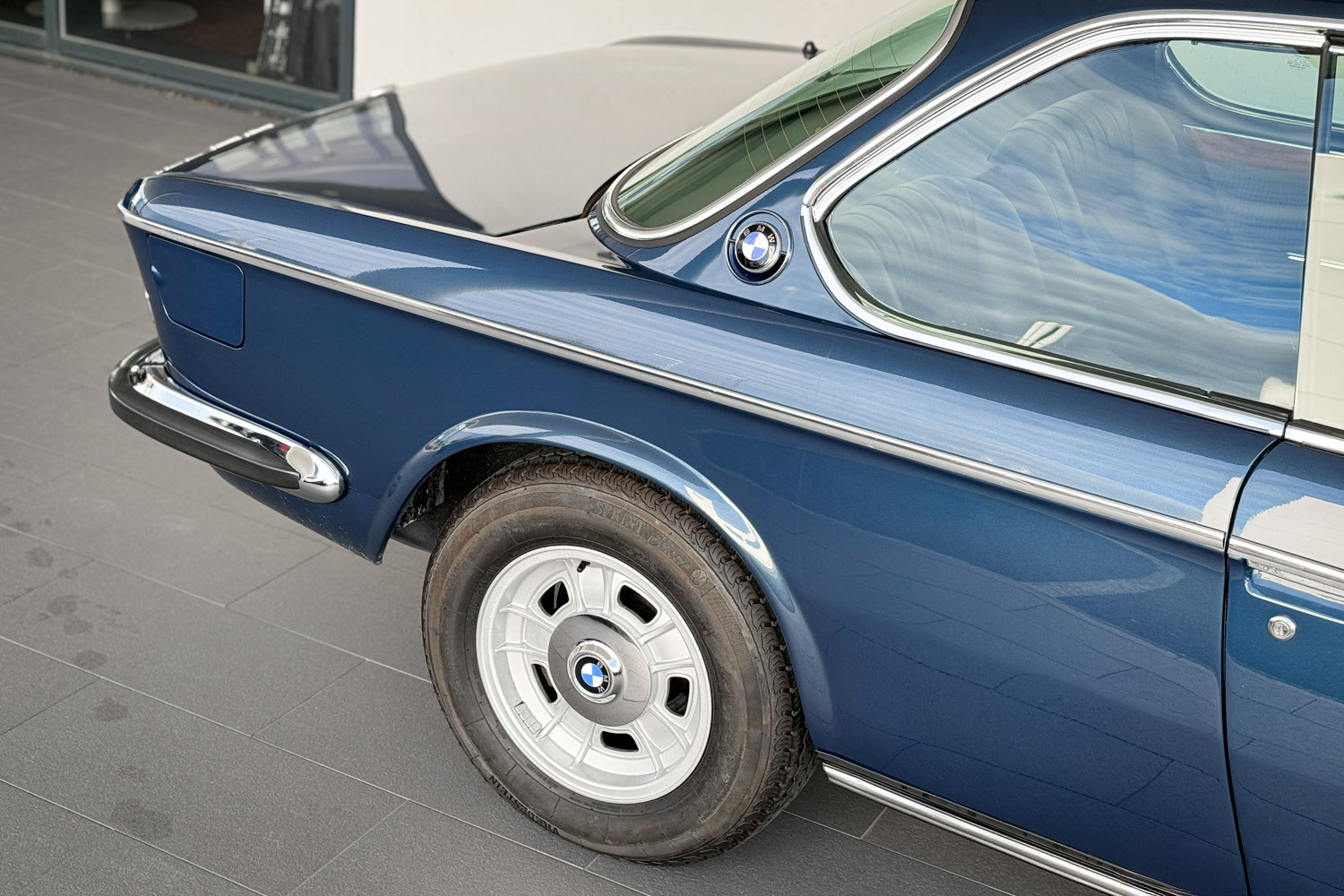
The model line's only body style: two doors, pillarless, retractable rear side windows. Body shell by Karmann at the Rheine plant, final assembly in Munich. The E9 never had a factory Convertible, a four-door, or a Touring.
3.0 CSL — lightweight construction
Formally the same body, but with aluminium doors, bonnet and wings, thinner steel panels, Plexiglas side windows and stripped-down equipment. From 1973, the aerodynamics package with roof and rear wing was added.
05 · Engines
The large straight-six M30
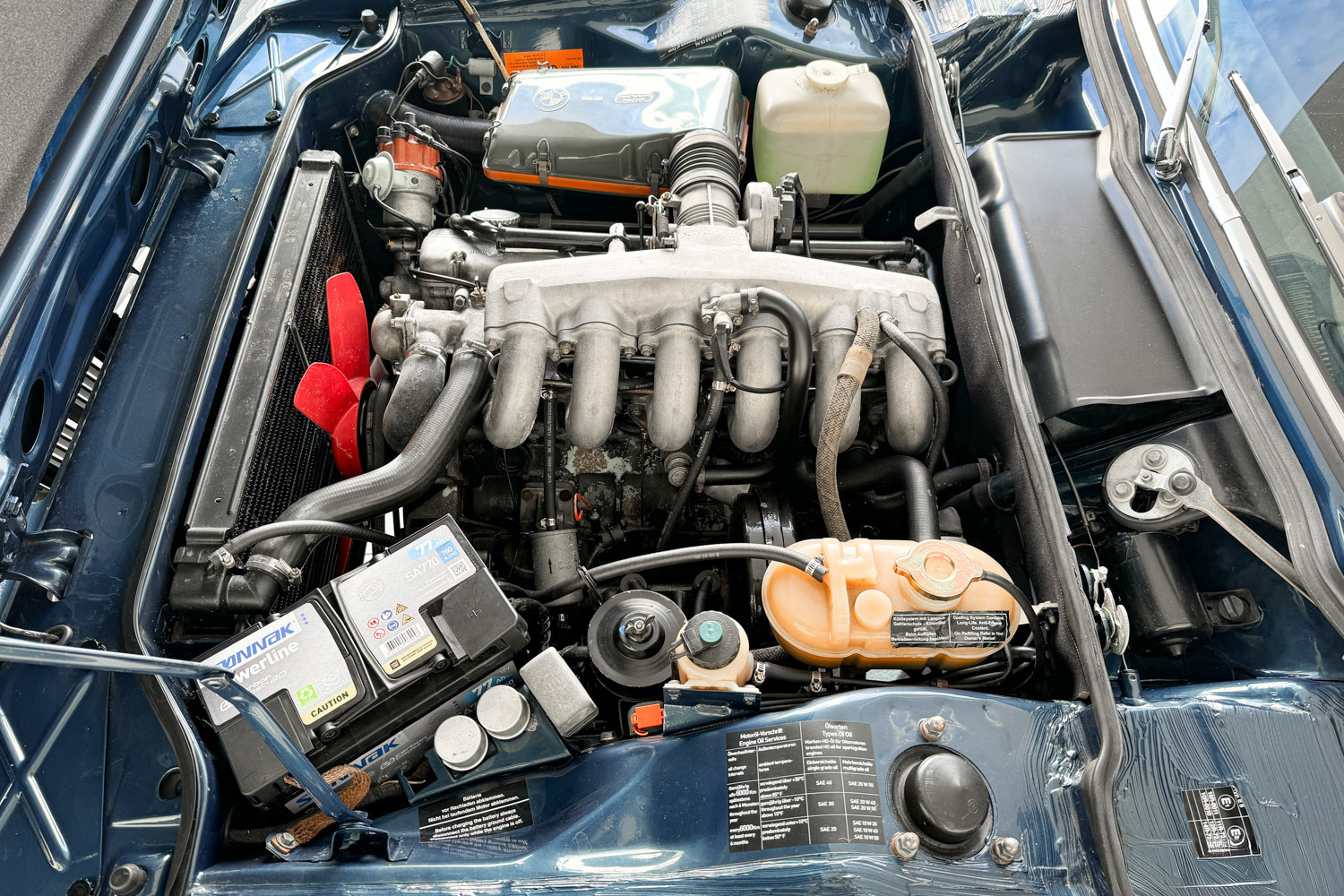
The E9 has exactly one engine family: the M30, BMW's "large six," which entered production in 1968 and was built in various forms until 1994. Cast-iron block, aluminium crossflow head modelled on the M10, a chain-driven single overhead camshaft and a seven-bearing crankshaft — an engine regarded as robust, and in the E9 it works between 2.5 and 3.2 litres.
M30 with carburetor — 2.5 CS, 2800 CS, 3.0 CS verified
Two Zenith 35/40 INAT twin-choke carburetors. The 2800 CS produces 170 hp from 2,788 cc, the 3.0 CS 180 hp from 2,985 cc, and the 2.5 CS, added as a response to the oil crisis, 150 hp from 2,494 cc. Characteristic is the very elastic torque curve — the car can be driven in fourth gear without feeling sluggish.
M30 with Bosch D-Jetronic — 3.0 CSi verified
The electronically controlled manifold injection lifts the same three-litre to 200 hp at 5,500 rpm. The CSi is the fastest production version of the E9 and today the most sought-after series variant. The first-generation D-Jetronic, however, is sensitive to ageing of the control unit, wiring harness and temperature sensors.
M30 in the CSL — 3,003 and 3,153 cc verified
The CSL's displacement stages are pure regulation arithmetic: at 3,003 cc, the car deliberately slipped over the three-litre limit into the next class in 1972; 1973 followed with 3,153 cc and 206 hp. For racing, the same block grew to 3.2 and later 3.5 litres — in the turbocharged Group 5 version M49/4, to around 750 hp.
06 · Weak points
Reliability & weak points
- Rust in the E9 is not a fault of individual cars but a trait of the model line. There was hardly any factory corrosion protection, sheet metal quality of the time varied, and drainage is poorly designed.
- M30 timing chain and chain tensioner: a rattling cold start is the warning sign. The repair itself is manageable; a skipped tooth is not.
- Overheating warps the aluminium cylinder head. The cause is usually a clogged or undersized radiator, not the engine itself.
- Bosch D-Jetronic on the CSi: control unit, wiring harness and temperature sensors are fifty years old. Replacement parts are expensive and troubleshooting is a specialist’s discipline.
- Aluminium parts on the CSL corrode at the transitions to the steel panels — contact corrosion on doors, bonnet and wings.
- Body parts are the real cost driver. Mechanical components are largely available via the M30 family and the six-cylinder Sedans; sheet metal and trim parts are not.
07 · Engineering
Chassis, drivetrain, brakes
Fahrwerk
Bremsen
Lenkung
Getriebe
Technical data — final drive ratios & gearboxes
- Transmission 2800 CS
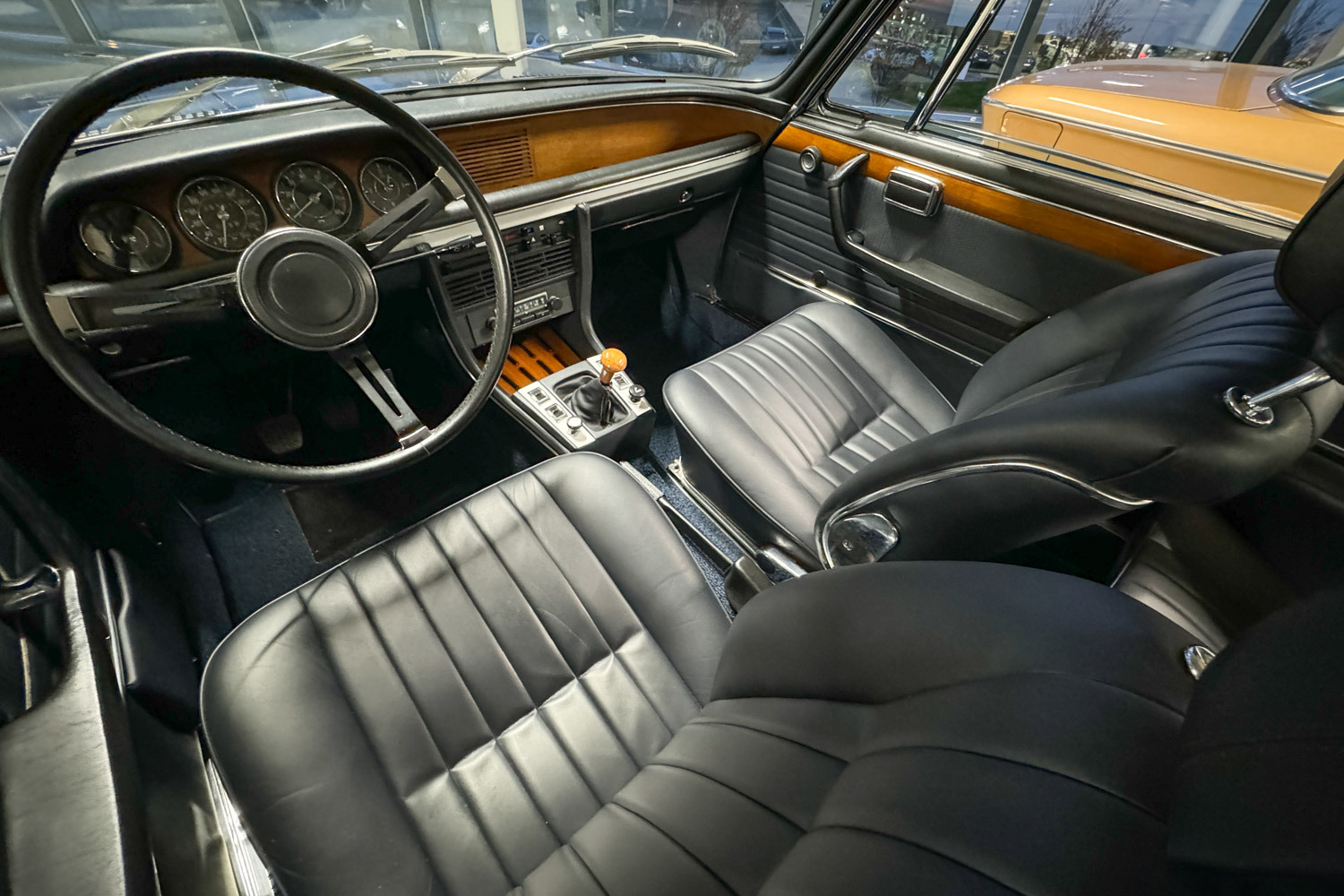
- ZF four-speed as standard, three-speed automatic optional (2800 CSA)
- Transmission 2.5 CS
- Getrag 262 four-speed as standard, three-speed automatic optional
- Transmission 3.0 CS and 3.0 CSi
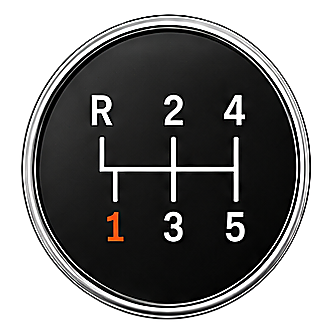
- Getrag 262 four-speed as standard, Getrag 265/5 five-speed optional, automatic optional
- Transmission 3.0 CSL
- Getrag four-speed, no automatic from the factory
- Final drive ratio 3.0 CSi
- 3.25 (39:12)
- Final drive ratio 3.0 CSL
- 3.45 for the carburetor version, 3.25 for the injected versions
- Limited-slip differential
- available with 25 or 40 percent locking value
- CSL displacements
- 2,985 cc in the first series, 3,003 cc from 1972, 3,153 cc in the final stage
- Brakes
- 2800 CS discs at the front and drums at the rear, discs on all four wheels from the 3.0 CS of 1971
- Which automatic type was fitted is disputed
- Wikipedia consistently names a ZF three-speed automatic, while the parts catalogue and buyer's guides instead list a Borg-Warner BW 65 for the 3.0 CS from May 1972.
The final drive ratios of the 2800 CS, 2.5 CS and 3.0 CS could only be verified from a single source and are therefore not included in the list. BMW Group Classic and the PressClub publish neither final drive nor gear ratios for the E9.
08 · Top models
Top models
Three variants that get their own subpage. Here are the short profiles.
3.0 CSL "Batmobile"
Homologation model with 3,153 cc, 206 hp and the full aerodynamics package. The rear wing came in the boot due to lack of road approval. Today by far the most expensive production model of the model line.
To the sub-page →
3.0 CSi
The fastest civilian version: 200 hp from three litres with Bosch D-Jetronic, disc brakes all round, full equipment. For many, the best compromise between drivability and value.
To the sub-page →
2800 CS
The beginning of the model line: 170 hp, carburetor, still drum brakes at the rear. The purest form of the Hofmeister coupé and the most affordable way to drive an E9.
To the sub-page →
09 · Special Editions & Tuners
No M model — but the CSL and Alpina
The E9 never had an M version in the later sense; BMW Motorsport GmbH was not founded until 1972 and was not yet building road cars under its own badge. The role of flagship model fell to the 3.0 CSL, which, strictly speaking, was a commissioned work: it was developed by Alpina on BMW’s behalf.
The CSL was built in three stages. Stage 1 (1971/72, 169 examples) with 2,985 cc and 180 hp, stage 2 with 3,003 cc and 200 hp, and stage 3 from 1973 with 3,153 cc, 206 hp and the aerodynamics package. In total, 1,265 CSLs were built. Sources disagree on the unit numbers for the individual stages — for stage 2, figures of 929 and 939 vehicles circulate, for stage 3, 167 and 169; even BMW’s own publications do not fully agree here. We therefore treat only the total figure as verified.
Besides Alpina, Schnitzer and Koepchen also modified the E9. These vehicles are not factory models and are only traded with verifiable history.
10 · Motorsport
Six European Championship titles and the first Art Car
The E9 is the car with which BMW restructured its works motorsport. On 1 May 1972, the company founded BMW Motorsport GmbH and brought in Jochen Neerpasch from Ford; Martin Braungart came along as an engineer. Their first major project was the 3.0 CSL — lightweight construction, aerodynamics, and an engine whose displacement was dictated by the regulations, not by the brochure.
In the European Touring Car Championship, the CSL won six drivers’ titles: Toine Hezemans in 1973, Sigi Müller and Alain Peltier in 1975, Jean Xhenceval and Pierre Dieudonné in 1976, Dieter Quester in 1977, Umberto Grano in 1978, and Martino Finotto and Carlo Facetti in 1979. Only in 1974 did BMW go without a title. On top of that came overall wins at the 12 Hours of Sebring in 1975 and the 24 Hours of Daytona in 1976 — both with US works support.
1976 saw the most extreme version yet: a turbocharged CSL for Group 5, whose 3.2-litre M49/4 engine produced around 750 hp. The German and English versions of the same BMW press release give different figures for boost pressure (1.27 bar versus 1.72 bar) — we therefore do not treat this figure as verified.
And finally, the Art Car collection begins with the E9: in 1975 Alexander Calder designed the Le Mans CSL with start number 93, followed in 1976 by Frank Stella on the Turbo CSL with number 41. Both cars retired from their races — and nonetheless became the best-known E9s of all.
The CSL didn't just win races — it created the department that has defined BMW's sporting character ever since.
11 · Buying guide
What matters: rust decides everything
With the E9, the condition of the body is not one criterion among several — it is the criterion. Mechanical parts can be sourced and repaired, sheet metal and trim parts hardly at all. A restoration regularly costs more than the finished car is worth — except in the case of the CSL.
Front wings and their mounting areas — the classic first point of attack
Sills, inside and out, and the jacking point mounts
Base of the A-pillar and the transition to the scuttle
Windscreen and rear window frames beneath the trim strip
Rear wheel arches and the corners of the boot floor
Floor pan, seat crossmember and the rear axle mounts
On the CSL, additionally the transitions between aluminium and steel panels (contact corrosion)
Check the chassis number against the claimed variant — CS, CSi and CSL differ in value by a multiple, and "CSLs" built up from CS models are a known issue. Have any restoration documented; photos of the bare body shell are worth more than any appraisal of the finished car. On injected cars, drive the D-Jetronic both warm and cold.
12 · The competition
What the E9 had to compete with
Mercedes-Benz SLC (C107)
The direct German rival from 1971: larger, heavier, more comfortable, and with a V8 instead of a straight-six. Those wanting to make an impression chose the SLC; those wanting to drive chose the CSi.
Jaguar E-Type 2+2 and XJ-C
The British answer, with more displacement and more grace, but weaker build quality. The XJ-C, from 1975, only met the E9 at the very end of its production run.
Porsche 911
Not a direct competitor in concept, but always present in the buying decision — and in racing, the benchmark BMW had to measure itself against.
Ford Capri RS 2600 / RS 3100
The real opponent on the racetrack. From the duel in the European Touring Car Championship came BMW's decision to found its own motorsport GmbH — and Neerpasch and Braungart came from exactly there.
Alfa Romeo Montreal
An emotional V8 counter-design with less everyday usability. Smaller production numbers, but moving in the same customer circle.
13 · Galerie
Bilder
14 · Sources
Belege & Literatur
Transparency is part of the product. Every figure on this page is backed by a source and cross-check. Lead sources are BMW Group Classic, the BMW PressClub and Wikipedia; everything else is only considered verified once two independent sources agree. Contradictions — CSL unit numbers per stage, turbo engine boost pressure — are marked as such.
- BMW Group Classic — model history BMW Coupé E9 (2800 CS, 3.0 CS, 3.0 CSi, 3.0 CSL)
- BMW PressClub — press kits on 50 years of BMW Motorsport GmbH and on the 3.0 CSL
- BMW PressClub — BMW Art Car Collection, Alexander Calder (1975) and Frank Stella (1976)
- Wikipedia (DE) — BMW E9
- Wikipedia (EN) — BMW New Six CS (E9)
- Wikipedia — European Touring Car Championship, title list 1973–1979
- AUTO BILD KLASSIK — Classic Data market valuation 2026 (3.0 CS and 3.0 CSL, condition 2)
- RM Sotheby's — auction result BMW 3.0 CSL, Munich 2022
- Bonhams — auction result BMW 3.0 CSL, 2024
- Walloth & Nesch — parts catalogue BMW E9, sections manual transmission, automatic transmission and rear axle
- Classic & Sports Car — Buyer's guide BMW E9 coupés