

01 · Overview
The driver's Sedan
The E38 is the Seven that deliberately did not want to be the largest car in its class. The Mercedes S-Class W140 had arrived in 1991 as the technical maximum and had publicly drawn criticism for its size, weight and price. BMW countered: same segment, but leaner, lighter, more dynamic to drive and more restrained in appearance.
That did not mean it lacked technology. The E38 was the first European production car with satellite navigation, one of the first cars ever with head airbags, and the first BMW with a built-in television. It brought diesel into the luxury class — first in 1996 with the 725tds, then in 1998 with the common-rail 730d, and in 1999 with the V8 diesel of the 740d. And it remained available with a manual gearbox right to the end; the successor E65 came only with automatic transmission.
In production numbers it did not win the comparison with the S-Class — 327,598 against 432,732 for the W140. But it shifted the question of whether a luxury Sedan must necessarily be the largest car.
There was no factory motorsport programme with the E38 — a Sedan of nearly two tonnes is not a racing car, and BMW never tried to make it one. The most famous appearance therefore took place at the cinema. In Tomorrow Never Dies from 1997, Pierce Brosnan drives a car listed in the film as a 750iL — in fact it was a 740iL, relabelled accordingly; BMW Group Classic states this itself. Sixteen vehicles were converted for filming so they could be controlled from the back seat. The famous remote control via mobile phone is thus a film trick with a hidden driver in the rear, not production technology — just like the rockets behind the sunroof and the tyre cutters. What was production technology, on the other hand, was exactly what made the car credible in the film: navigation, onboard telephone and the screen in the centre console.
02 · History
Seven years in seven dates
From the replacement of the E32 to the Bangle successor.
- 1994 In summer the E38 replaces the E32; the predecessor's design is carried forward only cautiously. At launch two V8s from the M60 series are available: the 730i with 218 PS and the 740i with 286 PS.
- 1994 In autumn the flagship model 750i follows with the 5.4-litre V12 M73, 326 PS and, for the first time, a five-speed automatic instead of the E32's four speeds. Launch price: 148,000 Mark.
- 1996 With the 725tds, BMW offers a diesel in the luxury class for the first time, 143 PS from the six-cylinder M51. At the same time the M62 replaces the M60: the 730i becomes the 735i, the 740i grows to 4.4 litres — with unchanged 286 PS and unchanged name.
- 1998 From September the revised version runs: clear-glass headlights and tail lights, altered kidney grille struts, continuous side sills, chrome strip on the tailgate. Technically, VANOS arrives for the M52 and M62, along with DSC III and head airbags as standard.
- 1998 At the same time the 730d appears with the new common-rail six-cylinder M57 from Steyr, 184 PS. With over 12,000 units it becomes the best-selling diesel model of the series.
- 1999 In May the 740d follows with the biturbo V8 diesel M67, BMW's first eight-cylinder diesel. 560 Nm are available from 1,750 rpm, top speed is 242 km/h.
- 2001 On 27 July production ends in Dingolfing. In September BMW presents the E65 at the IAA — with new design, iDrive and no manual gearbox.
03 · Model overview
All engine variants
Six, eight and twelve cylinders, petrol and diesel. The switch from the M60 to the M62 in early 1996 is the most important break in the table: the 730i became the 735i, and the 740i grew to 4.4 litres without the name or output changing.
Source: factory and literature data · verified
Technische Daten anzeigen — komplette Modellmatrix
| Modell | Motor | Hubraum | Leistung | Bauzeit |
|---|---|---|---|---|
| 728i / 728iL | M52B28 / M52TÜB28 | 2.793 cm³ | 193 PS (142 kW) | 1995–2001 |
| 730i / 730iL | M60B30 · V8 | 2.997 cm³ | 218 PS (160 kW) | 1994–1996 |
| 735i / 735iL | M62B35 · V8 | 3.498 cm³ | 235 PS (173 kW) | 1996–1998 |
| 735i / 735iL | M62TÜB35 · V8 | 3.498 cm³ | 238 PS (175 kW) | 1998–2001 |
| 740i / 740iL | M60B40 · V8 | 3.982 cm³ | 286 PS (210 kW) | 1994–1996 |
| 740i / 740iL | M62B44 / M62TÜB44 · V8 | 4.398 cm³ | 286 PS (210 kW) | 1996–2001 |
| 750i / 750iL | M73B54 / M73TÜB54 · V12 | 5.379 cm³ | 326 PS (240 kW) | 1994–2001 |
| L7 | M73 · V12 | 5.379 cm³ | 326 PS (240 kW) | 1997–2001 |
| 725tds | M51D25TÜ · in-line six-cylinder | 2.498 cm³ | 143 PS (105 kW) | 1996–2000 |
| 730d / 730dL | M57D30 · common rail | 2.926 cm³ | 184 PS (135 kW) | 1998–2000 |
| 730d / 730dL | M57D30 · common rail | 2.926 cm³ | 193 PS (142 kW) | 2000–2001 |
| 740d / 740dL | M67 · V8 biturbo | 3.901 cm³ | 238 PS (175 kW) according to BMW, 245 PS (180 kW) according to other sources | 1999–2001 |
04 · Body variants
Body variants
Sedan

Wheelbase 2,930 mm at 4,984 mm overall length, the only body style offered throughout the entire production run and with all engines. In Germany clearly the more frequent choice; the long version sold mainly with the large eight-cylinders and the V12.
Long version iL

Exactly 140 millimetres longer, the increase lies entirely in the wheelbase and thus in the rear. BMW Group Classic puts the surcharge for the 740iL at around 15,000 Mark. The extension was not an end in itself for design but was meant to close the gap to the Mercedes S-Class, which as a long version had set the standard for chauffeur-driven cars for years.
L7
Based on the 750iL, stretched a further 250 millimetres behind the B-pillar — around 5.40 metres overall length. Built from March 1997 to July 2001 at a price of 246,000 Mark, with electrically adjustable rear seats, refrigerator, television and video player; BMW fulfilled special requests down to a fax machine in the glovebox. The commonly cited figure of 899 units traces back to a single original source; BMW Group Classic speaks only of small production numbers.
Sonderschutz
From 1999, based on the 740iL and 750iL, the Protection Line with aramid fibre armouring, protective glazing and run-flat tyres, additional weight around 145 kilograms. Above it stood the 750iL S with protection class B6/7 and around 950 kilograms additional weight: detonating cord in the windscreen, hydraulically operated windows, gas sensor, fire extinguishing system, breathing air supply. A coupé, however, never existed — the two-door luxury segment was occupied until 1999 by the E31, with which the E38 even shared the V12.
05 · Engines
From six-cylinder to V12
The E38 had the widest range of engines ever fitted in a 7 Series — and with the M60 also the Nikasil story on its programme.
M52 and M52TÜ — the six-cylinder in the 728i verified
The 2.8-litre in-line six-cylinder from the 3 Series and 5 Series was the entry-level unit from September 1995. 193 PS in a Sedan of around 1.8 tonnes is enough for 227 km/h, but not for a sense of authority. For the 1998 facelift the TÜ version arrived with double VANOS, unchanged at 193 PS. The engine is regarded as the most durable in the E38 line-up — and the only one for which Nikasil was never an issue.
M60 — the V8 at market launch and the Nikasil question verified
At market launch in 1994 the E38 did not have the M62 but the older M60: the 730i with 2,997 cm³ and 218 PS, the 740i with 3,982 cm³ and 286 PS. This is precisely the engine that carries the Nikasil story. Its cylinder bores were coated with a nickel-silicon dispersion layer, and nickel reacts sensitively to sulphur-containing combustion gases. In the USA, the UK and South America, where the sulphur content in petrol was several hundred ppm, compression loss and engine damage occurred; on the German market the problem barely appeared. The M60 in the E38 ended in early 1996.
M62 and M62TÜ — the V8 from 1996 verified
From early 1996 the M62 replaced the M60. The 730i became the 735i with 3,498 cm³ and 235 PS, the 740i grew to 4,398 cm³ — with unchanged 286 PS and unchanged name. For the 1998 facelift the TÜ variants followed with VANOS for the intake camshaft, an electronic accelerator pedal and Motronic ME7.2; the 735i rose to 238 PS. The M62 uses predominantly Alusil; the English Wikipedia states that some early examples still had Nikasil, though no changeover date can be verified.
M73 — the V12 verified
The 5.4-litre V12 with 326 PS at 5,000 rpm and 490 Nm was the technical flagship and ran from 1994 to 2001. It has only two valves per cylinder — conservative by BMW standards — and operates with two separate engine control units, one per cylinder bank. The crankcase is made of Alusil, so the Nikasil question does not arise here. From model year 1999 the 750i received an electrically heated catalytic converter to meet emissions standards without any change in output.
M51 and M57 — the six-cylinder diesels verified
The M51 in the 725tds was a swirl-chamber turbodiesel with intercooler, 143 PS and 280 Nm at 2,200 rpm. In a two-tonne Sedan that was too little, and the 725tds remained a niche model. Its successor, the M57, built in Steyr from July 1998, was BMW's first common-rail direct injection engine: 184 PS, 193 PS from March 2000, turbocharger with variable turbine geometry. The 730d reached over 12,000 units and made diesel socially acceptable in the luxury class.
M67 — the V8 diesel in the 740d verified
The M67 was BMW's first eight-cylinder diesel engine: 3,901 cm³, biturbo with variable turbine geometry, common rail, four valves per cylinder, cast-iron crankcase. 560 Nm are available as early as 1,750 rpm, and the top speed of 242 km/h was only just below the petrol models' regulated limit — with considerably lower fuel consumption. It was named International Engine of the Year in 1999 and 2000. The output figure is disputed: BMW Group Classic states 238 PS, several other sources 245 PS.
06 · Weak points
Reliability & weak points
- The coolant hoses become porous and can burst. Anyone who continues driving risks overheating and, in the worst case, new cylinder head gaskets — a classic issue on all V8 models.
- The rear axle frequently shows excessive play and is the most common finding at the German MOT-equivalent inspection. Worn-out axle bearings are repairable but, on a car of this mass, a recurring issue.
- Pixel defects in the on-board monitor and instrument cluster, wing mirrors going blind, failing actuator motors for seats, sunroof and tailgate. The E38 was one of the most electronically complex cars of its time — and that takes its toll today.
- The front axle suffers under the weight of the eight- and twelve-cylinder engines. Control arms, ball joints and strut mounts are wear parts with a limited service life.
- Nikasil affects the M60 in the 730i and 740i of the 1994 to 1996 model years. Damage occurred almost exclusively in markets with high-sulphur petrol — for cars imported from the USA or UK, a compression test is mandatory.
- Kerb weights from 1,775 kilograms for the 728i to over two tonnes for the 740d cause high brake wear. This is not a defect, but the most common reason these cars eventually come to a stop.
07 · Engineering
Chassis, brakes, steering, gearbox
Fahrwerk
Bremsen
Lenkung
Getriebe
Technical data — final drive ratios & gearboxes
- Drive type
- rear-wheel drive, no all-wheel drive in the range
- Manual gearbox 725tds, 728i, 730i and 735i
- five-speed gearbox
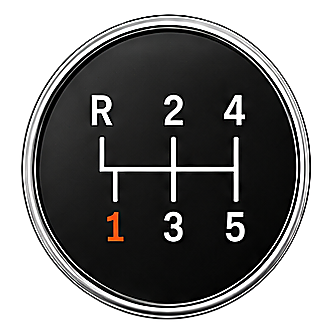
- Manual gearbox 740i
- six-speed gearbox Getrag 420G
- Automatic all models
- five-speed torque-converter automatic from ZF
- Gear ratios Getrag 420G
- 4.227 / 2.528 / 1.669 / 1.226 / 1.000 / 0.828, reverse gear 3.746
- Wheelbase Sedan
- 2,930 mm
- Wheelbase long version iL
- 3,070 mm, i.e. 140 mm more
- Length Sedan
- 4,984 mm
- Length L7
- around 5.40 m, wheelbase around 3,320 mm
- Successor E65
- exclusively six-speed automatic, no manual gearbox anymore
- Sources disagree on the manual gearbox of the 740i
- Wikipedia in both languages states six gears, one vehicle database states five. The list follows the majority.
Axle ratios could not be verified for any E38 variant from two mutually independent sources and are therefore not included in the list. BMW Group Classic and the PressClub do not publish axle data for this model line.
The assignment of the individual ZF series (5HP18, 5HP19, 5HP24, 5HP30) to the engine variants is contradictory between the available sources. What can be confirmed is only that all automatic variants were five-speed torque-converter automatics from ZF.
08 · Top models
Top models
Three models on which the model line can be defined — and the L7 as an exceptional case.
740d
From May 1999 the technically boldest model: BMW's first eight-cylinder diesel, 3.9 litres, two turbochargers with variable turbine geometry, common rail. 560 Nm from 1,750 rpm pushed the Sedan to 242 km/h — practically matching the petrol models' level with considerably lower fuel consumption. Named International Engine of the Year twice in a row. On output, BMW states 238 PS, other sources 245.
To the sub-page →
740i
With around 130,000 units, the most successful model in the series. Until early 1996 with the 4.0-litre M60, thereafter with the 4.4-litre M62 — with unchanged 286 PS and unchanged type designation. The 740i was the only E38 model with a six-speed manual gearbox and thus the car that established the E38's reputation as a driver's Sedan. Today the best compromise of performance, spare parts availability and running costs.
To the sub-page →
750i and 750iL
The 5.4-litre V12 with 326 PS was the statement against the Mercedes S 600. For the first time in the 7 Series with a five-speed automatic instead of four gears, electronically limited to 250 km/h. BMW Group Classic puts the short version at over 9,000 and the long version at nearly 17,000 units. Anyone buying one today is buying two engine control units, two catalytic converter systems and the corresponding maintenance effort.
To the sub-page →
09 · Buying guide
What matters: history, condition, then the engine
The E38 is the 7 Series where the purchase price is the smallest problem. Good vehicles start in the low five-figure range; running costs, independent of that, sit at the level a two-tonne car with a V8 and two dozen control units simply demands. Anyone who cuts corners here pays twice.
Cooling system — check hoses, expansion tank, thermostat and water pump for age and porosity; traces of overheating in the service book are a disqualifying factor on the V8s
Rear and front axle — check axle bearings, control arms, ball joints and strut mounts for play; excessive play at the rear is the most common inspection finding for this model line
Electronics functional test — cycle through every seat adjustment, sunroof, tailgate, on-board monitor, instrument cluster, automatic climate control and wing mirrors individually
Engine code and origin — for the 730i and 740i of 1994 to 1996, establish whether an M60 is fitted; for imports from the USA and UK, measure compression
Gearbox under load — run the automatic through all gears when warm; on the rare manual, check clutch and shiftability
Water drainage channels — check air conditioning and sunroof drains; blocked drains destroy the control units in the footwell and under the seats over the years
The order is clear: first history, then condition, then engine, then equipment. A car with a complete service history but the wrong engine is always the better choice than a cheap 750iL without papers. A good entry point is the 728i, considered the most durable and cheapest to run, without taking anything away from the car’s presence — even if 193 PS is on the modest side for this class. The sensible compromise is the 735i or the 740i with the M62, because here output, spare parts supply and repair experience come together best; models from the September 1998 facelift additionally have DSC III and head airbags as standard. The 730d is the everyday diesel and, with over 12,000 units built, well supplied with parts. The 740d remains a collector’s item: a fascinating engine, but built in small numbers and correspondingly difficult when it comes to special parts. The 750i and the L7 are collector’s vehicles, where every euro saved on purchase comes back doubled later. Buying the cheapest offer in any engine variant is generally inadvisable, because deferred maintenance backlog regularly exceeds the purchase price.
10 · The competition
The competition
Mercedes-Benz S-Class W140 and W220
The W140, from 1991 to 1998, was the benchmark against which BMW positioned the E38 — and at the same time its counter-design: larger, heavier, technically maximal, with Mercedes' first V12 passenger car engine in the S 600. With 432,732 units it remained clearly ahead of the E38 in production numbers, but drew public criticism for its size and price. Its successor, the W220, arrived in 1998 and was the first S-Class with optional all-wheel drive — a field the E38 never entered.
Audi A8 D2
Launched in mid-1994 at the same time as the E38, taking on the luxury class with two arguments BMW did not have: a space frame built entirely from aluminium and quattro all-wheel drive, standard on the V8s. With 105,092 units built it remained far behind the E38, but it was what first established Audi permanently in this segment.
Jaguar XJ (X308)
Built from July 1997 to December 2002, the first Jaguar Sedan with a V8 — the AJ-V8 with 3.2 and 4.0 litres, supercharged with 370 PS in the XJR. 126,260 vehicles in just over five years. It competed on tradition and cabin atmosphere, but technically with a body structure that was, at its core, considerably older — the counterpoint to the engineering-driven approach from Munich and Ingolstadt.
11 · Galerie
Bilder
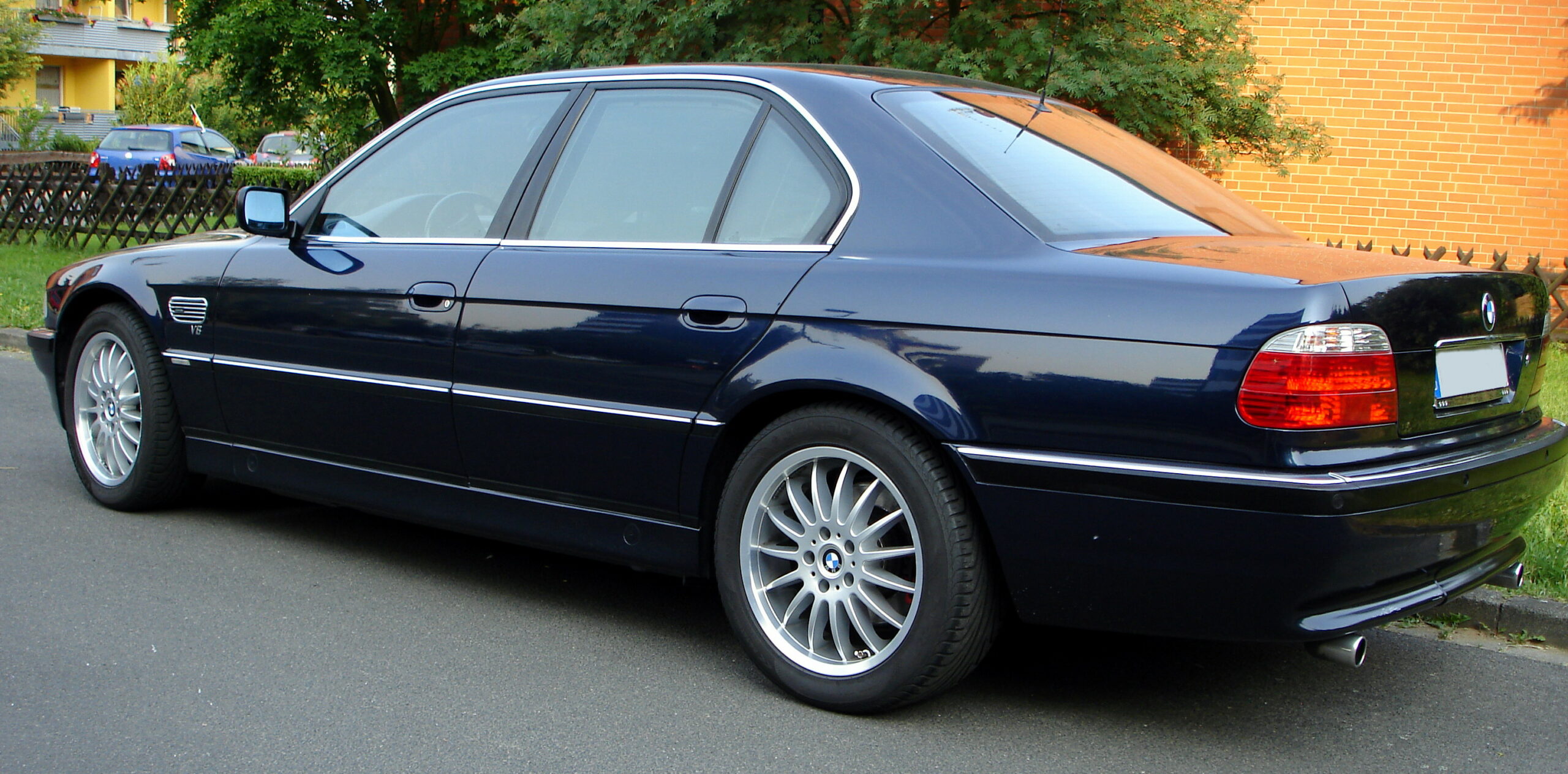
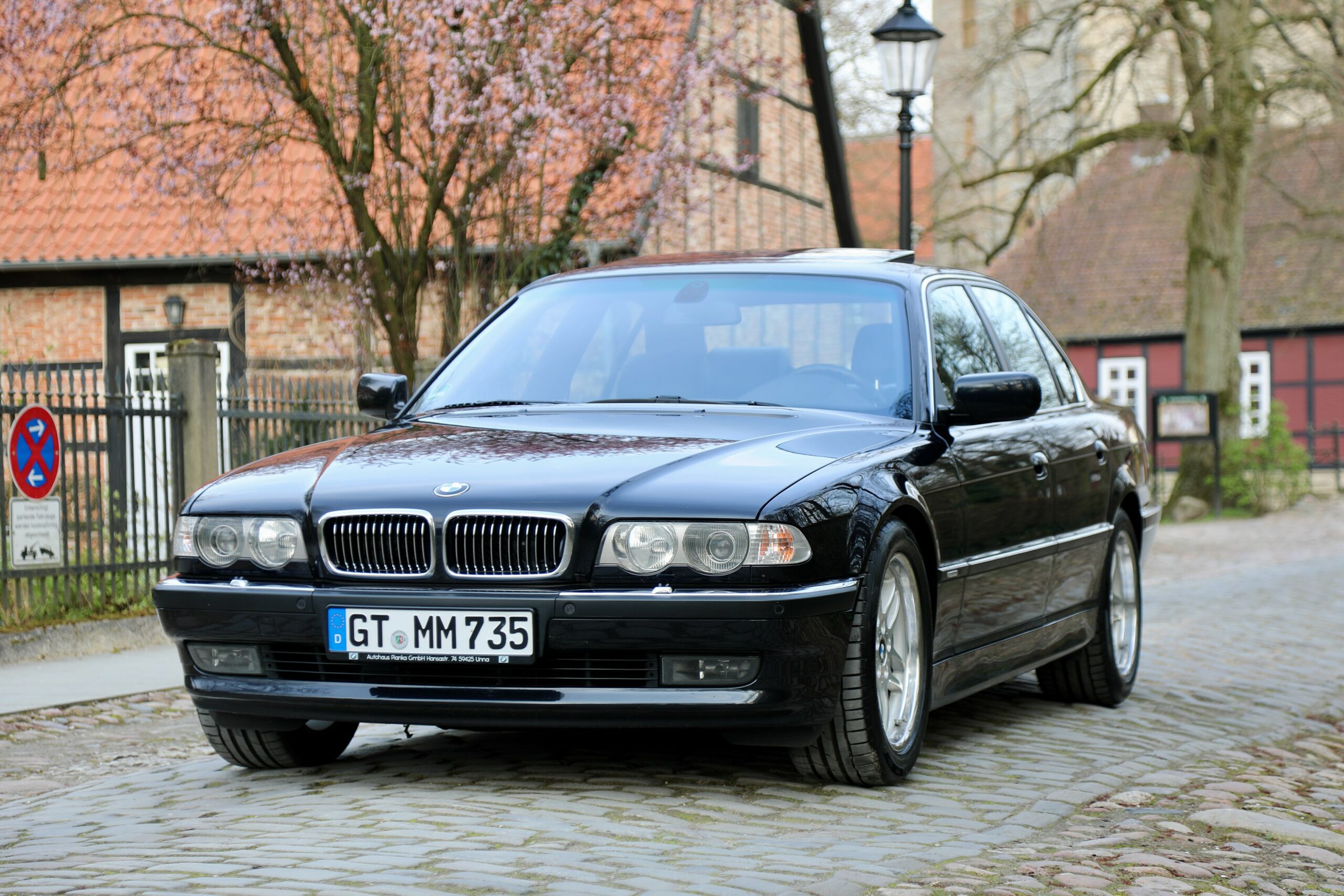
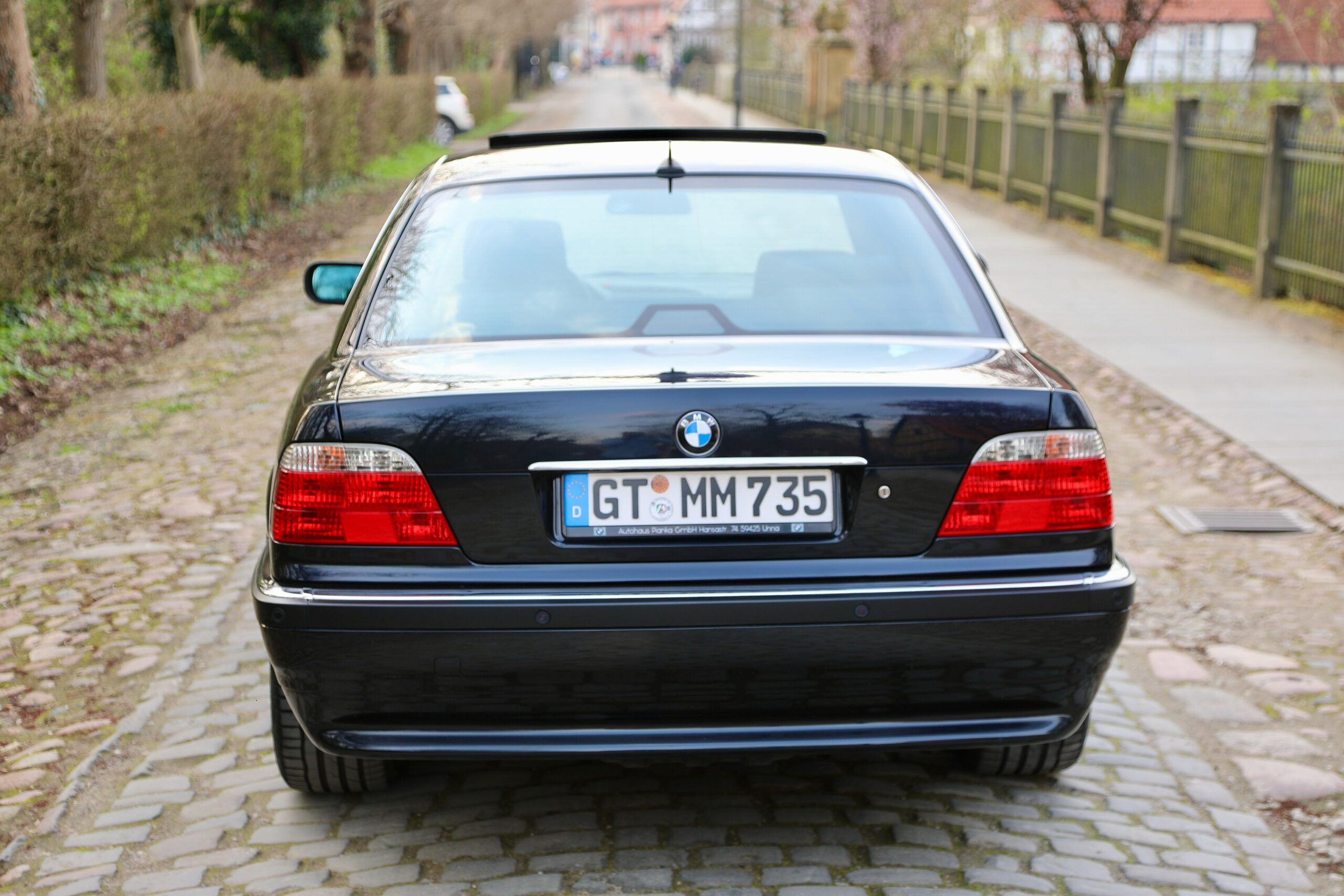
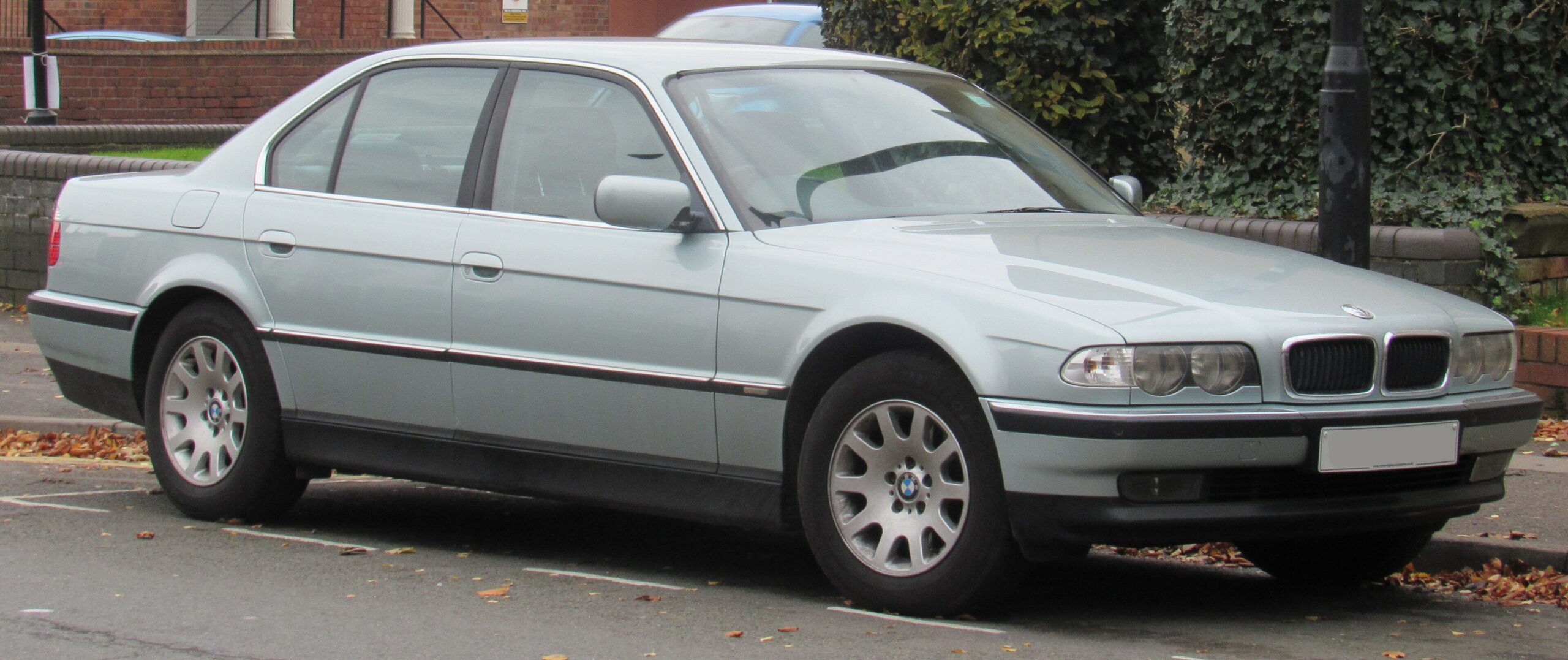
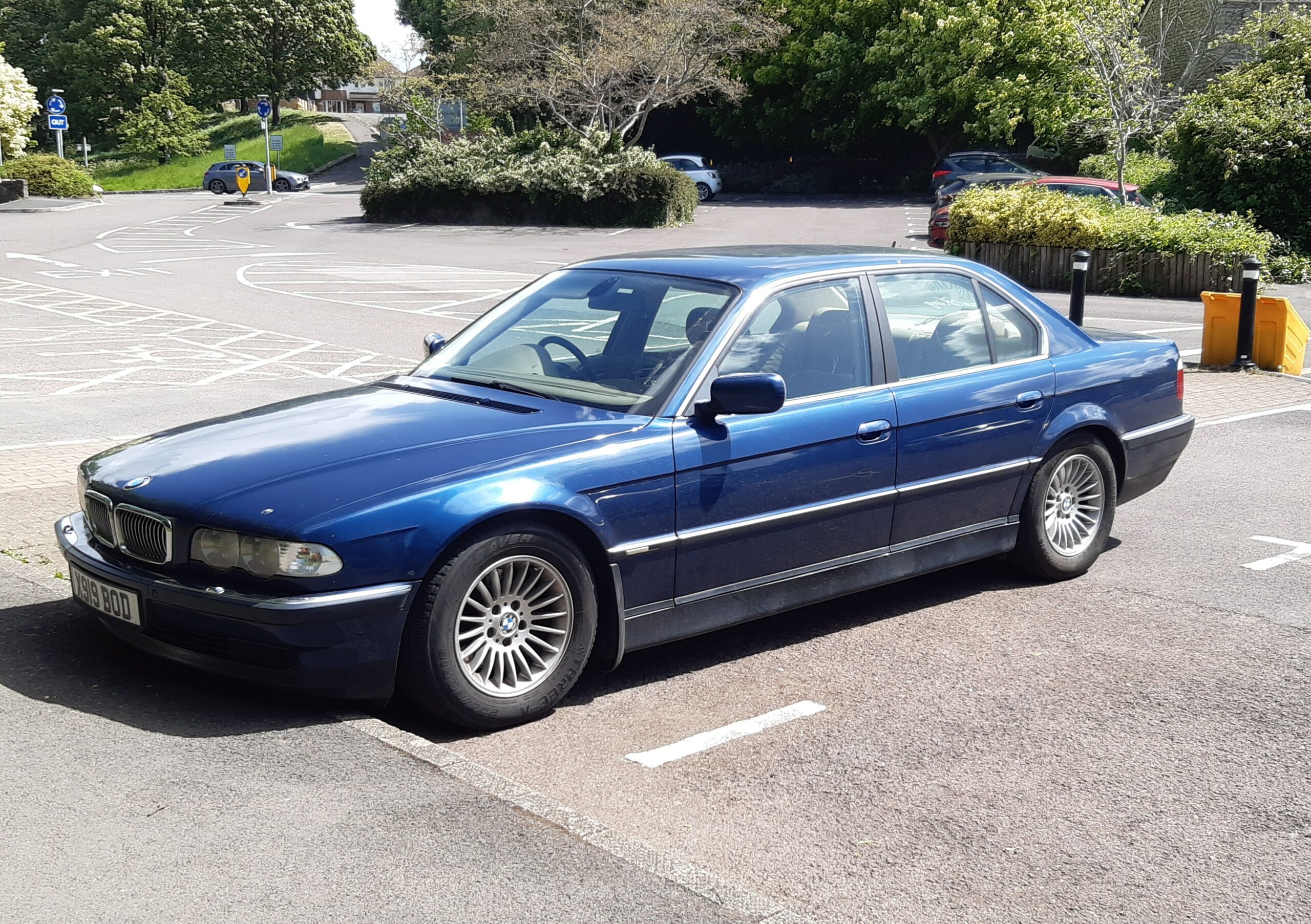
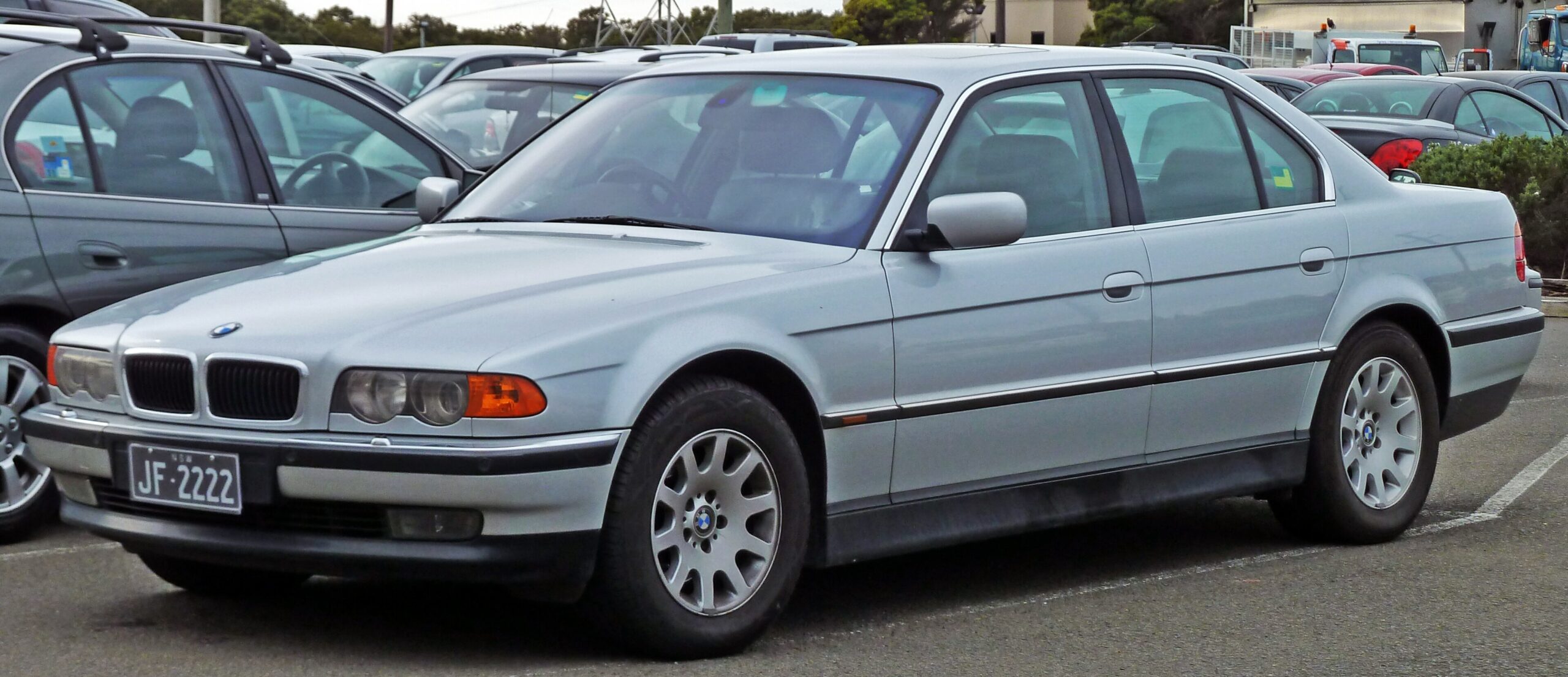
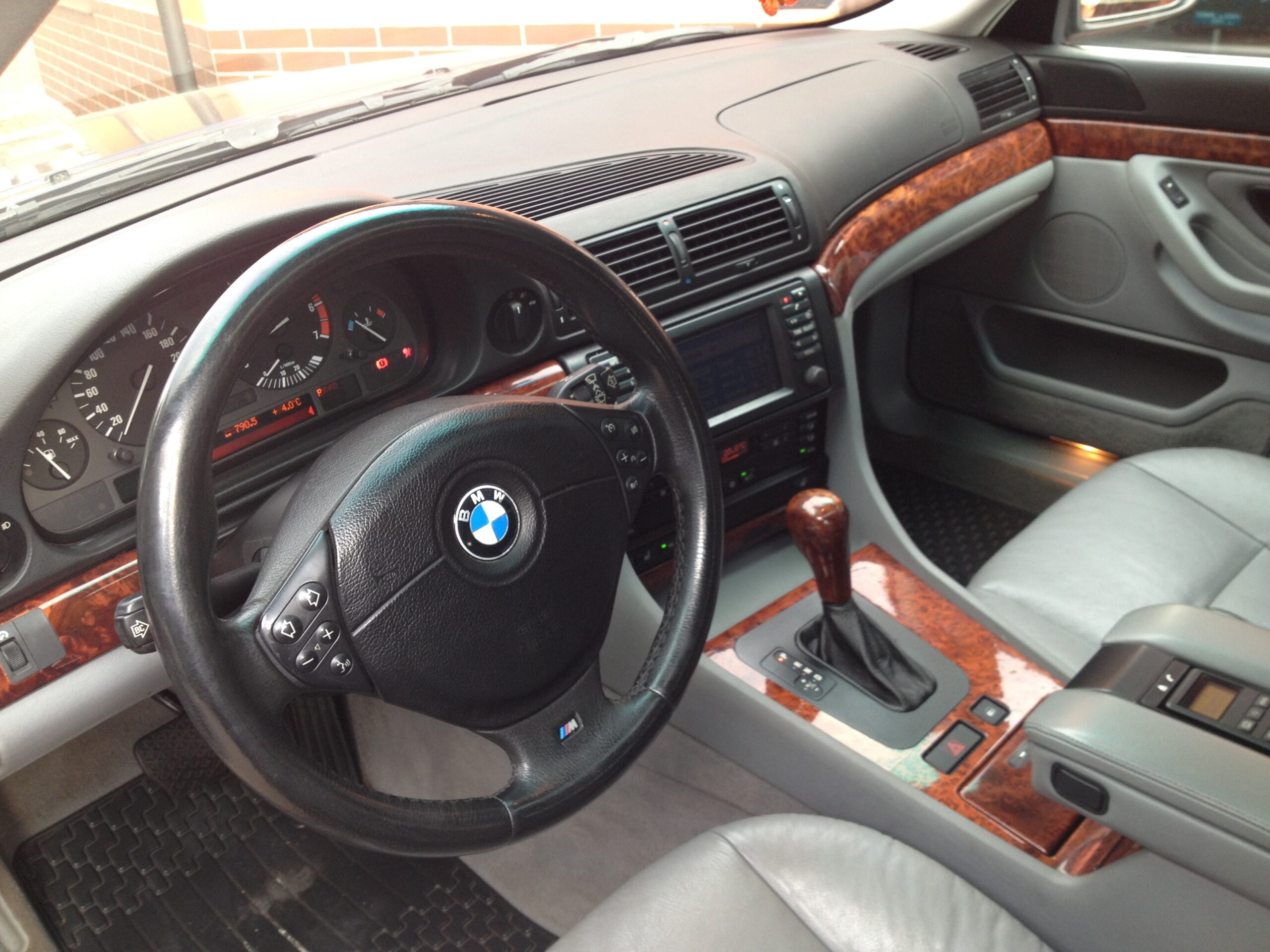
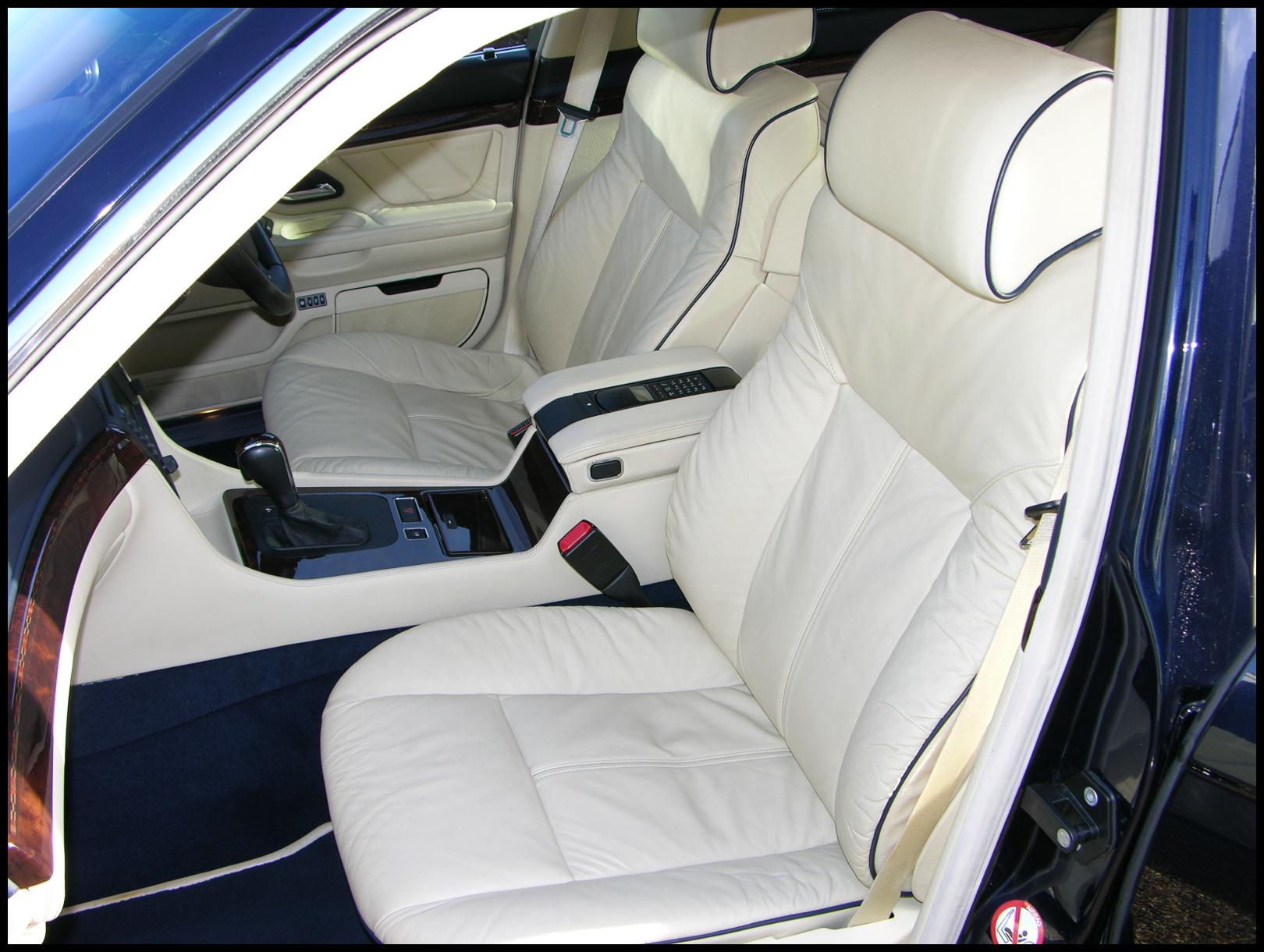
Sedan before and after the facelift, plus the cockpit, on-board monitor and the rear of the long version.

Other BMW 7er generations
4 model lines with an E-number, from 1977 to 2008.


12 · Sources
Belege & Literatur
Primary sources are BMW Group Classic, the BMW PressClub and Wikipedia; everything else is considered verified only once two independent sources agree. Several points remain open: the total production figure (327,598 according to BMW Group Classic and the German Wikipedia versus 340,242 according to the English Wikipedia), the output of the 740d (238 versus 245 PS), its engine code (M67D39 versus M67D40) and the question of the date from which BMW switched from Nikasil to Alusil on the V8. It is not claimed here that the 740d was the first V8 diesel in a production Sedan ever — what can be verified is only that it was BMW's first V8 diesel.
- BMW Group Classic — BMW 7 Series model line (E38)
- BMW Group Classic — BMW 740i (E38)
- BMW Group Classic — BMW 750i and 750iL (E38)
- BMW Group Classic — BMW 740d (E38)
- BMW Group Classic — BMW 730d (E38)
- BMW Group Classic — BMW L7 (E38)
- Wikipedia (DE) — BMW E38
- Wikipedia (EN) — BMW 7 Series (E38)
- Wikipedia (DE) — BMW M60, M62, M73, M51, M57 and M67
- Wikipedia (EN) — Getrag 420G and ZF 5HP
- AUTO BILD — used car test BMW 7 Series (1994–2001)
- AUTO BILD KLASSIK — BMW 7 Series (E38): why the luxury Sedan is becoming a classic
- VAU-MAX — BMW 7 Series of the E38 generation
- Wikipedia (EN) — Mercedes-Benz W140, Audi A8 D2 and Jaguar XJ (X308)