

01 · Overview
New car, old cell
In April 1981 the first E28 rolled off the line in Dingolfing, and in September it stood at the IAA. Anyone who put it next to the E12 saw an old acquaintance — and was not entirely wrong technically. The passenger cell remained largely unchanged: floorpan, roof structure and doors are at their core derived from the predecessor. The directive for similarity came from company management; Claus Luthe could only influence details of the exterior.
Everything else was new. BMW developed the nose and tail completely from scratch — the cD figure fell from 0.45 to 0.39, and lift at both axles dropped by twenty-one percent each. Thanks to computer-aided design and better materials, the E28 became 60 to 90 kilograms lighter than the E12, depending on the model. Inside, it was the first 5 Series with a cockpit angled towards the driver, plus the computer-controlled service interval display and the world’s first direct fuel consumption display.
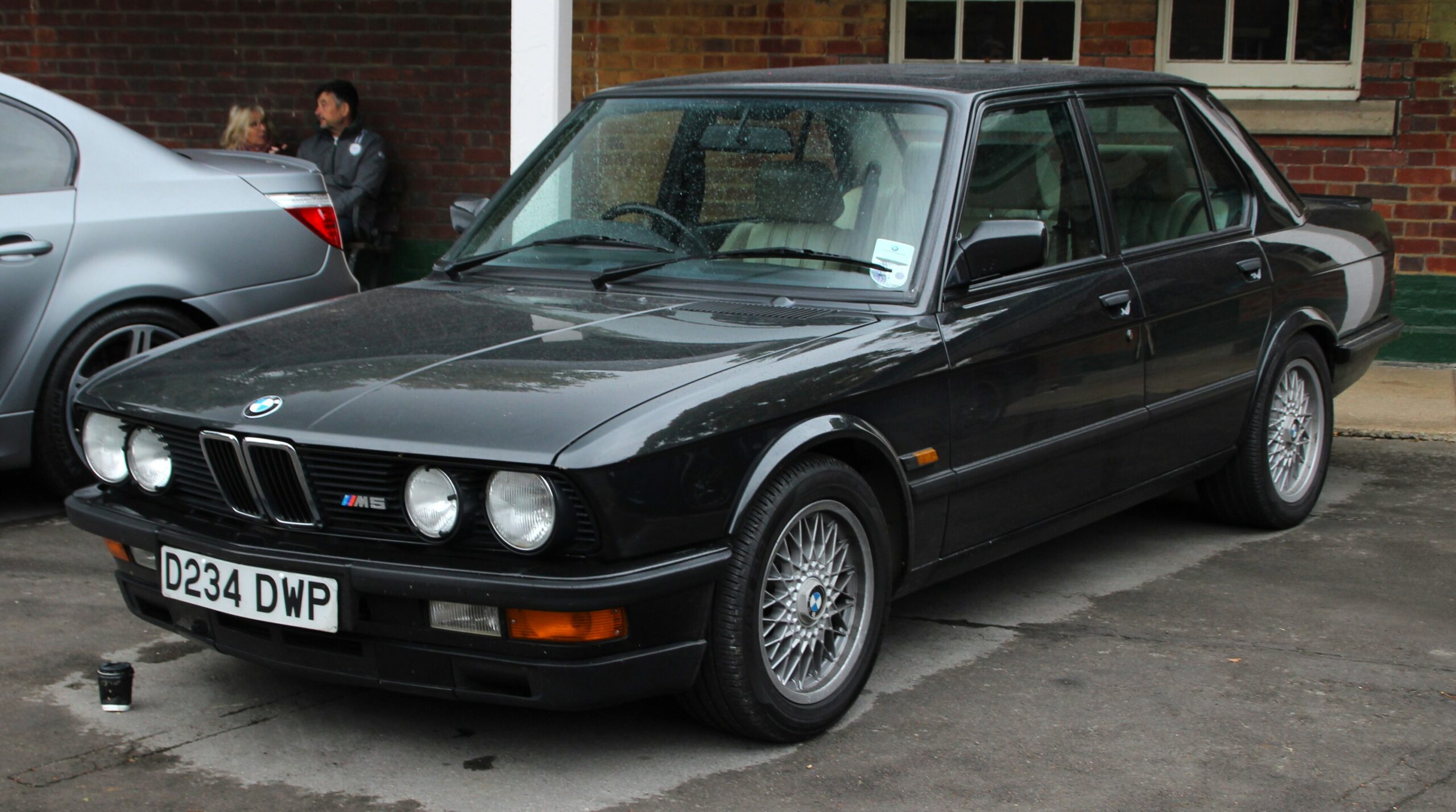
Two models still make the series special today. The 524td of 1982 was BMW’s first ever diesel car and, at 180 km/h, the fastest series-production diesel sedan in the world. And the M5 of 1985 was the first of its name: an inconspicuous four-door with the four-valve engine from the M1, 286 PS, hand-built in Garching, 2,241 times.
02 · History
Seven years in ten steps
From the start of series production in April 1981 to the end of production in December 1987 — in South Africa it continued until 1989.
- 1981 In April, series production starts in Dingolfing, followed by the press launch in June.
- 1981 Public premiere in September at the IAA in Frankfurt. At the same show, BMW announces the 524td — the brand's first diesel car.
- 1981 From autumn, ABS is available as an option for the 525i and 528i. At the same time, the 528e launches in the USA and Japan with the new eta concept.
- 1982 In November, the 524td enters production, preceded by 100 pre-series vehicles. With 115 PS and 180 km/h, it is the fastest series-production diesel sedan in the world.
- 1982 Umberto Grano and Helmut Kelleners win the European Touring Car Championship with the Eggenberger-built 528i — in the first year of the new Group A regulations.
- 1983 In March, the 525e arrives in Europe: 2,693 cm³, 125 PS at just 4,250 rpm, 240 Nm — large displacement, low revs, nine percent less consumption than the 520i.
- 1984 In autumn, the facelift: newly designed front apron, cD from 0.39 to 0.37, revised wheel trims, reworked interior. The 518i replaces the carburettor 518, and the 535i extends the range upward.
- 1984 In October, hand-assembly of the M5 begins in Garching with the M88/3 from the BMW M1.
- 1985 In February, the M5 has its public premiere at the Amsterdam motor show, and the M535i launches in March. From mid-year, the driver's airbag is available for 2,310 Mark, along with models fitted with a three-way catalytic converter.
- 1987 In September 1986, the naturally aspirated 524d had already arrived, and in November US production of the M5 began. Production ends in December 1987, followed by the E34 in January 1988. In South Africa, the E28 continues until 1989.
03 · Model overview
From the 518 to the M5
Factory figures for Europe. One peculiarity that is often stated incorrectly even in specialist articles: the 525i and 528i use the <strong>large M30</strong>, not the M20. Only the 518/518i (M10), 520i and 525e (M20) sit below it. North America had its own range with the 528e, 533i and the S38-powered M5.
Source: factory and literature data · verified
Technische Daten anzeigen — komplette Modellmatrix
| Modell | Motor | Hubraum | Leistung | Bauzeit |
|---|---|---|---|---|
| 518 | M10 B18 · carburettor | 1.766 cm³ | 90 PS (66 kW) | 04/1981–09/1984 |
| 518i | M10 B18 · fuel injection | 1.766 cm³ | 105 PS (77 kW) | from autumn 1984–12/1987 |
| 520i | M20 B20 | 1.990 cm³ | 125 PS (92 kW) | 04/1981–1987 |
| 525e | M20 B27 · eta | 2.693 cm³ | 125 PS (92 kW) | 03/1983–12/1987 |
| 525i | M30 B25 | 2.494 cm³ | 150 PS (110 kW) | 04/1981–12/1987 |
| 528i | M30 B28 | 2.788 cm³ | 184 PS (135 kW) | 04/1981–12/1987 |
| 535i | M30 B34 | 3.430 cm³ | 218 PS (160 kW) | 1984–12/1987 |
| M535i | M30 B34 | 3.430 cm³ | 218 PS (160 kW) | 03/1985–12/1987 |
| 535i · M535i with catalytic converter | M30 B34 | 3.430 cm³ | 136 kW | ab 1985 |
| 524d | M21 D24 · naturally aspirated diesel | 2.443 cm³ | 86 PS (63 kW) | 09/1986–12/1987 |
| 524td | M21 D24 · turbodiesel | 2.443 cm³ | 115 PS (85 kW) | 11/1982–12/1987 |
| M5 | M88/3 | 3.453 cm³ | 286 PS (210 kW) | 02/1985–12/1987 |
| 528e (North America) | M20 B27 · eta | 2.693 cm³ | 121 PS (90 kW) | 09/1981–06/1988 |
| 533i (North America) | M30 B32 | 3.210 cm³ | 183 PS (135 kW) | 09/1982–1984 |
| M5 (North America) | S38 B35 | 3.453 cm³ | 191 kW | model year 1988 |
04 · Body variants
Body variants
Sedan (E28)

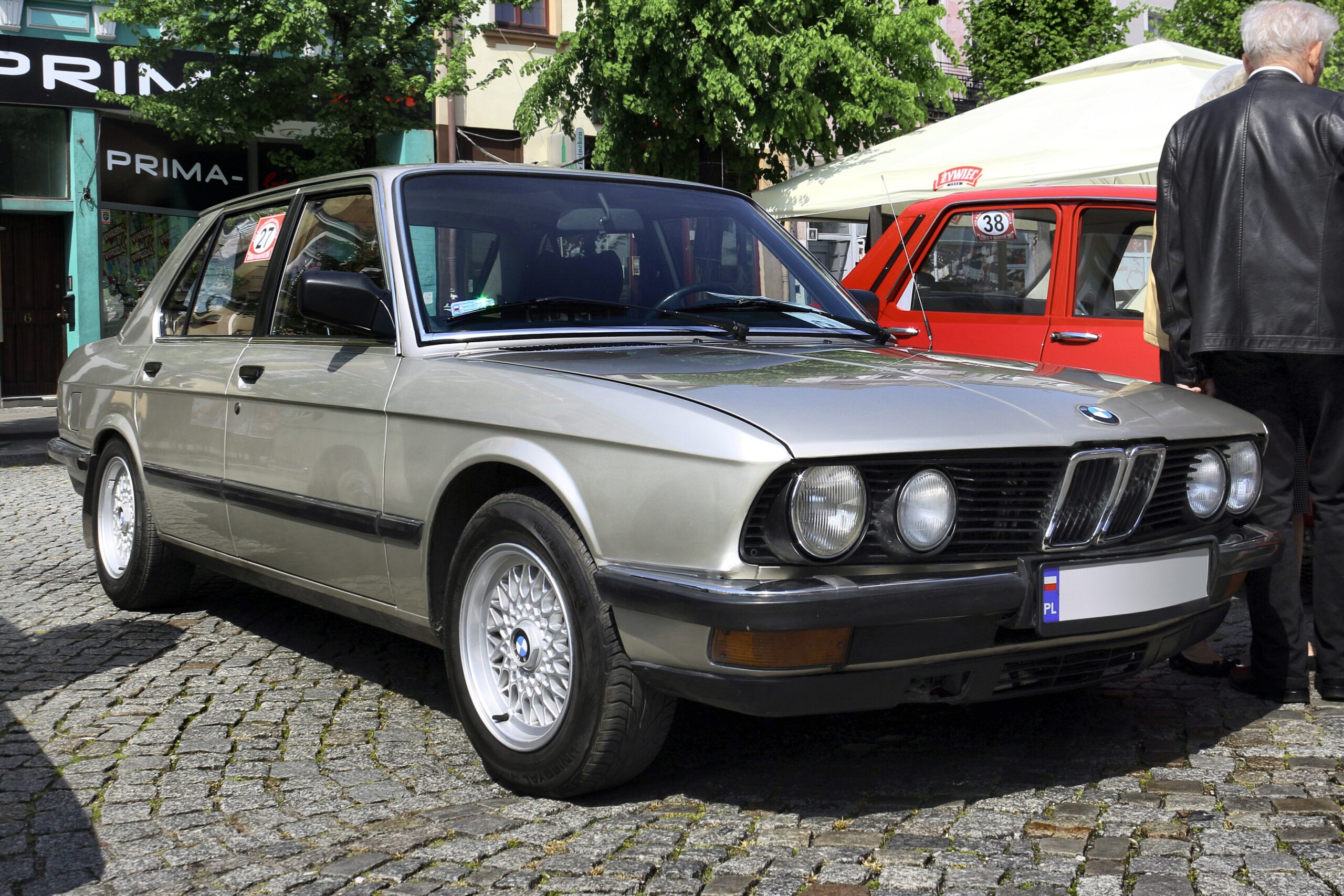
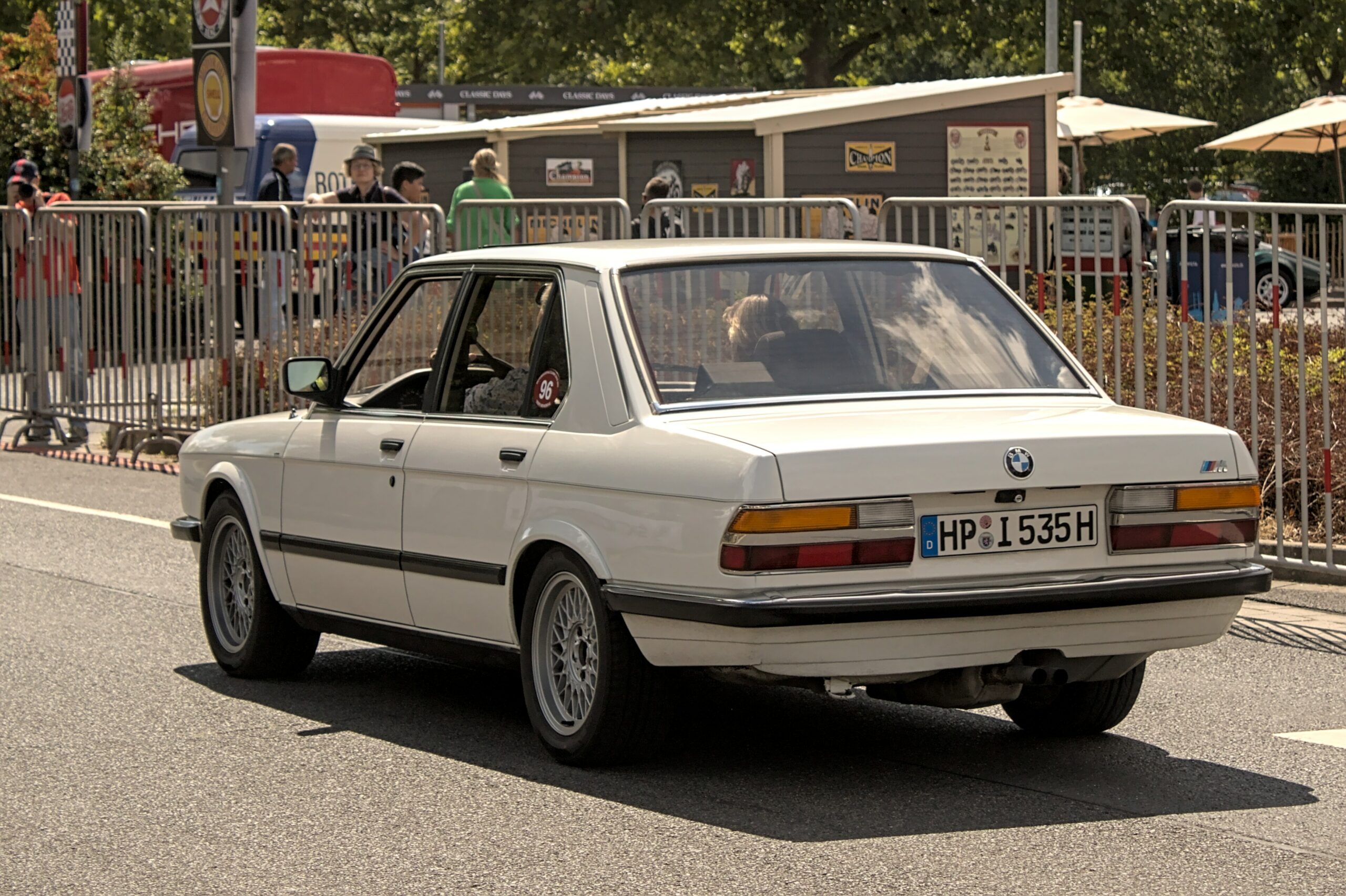
The series' only factory body — no Touring, no Coupé, no Convertible. 4,620 mm long, 1,700 mm wide, 1,415 mm high, 2,625 mm wheelbase, 460 litres of boot space. From the factory with 14-inch wheels or the 390 mm metric rims for Michelin TRX tyres, and 16 inch on the M5.
Estate conversions by Karosseriebau Schulz
About 32 vehicles were converted into estates after the fact. Not a factory model, and even in the sources it is only given as an estimate — we therefore state the figure as plausible, not as verified.
05 · Engines
Four families, from the original engine to the M1 powerplant
The E28 spans an unusually wide range: at the bottom the M10 from 1962, at the top the four-valve unit from the M1. In between, two six-cylinder families and the first diesel BMW ever built.
M10 — 518 and 518i verified
The last appearance of BMW's original engine from 1962 in the 5 Series; the 518 is also the series' only carburettor model. Extremely robust cast-iron block, simple technology, affordable parts — but clearly underpowered in the heavy E28. Watch out when buying: the banjo bolts of the oil spray rail can work loose and let the camshaft run dry. Valve clearance every roughly 16,000 kilometres.
M20 — 520i, 525e and 528e verified
The small six-cylinder, refined and well supplied with parts from the E30. The key issue is the timing belt: replace at the latest every four years, with the mileage interval given as either 48,000 or 80,000 kilometres depending on the source — when in doubt, go with the shorter one. The M20 is an interference engine, and a broken belt costs the head. Also watch for cylinder head cracks with oil-water mixing and snapped manifold studs.
M30 — 525i, 528i, 533i, 535i and M535i verified
The large six-cylinder and the backbone of the series. Timing chain instead of belt, enormous torque, mileages of 300,000 kilometres and more are documented with proper care. Weak points are the cylinder head gasket — usually caused by corroded water passages —, wear on the chain guide rails and tensioner, noticeable as a rattle on cold start, and oil leaks at the valve cover, oil pan and rear main seal.
M21 — 524d and 524td verified
BMW's first diesel: a six-cylinder with a swirl chamber, 2,443 cm³. The 524td produced 115 PS, reached 180 km/h and consumed 5.2 litres at a constant 90 km/h — in 1983 the fastest series-production diesel sedan in the world. The naturally aspirated 524d from 1986, with 86 PS and 4,239 units built, remained a slow seller. No solidly documented engine-specific series weaknesses exist for the M21.
M88/3 — M5 Europe verified
A direct descendant of the M88 from the BMW M1: 3,453 cm³, 24 valves, six individual throttle bodies, 10.5:1 compression, Bosch Motronic. 286 PS at 6,500 rpm, 340 Nm at 4,500 rpm, 245 km/h, 0 to 100 in 6.5 seconds. A known weakness: the single-row timing chain can break, sometimes well before the 160,000-kilometre replacement interval.
S38B35 — M5 North America verified
For the US market with a catalytic converter, detuned camshafts and adapted engine management: 191 kW instead of 210. The same figure circulates as either 260 PS or 256 hp depending on the unit — it is the same engine. At least the S38's timing chain is considered the more reliable of the two.
06 · Weak points
Reliability & weak points
- Rust starts at the sills and jacking points — the most expensive standard spot in the series. Also affected: front wings behind the headlights and at the transition to the sill, A-pillars at the door hinges, floor panels at the front and under the rear seat, rear wheel arches and the front edge of the bonnet.
- The boot floor is doubly at risk: from moisture and from battery acid, since the battery sits in the boot. Equally hard to inspect and structurally critical are the double-walled mounting points of the rear axle subframe.
- Cracks around the front strut towers are safety-relevant and must be checked before purchase. Likewise, the lower spring seats within the strut rust through because the water drain holes become blocked.
- Windscreen and rear window frames rust through from the inside out. Bubbles under the seal mean the glass has to come out — with a risk to the glass itself.
- The classic electronics failure: the NiCd buffer battery on the instrument cluster’s circuit board leaks and destroys the circuit traces. The result is failure of the service interval display and on-board computer, and in the worst case the whole instrument. Replacement boards are expensive and rare.
- Corroded earth points cause sporadic faults that are hard to trace. On ABS-equipped cars, the pulse rings on the rear wheel hubs can rust; the control unit does not tolerate jump-starting.
- Worn upper wishbone bushes cause judder under braking and the notorious steering wheel shimmy at around 90 km/h. Add to that worn rear axle subframe bushes and a steering box that develops play and starts to leak.
- A practical ageing problem: the 390 mm metric wheels for Michelin TRX tyres are barely fittable with tyres anymore, and clutch kits for M30 models are becoming scarce and expensive. Inside, the dashboard tops crack, the driver’s seat bolsters wear through and the headliner sags.
07 · Engineering
Axles, brakes, gearbox, eta concept
Vorderachse
Hinterachse
Bremsen
ABS
Getriebe
The eta concept
Katalysator
Technical data — final drive ratios & gearboxes
- Gearbox 518
- Getrag 242 four-speed standard, Getrag 240 five-speed on request, no automatic
- Gearbox 518i and 520i
- Getrag 240 five-speed with overdrive, automatic ZF 4HP22
- Gearbox 525e and 525i
- Getrag 260 five-speed with overdrive, automatic ZF 4HP22 EH
- Gearbox 528i, 535i and M535i
- Getrag 260 standard, Getrag 280 sport gearbox on request, automatic ZF 4HP22 EH
- Gearbox 524d and 524td
- Getrag 260 with short first and second gears, automatic only on the 524td
- Gearbox M5
- exclusively the Getrag 280 five-speed in sport specification, no automatic
- Automatic in general
- ZF 3HP22 three-speed only until 1982, then the ZF 4HP22 four-speed
- Gear ratios of the Getrag 280 in the M5
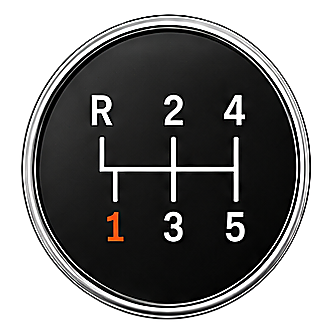
- 3.51 / 2.08 / 1.35 / 1.00 / 0.81, reverse 3.71
- Final drive ratio 525e
- 2.93 (41:14)
- Final drive ratio 528i
- 3.46 (45:13) with the overdrive gearbox, 3.25 (39:12) with the sport gearbox
- Final drive ratio 535i and M535i
- 3.07 (40:13), 3.25 (39:12) with the sport gearbox
- Final drive ratio M5
- 3.73 (41:11) with limited-slip differential
- The gearbox lists on the German and English Wikipedia differ
- the English version additionally lists the Getrag 262, 245, 265 and ZF S5-16.
The final drive ratios come from the BMW parts catalogue; a second independent source could not be found. BMW Group Classic and the PressClub do not list technical data for the gearbox or final drive.
According to the parts catalogue, the final drive ratio of the 520i changes three times (4.27, then 3.91, then 4.10); the assignment to production periods is contradictory there and is therefore not listed here.
08 · Top models
Top models
Two models above the standard range, plus the three variants that define the series’ character.
M5
February 1985 to December 1987, 2,241 units worldwide, of which around 1,340 for North America and about 96 CKD kits for South Africa. 286 PS from the M1 engine, 245 km/h, hand-built in Garching — and outwardly barely distinguishable from the 528i.
To the sub-page →
M535i
March 1985 to December 1987, 9,483 units. The same 218 PS M30B34 as in the 535i, plus front and rear spoilers, sport seats, sport suspension and limited-slip differential. The M535i is notably affordable today relative to the M5.
To the sub-page →
535i
From 1984, the top of the standard range: 3,430 cm³, 218 PS, confident pulling power without the maintenance demands of the M88. For many, the most sensible choice in the E28 lineup.
To the sub-page →
524td
November 1982 to December 1987, 74,602 units. BMW's first diesel car and, at 180 km/h, the fastest series-production diesel sedan in the world. Historically the most important model in the series after the M5.
To the sub-page →
525e
From March 1983, 40,621 units. The eta concept in its purest form: large displacement, low revs, 5.9 litres official consumption at 190 km/h. A car ahead of its time that hardly interests anyone today.
To the sub-page →
09 · M & special editions
The first M5 — an M1 engine in a sedan
The idea was simple: put the four-valve six-cylinder from the BMW M1 into a four-door sedan and change almost nothing on the outside. The M88/3 produces 3,453 cm³, 286 PS at 6,500 rpm and 340 Nm at 4,500 rpm, has six individual throttle bodies and a compression ratio of 10.5:1. The result: 245 km/h and 6.5 seconds to 100 — in 1985, the fastest series-production four-door in the world.
It was not built in Dingolfing but hand-built in Garching at BMW Motorsport GmbH. Between February 1985 and December 1987, 2,241 units were made, of which around 1,340 for North America and about 96 as CKD kits for South Africa.
Important for buyers: North America received the S38B35 with a catalytic converter, detuned camshafts and 191 kW instead of 210. The figures “260 PS” and “256 hp” refer to the same number in two units. And: the single-row timing chain of the European M88/3 can break, sometimes well before the 160,000-kilometre interval — this must be verified before purchase. The US S38 has the more durable chain.
10 · Motorsport
A family car wins the European Championship
When the new Group A regulations took effect in 1982, BMW’s previous Group 2 635 CSi could no longer be entered. Eggenberger Motorsport then built a Group A kit for the new 528i together with BMW — around 240 PS instead of 184, minimum weight 1,035 kilograms in its displacement class. About twenty road cars were converted.
The result came immediately: Umberto Grano and Helmut Kelleners won the 1982 European Touring Car Championship — in the first year of the new regulations, with a sedan that looked almost indistinguishable from an ordinary 528i. At the start of the season there were five consecutive wins.
After that it was over. From 1983, BMW shifted its factory programme to the 635 CSi Coupé, and later to the M3. Despite its technology, the M5 never had a factory racing programme — the known Group A E28s in collectors’ hands are almost all replicas.
The E28's only factory title did not go to the M5, but to a 528i — and in the very first year it was allowed to compete.
11 · Buying guide
What matters: sills, strut towers, timing belt
The E28 is solidly built for its time and well protected against rust. Its problem is not its construction but its history: decades as a cheap used car, neglected accordingly, plus massive export to the Middle East and Eastern Europe. Surviving numbers are thin, and what remains has often suffered.
Sills and jacking points — number one
Front wings behind the headlights and at the sill transition
A-pillars at the door hinge mounts
Floor panels at the front and under the rear seat
Boot floor and battery tray — acid damage
Front strut towers, cracks around the mounts
Windscreen and rear window frames
Double-walled mounting points of the rear axle subframe
Rear wheel arches, front edge of the bonnet, sunroof panel
First feel and tap the jacking points and sills — foamed-on underbody coating is a warning sign, as it usually means something was covered up rather than repaired. Then empty the boot completely, remove the carpet and spare wheel, and check the battery tray and floor. Check the front strut towers for cracks and see whether the drain holes of the lower spring seats are clear. Check the window frames under the seal: bubbles mean the glass has to come out. Engine-specific: for the M20, get written proof of the last timing belt change with date and mileage — without proof, budget for it immediately. For the M30, listen for chain rattle on cold start and check the oil cap and expansion tank for emulsion. For the M10, remove the valve cover and check that the banjo bolts of the oil spray rail are securely seated. Ignition on: does the service interval display cycle through cleanly, do the on-board computer and Check Control work? If they fail, check the circuit board for a leaked NiCd battery. On the test drive, brake from 90 to 100 km/h — judder or steering wheel shimmy points to the upper wishbone bushes. Finally the wheels: are the 390 mm metric rims still fitted, and is the rubber younger than ten years? On the M5, additionally have the M88/3’s timing chain history verified and check the chassis number against the engine number — M535i conversions exist in the market.
12 · The competition
What the E28 had to compete with
Mercedes-Benz W123 and W124
Better in longevity, body quality, value retention and parts supply; the W124, from late 1984, additionally better in aerodynamics with a cD of 0.29, and with an estate and coupé offers a body variety that the E28 does not provide at all. Worse in driving dynamics and engine refinement at the top end — up to the 500 E, Mercedes had nothing to match the M535i and M5.
Audi 100 C3 (1982–1991)
Better in aerodynamics — a cD of 0.30 set the benchmark in 1982 and even beats the facelifted E28 —, plus interior width, a galvanised body, and with quattro the only all-wheel drive in the field. Worse in handling under load due to front-wheel drive and front-heavy weight distribution; the five-cylinder engines match neither the smoothness nor the eagerness to rev of the M30.
Opel Senator A2 and Monza (1982–1987)
Better in value for money and space: the three-litre six-cylinder matched the 528i in output but cost significantly less and came more generously equipped. Worse in build quality, rust protection and resale value — and today with a dramatically worse parts market.
Volvo 760 (1982–1990)
Better in passive safety, long-distance seating comfort, practicality thanks to the estate, and the durability of the turbodiesel. Worse in driving dynamics, aerodynamics and design — the angular 760 already looked dated in 1982 and to this day has no comparable collector base.
Rover SD1 Vitesse (1982–1986)
Better in price, character and the sound of the 3.5-litre V8 — one of the few that came close to the 535i in performance —, plus more practical thanks to the large tailgate. Worse in build quality, electrics, corrosion protection and reliability; the surviving population is correspondingly small.
13 · Galerie
Bilder
Other BMW 5er generations
5 model lines with an E-number, from 1972 to 2010.


14 · Sources
Belege & Literatur
Primary sources are BMW Group Classic, the BMW PressClub and Wikipedia; everything else is only treated as verified once two independent sources agree. Not verifiable and therefore not stated here: Classic Data condition ratings, the output of the North American 535i and 524td, engine-specific series weaknesses of the M21, and the 1982 Spa win, which appears in only a single source. Two open source conflicts: the M20's timing belt interval and the catalytic-converter output of the 525e.
- BMW Group Classic — BMW 5 Series model line (E28), plus the individual pages on the 518, 518i, 520i, 524d, 524td, 525e, 525i, 528e, 528i, 533i, 535i, M535i and M5
- BMW PressClub — Five Times Around: History of the BMW 5 Series
- BMW M — The BMW M5 E28 from 1985
- Wikipedia (DE) — BMW E28
- Wikipedia (EN) — BMW 5 Series (E28), BMW M5, Eggenberger Motorsport
- BMW Tradition, press release "40 Years of the BMW 5 Series (E28)", 2021 — source of individual production figures
- Classics World — BMW 5 Series (E28) buyer's guide, 20 Mar 2024
- ZRG Classics — BMW E28 Resources
- Classic Trader — The BMW E28 M5 buyer's guide
- Hagerty — Low Miles, Big Price for Record-Breaking $196K BMW E28 M5, 31 Mar 2026
- CLASSIC.COM — BMW 5 Series E28 and M5 E28, accessed 05 Aug 2026
- Classic Trader and mobile.de — BMW E28 listings monitoring, accessed 05 Aug 2026
- Classic GP Assen — BMW 528i Group A: From family saloon to European Champion
- bmwfans.info — BMW E28 parts catalogue, rear axle drive section