

 Spotlight


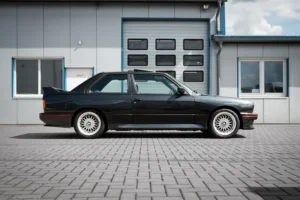
The start number sits in the DEKRA field on the driver’s door, right where it belongs. Above it the Warsteiner lettering, Wintershall on the flank, Yokohama on the rear apron. The blue-red band runs across the roof and sides. Yellow-tinted twin headlights, a low spoiler lip, BBS cross-spoke wheels, door interiors painted red inside.
Everything about it says touring car, late Eighties. Until the eye moves to the rear, where instead of a coupé tail there is a tailgate.


Two titles, one body problem
The M3 of the E30 model line won the DTM twice: in 1987 with Eric van de Poele for Zakspeed, in 1989 with Roberto Ravaglia for Schnitzer in the Sport Evolution. Schnitzer raced with Warsteiner as sponsor — hence the livery still recognised today by anyone who sat in front of a television in the Eighties.
The estate had no place in it, and not for reasons of taste. Group A required homologation, and what was homologated was a body variant built in a certain quantity. The M3 was built as a two-door model in sufficient numbers to gain eligibility. A Touring based on the M3 did not exist, so there was nothing to homologate, so there was no start number. As simple and as final as that.
The bitter part: the opportunity was there. The Touring rolled off the line under the works code E30/5 from July 1987, the M3 as E30/2S until December 1990. For over three years both stood in production at the same time. BMW even added the M3 Cabriolet within that very window, from June 1988 — an elaborate small series with its own bodywork. For the estate it did not happen.
What the factory built — and what it didn’t
Whether anyone in Munich ever thought about an M3 Touring, we do not know. Nothing is publicly documented, and we won’t pretend to know more.
What is documented: the prototype workshop did build some curious things. In 1986 an M3 pick-up was created from a Convertible bodyshell, initially with the reduced-displacement four-cylinder from the so-called Italy M3, later converted to the original 2.3-litre with 200 PS. For over 26 years the vehicle hauled material around the factory grounds. An estate was not built.
An M3 Touring as a factory prototype did appear later — based on the E46 series, declared a feasibility study and intended purely for internal purposes. An M3 Touring did not go into series production until 2022.


The punchline lies in its own family tree
It is the Touring, of all things, that owes its existence to a private individual. Max Reisböck, a BMW employee, built himself an estate based on the E30 in a friend’s garage in the mid-Eighties, because none was available to buy. He showed it to the board, and the board put it into the programme.
So anyone asking whether a self-built Touring has the right to wear a racing livery should know this order of events. That is how the Touring itself came into the world.
What’s underneath the skin
The base is a 318i Touring. From the factory it ran the M40B18 with 83 kW, that is 113 PS at 5500 rpm and 162 Nm. A well-behaved estate.
None of that remains. Under the bonnet sits an M54B30 from an E46 330Ci, an inline six-cylinder with three litres of displacement. It is the most interesting decision on the whole car, because it refuses to be a copy. The M3 E30 never had a six-cylinder — the S14 was a four-cylinder and stayed one through every evolution stage. Fitting the original engine here would have made it a replica. This way it is its own idea. The cover with the M-Power lettering is decoration here, not a nameplate.
Added to that is the conversion to five wheel bolts with axle parts from the E36 and E46. This work shows in no photograph, and without it nothing works: brakes, wheel bearings, and the freedom to draw on a parts catalogue that has not yet died out.
And then the sheet metal
Here the car differs from most of its kind. The rear side panels and the wings are made of metal.
That sounds like a footnote, and it isn’t one. Wide arches can be suggested with bolted-on plastic parts, a weekend’s work, done. From ten metres away that looks similar. From two metres it no longer does, and after the second winter certainly not.
In steel it means cutting, fitting, tacking, welding, tinning, grinding — with the risk at every step of warping the body. On the four-door Touring there is also something the two-door M3 was spared: the rear doors. They have to fit into a flank that never existed at this width, and afterwards they still have to close.
On the livery, to be honest
A note we owe our readers: the 30 has no historical precedent. Documented Schnitzer start numbers from those years include the 3 of Johnny Cecotto, the 15 with which Ravaglia took the title in 1989, and the 16 of Altfrid Heger. We have not come across a 30.
That is not a shortcoming but the cleanest solution. The car does not pretend to recreate a specific race car. It wears a livery in the style of the Schnitzer-Warsteiner cars and a number that belongs to no one. A car that never existed, with a start number that was never assigned — that is more consistent than any exact copy could ever be.
Where it stands
The series M3 produced 195 PS with catalytic converter, 200 PS without. The Sport Evolution, the strongest factory version, reached 238 PS. This Touring sits between the two and, as an estate, weighs more than both. So it will not leave any M3 standing.
That is not the point. For four decades the M3 Touring E30 was a line in forum discussions, a Photoshop rendering, a “they should have.” Someone stopped talking about it and started welding.
He gave himself the start number. No one can take it from him.