

 Spotlight


A narrated life story about precision, racing and the transfer into series production. Facts as of 10 August 2026.
Introduction: An engine is an attitude
With Paul Rosche, the story does not begin with 1,400 PS, a World Championship trophy or the rasping sound of a twelve-cylinder. It begins with a camshaft. This unassuming component determines when and how far an engine breathes in and out. Whoever calculates its profile translates geometry into character: idle, torque, revving pleasure, consumption, durability. Rosche mastered this translation so well that colleagues called him “Nocken-Paule” (“Cam Paule”). The nickname was affectionate, but it also described his method: great effect from precise detail work. [1, 2]
Over 42 years at BMW — from 1957 to 1999 — Rosche connected three worlds that remain separate at many companies: solid volume production, the highly specialised M road cars, and the uncompromising racing engine. Under his leadership or significant involvement, engines were created for the BMW 320 and 323i, BMW M1, M3 and M5, for Formula 2 and Formula 1, as well as for the McLaren F1 and the BMW V12 LMR. This range, not a single PS figure, explains his significance. [1, 2]
GUIDING THESIS — Rosche’s lasting achievement was a development principle: recognise existing, proven substance, push it further with precise valve timing, high rev durability and consistent testing — and let insights circulate between the racetrack and the road.
1. Munich, 1934: An engineer grows into post-war BMW
Paul Rosche was born on 1 April 1934 in Munich. When he joined BMW engine development as a design engineer straight after finishing his studies in 1957, the company was not yet the globally successful premium manufacturer of later decades. BMW was searching, technically and economically, for a viable future. Rosche’s professional life thus fell exactly within the era in which BMW transformed from a threatened post-war company into a manufacturer of sporting sedans and, finally, into a global performance brand. [1, 2]
His formative superior was Alexander von Falkenhausen, racing driver, engineer and head of engine development. In a small development environment, Rosche learned that a production engine need not be thought of as a static product. A good base engine can accommodate displacement increases, higher compression, fuel injection, four-valve technology or forced induction — provided the block, bearings, cooling and gas flow have reserves. This mindset later became Rosche’s guiding thread.
His early tasks included camshaft calculations for sports engines. BMW describes how, in one of his first projects, the camshaft became the starting point for a near-complete engine overhaul. This already shows a characteristic pattern: Rosche never treated a single component in isolation, but as a lever within the overall system of intake, combustion, revs and durability. [2]
2. The Neue Klasse: The production engine as capital for the future
In 1961, BMW presented the 1500, the first model of the “Neue Klasse”. It became the starting point of the modern BMW automobile programme. Its four-cylinder engine, later known as the M10 family, was robust, capable of further development and usable across many displacement and output levels. Rosche worked in engine development on production units and the sporting variants derived from them; BMW later credits him with involvement in all the production engines of that time. The wording is important: engines of this magnitude are teamwork. Rosche’s role lay in design, calculation and, later, technical leadership — not in the romantic notion of a lone figure at the drawing board. [2, 9]
The M10 base concept became the strongest symbol of this era. In its civilian form, it powered family sedans. In the BMW 2002 turbo, the 1,990 cm³ variant produced 170 PS and 240 Nm. In racing, the same design lineage served as the starting point for outputs that would have been unthinkable decades earlier. BMW itself spans the arc for this block from 75 to around 1,400 PS — a striking, but technically revealing narrative about reserves and consistent further development. [3]
3. 1969: Turbo as a trial by fire
The first major international milestone came in 1969. Rosche designed the two-litre turbo engine M121 for the BMW 2002 TI. With around 280 PS at 6,500 rpm and about 0.98 bar boost pressure, Dieter Quester won the European Touring Car Championship. Output was only part of the task: forced induction drastically increased combustion chamber pressure and thermal load. BMW’s retrospective vividly reports that at even higher boost pressure, the cylinder head would have lifted. The turbo thus forced developers to treat combustion, sealing, cooling and material limits as an interconnected problem. [1, 4]
Four years later, the BMW 2002 turbo appeared as the first car built in series production in Germany with an exhaust turbocharger. The 1969 racing engine had not simply migrated unchanged into series production. The transfer lay rather in experience and mastery: boost pressure control, mixture preparation, thermal management, and the question of how much power density an everyday-usable unit could tolerate. Rosche’s influence on production engines is exemplified here — not as a copy of the racing part, but as a shortened learning path. [3, 4]

INTERIM CONCLUSION I — For Rosche, the racetrack was not a showcase alongside series production. It was an accelerated laboratory. The actual transfer often did not consist of identical parts, but of robust knowledge about reserves, control and long-term durability.
4. From development to leadership: 1973 to 1979
In 1973, Rosche became head of the main department for advanced development and racing engine development. Two years later, he moved to BMW Motorsport GmbH and took over development of the road and racing engines for the BMW M1. From 1979 to 1996 he was Technical Managing Director or Technical Director — BMW sources cite both 1979 and 1980 for the start of this role. This changed his impact: from a specialist he became the person who shaped the goals, architecture and testing standards of an entire team. [1, 2]
BMW Motorsport GmbH, founded in 1972, was meant to bundle motorsport expertise and translate it into standalone products. In the M1, this idea met a spectacular vehicle concept. Its M88 straight-six was based on the M30 base engine, but received a four-valve head, individual throttle bodies and dry-sump lubrication. In the road-going M1 it produced 277 PS; the Procar version reached around 470 PS, the later turbocharged Group 5 version significantly higher figures. The M88 combined racing technology with road homologation and thus became the progenitor of an entire M high-performance family. [3, 8, 10]

At the same time, BMW dominated Formula 2 with two-litre four-valve four-cylinders. Under Rosche’s leadership, this engine family, according to BMW, achieved more than 150 race wins and six titles in the Formula 2 European Championship. The success was strategically important: it proved that BMW could not only field vehicles, but also develop and support customer racing engines competitive worldwide. [1, 2]
5. The M12/13: World champion from a production block
In 1980, Rosche and motorsport director Dieter Stappert laid the groundwork for BMW’s first Formula 1 engine programme. The M12/13 was a 1.5-litre inline four-cylinder with 16 valves and an exhaust turbocharger. Its design lineage led back to the volume-production four-cylinder and via Group 5 and Formula 2 racing. This heritage was precisely no flaw, but an advantage: the cast-iron block was known, available and proven under high loads. Rosche relied on an architecture whose weaknesses the team already knew. [1, 4]

At the start of the 1982 season, the Brabham BMW made its debut. In June, Nelson Piquet won the first Grand Prix with BMW Turbo Power in Canada. In 1983, the Brabham BT52 followed with the Drivers’ World Championship — 630 days after the engagement began. In races, the engine produced significantly less than its legendary qualifying peak figures depending on the state of development; BMW cites around 640 PS in race mode at 2.9 bar for the championship season, later versions reportedly reached about 1,400 PS in qualifying trim by calculation. Rosche’s famous remark that the test bench only measured up to 1,280 PS is thus both fact and warning: 1,400 PS is a plausible manufacturer figure, not a directly measured precision number. [1, 2, 4, 5]
Just as significant technically as the output was the control: mechanical injection was supplemented electronically — in an era of extreme boost pressures, regulation became the prerequisite for the power to be usable at all. By 1987, the BMW Turbo achieved a total of nine Grand Prix wins; besides Brabham, ATS, Arrows and Benetton also used the engine family. Gerhard Berger won his first Grand Prix in 1986 in Mexico with Benetton-BMW. [1, 3, 4, 16]
INTERIM CONCLUSION II — The M12/13 was not proof that a production engine could “simply” withstand 1,400 PS. It was proof that a cleverly chosen base, countless reinforcements, new heads, forced induction, fuel chemistry, electronics and consistent testing could together produce an entirely new machine.
6. The S14: Racing logic becomes a production character
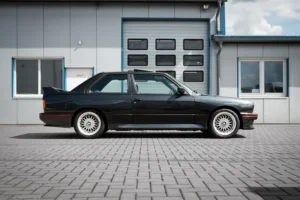
In the mid-1980s, BMW CEO Eberhard von Kuenheim demanded a sporting engine for the 3 Series — recorded as an almost casual remark after a visit to the Munich Preußenstraße: “Herr Rosche, we need a sporting engine for the 3 Series.” Rosche’s answer was radically pragmatic: for the S14 of the first M3 , the team combined the robust four-cylinder base with the four-valve idea from the M88. Rosche later described vividly how they had “cut off” two combustion chambers from the six-cylinder head. Technically, of course, it was a standalone development effort; the anecdote nevertheless shows his ability to recombine a working architecture. [3, 13]
The 2.3-litre S14 initially produced 200 PS in the production M3, revved freely and kept weight low on the front axle. Later road versions reached up to 238 PS. The car was intended as a homologation model, but precisely because of this, an exceptionally clear road product emerged: the engine responded directly, demanded revs and made the mechanical quality of the gas flow noticeable. The racing version initially competed with 300 PS at 8,200 rpm. [3, 11]
In motorsport, the E30 M3 became the “Champion Maker”. BMW puts its record at more than 1,400 race wins and numerous titles. In 1987, Roberto Ravaglia won the Drivers’ title in the Touring Car World Championship; DTM, European and national championship titles as well as endurance racing successes followed, among others. Not every one of these wins belongs personally to Rosche, but without the S14 as a supporting technical constant, this breadth of customer racing would hardly be conceivable. [5, 14]
7. What migrated from Rosche into production engines
Rosche’s influence on BMW production engines can be read along five lines. First, at the beginning stood direct involvement: BMW cites his involvement in the production engines of that time, expressly including the six-cylinders of the BMW 320 and 323i. Second, the M88 brought racing engine principles — four-valve head, individual throttling, high specific output — into M1, M635 CSi , and M5. Third, the S14 turned the homologation requirement into a desirable production engine. Fourth, under Rosche’s technical leadership, the S50 of the E36 M3 emerged, with four-valve technology, individual throttle bodies and continuously variable VANOS on the intake side. Fifth, a development ethos took hold: high revving pleasure and precise throttle response should be recognisable not first in the data sheet, but in the driving feel. [2, 3, 7, 17]
It would be wrong, however, to describe modern BMW production engines as direct technical descendants of a single Rosche unit. Emissions legislation, manufacturing, software, forced induction and electrification fundamentally changed engine construction. His legacy lies rather in the system: motorsport as a stress test, modular further development of proven geometries, the courage for high specific output, and the commitment to making performance suitable for everyday use.
8. The V12 for the McLaren F1: Freedom within strict limits
In the early 1990s, Rosche once again met Gordon Murray, the designer of the Brabham BT52. For the McLaren F1, BMW Motorsport developed the S70/2. Although the cylinder spacing was known from the BMW M70, the engine was, according to BMW, otherwise completely newly designed. It had twelve individual throttle bodies, continuously variable intake camshafts, two injectors per cylinder and dry-sump lubrication. From 6,064 cm³ came 627 PS at 7,500 rpm and 651 Nm. [3]
The S70/2 shows Rosche’s mature art: not maximum forced induction, but a large naturally aspirated engine with immediate response, a broad usable range and high durability. In 1995, the McLaren F1 GTR with the BMW V12 won the 24 Hours of Le Mans; Yannick Dalmas, Masanori Sekiya and JJ Lehto won, with four McLarens placed in the top five. For BMW, this was a triumph of the engine in a British chassis. [6]

For the open-top BMW V12 LMR, the family was further developed as the S70/3. The nearly six-litre V12 was designed for extreme endurance durability and, with the mandated intake restrictors, produced an estimated 580 PS or so. In 1999, BMW won Le Mans for the first time as a vehicle manufacturer, with Joachim Winkelhock, Pierluigi Martini and Yannick Dalmas. The often shortened statement that “Rosche’s S70/2” won in 1995 and 1999 therefore needs clarification: in 1995, the S70/2 won in the McLaren F1 GTR; in 1999, the further-developed S70/3 family in the BMW V12 LMR. [1, 3, 6, 15]
INTERIM CONCLUSION III — The McLaren V12 was Rosche’s counterpart to the Formula 1 turbo: there, extreme power density from 1.5 litres; here, assured, finely dosable power from 6.1 litres. Both shared the uncompromising control of gas flow and load.
9. Second Formula 1 bridge and farewell
After BMW’s withdrawal from Formula 1 at the end of 1987, Rosche remained Technical Managing Director of BMW M GmbH until 1996. Afterwards, as Technical Director and Managing Director of BMW Motorsport Limited, he set the course for BMW’s return as an engine partner to Williams. When he retired in 1999, the development direction of the V10 programme had been set. The new V10 of type E41 debuted in 2000 in Melbourne; Ralf Schumacher finished third, and Williams BMW finished third in the Constructors’ Championship at the end of the season. The operational race debut came after Rosche’s departure, but the programmatic and technical groundwork was still within his era of responsibility. [1, 6, 16]
In 2013, Rosche once again visibly returned to one of his greatest works. For the Goodwood appearance of the restored Brabham BT52, he worked together with former mechanics on the World Championship car — our cover image shows Nelson Piquet in exactly this car at the Festival of Speed 2013. Colleagues continued to call him “Chief”. On 15 November 2016, Paul Rosche died at the age of 82 in Munich. [1, 2, 19]
10. The most important engines — classified technically and historically
| Engine / Period | Core idea | Road impact | Motorsport impact |
|---|---|---|---|
| M10 / M121 (1960s–70s) | Robust production four-cylinder as an extremely developable base; turbo from 1969 | Neue Klasse; 2002 turbo with 170 PS as an early turbo production statement | European Touring Car Championship 1969; starting line for F2, Group 5 and F1 engines |
| M49 / M30 racing family (1970s) | Highly developed straight-six, fuel injection and four-valve racing technology | M30 family shaped BMW’s six-cylinder image | 3.0 CSL: touring car and IMSA successes; 1976 overall Daytona win [18] |
| F2 four-cylinder (1970s) | 2.0 litres, 16 valves, high revs, customer racing | Know-how for four-valve heads and highly loaded naturally aspirated engines | More than 150 wins and six F2 European Championship titles, according to BMW |
| M88 (from 1978) | M30 block plus four-valve head, individual throttles, dry sump | M1; later M635 CSi and M5 — blueprint of the M road engine | M1 Procar; Group 4 and Group 5 |
| M12/13 (1981–1987) | 1.5-litre turbo, 16 valves, electronically supplemented injection; production block lineage | Indirect transfer: turbo, electronics and load knowledge | F1 Drivers’ Championship 1983; nine Grand Prix wins in total |
| S14 (from 1986) | Compact 2.3-litre four-valve engine; light and rev-happy | E30 M3: 200 to 238 PS, immediate throttle response | Base of, according to BMW, the most successful touring car; more than 1,400 wins |
| S50 (from 1992) | Straight-six with four-valve head, individual throttles and VANOS | E36 M3: M technology becomes an everyday-usable high-performance coupé | Racing capability remained the development benchmark |
| S70/2 / S70/3 (1993–1999) | Large naturally aspirated V12: individual throttles, variable intake timing, dry sump | McLaren F1; at BMW itself only in the M8 E31 prototype | Le Mans overall wins 1995 (S70/2) and 1999 (S70/3) |
Classification according to BMW sources; engines are team achievements. Output figures refer to selected specification levels. [1, 2, 3, 4, 6, 7, 12]
11. Motorsport record: Successes bearing Rosche’s signature
| Year / Series | Vehicle and engine | Success | Classification |
|---|---|---|---|
| 1969 European Touring Car Championship | BMW 2002 TI, M121 Turbo | Title Dieter Quester | Rosche’s first major turbo milestone |
| 1970s Formula 2 European Championship | BMW 2.0-litre 16V four-cylinder | Over 150 wins, 6 titles | Manufacturer figure for the engine family under Rosche’s leadership |
| 1976, 24 Hours of Daytona | BMW 3.0 CSL, racing six-cylinder | Overall win | BMW continues to list the IMSA racers with 3.5-litre engines as 3.0 CSL [12, 18] |
| 1978 DRM | BMW 320 Group 5, M12/12 Turbo | Title Harald Ertl | Direct technical precursor of the F1 M12/13 [4] |
| 1979/1980 Procar | BMW M1 Procar, M88/1 | Title Niki Lauda / Nelson Piquet | Identical 470 PS cars as a spectacular F1 support series |
| 1983 Formula 1 | Brabham BMW BT52, M12/13 Turbo | Drivers’ Championship Nelson Piquet | First F1 Drivers’ World Champion with a turbo engine |
| up to 1987 Formula 1 | Brabham/ATS/Arrows/Benetton, M12/13 family | 9 Grand Prix wins | BMW works and customer engines combined |
| from 1987 touring cars | BMW M3 E30, S14 | Over 1,400 race wins, numerous titles | BMW count for the vehicle; the S14 was its technical constant |
| 1995, 24 Hours of Le Mans | McLaren F1 GTR, S70/2 V12 | Overall win | Four McLaren F1 GTRs among the top five |
| 1999, 24 Hours of Le Mans | BMW V12 LMR, S70/3 V12 | Overall win | BMW wins for the first time as a vehicle manufacturer; focus on reliability |
Sources and counting methods: BMW Group/BMW M, supplemented with Wikipedia references. The successes are attributed to Rosche’s engines and areas of responsibility; they are not a claim of sole personal authorship. [1, 2, 4, 5, 6, 10, 12, 15, 18]
12. What Rosche changed at BMW
From component to system
Rosche’s specialty was the camshaft, yet his career shows the opposite of narrow specialisation. He made gas flow the starting point of a systems perspective: combustion chamber, valvetrain, intake, injection, forced induction, lubrication and cooling had to work towards the same goal. This holistic approach became a hallmark of BMW M engines.
From single component to engine family
M10, M30/M88 and S70 show a recurring strategy: proven geometries and manufacturing knowledge are not discarded, but carried into new performance realms. This does not automatically save work; but it reduces unknown risks. Rosche was a master of intelligent reuse, not mere recycling.
From racing engine to credible road product
Sporting BMWs existed before Rosche’s era. Under his technical leadership, however, a particularly clear M logic emerged: the road engine should not only have more power, but make racing engine qualities noticeable — spontaneous throttle response, rev durability, thermal reserve and an unmistakable response behaviour. M1, M635 CSi, M5, E30 M3 and E36 M3 translated this logic into very different vehicles.
From mechanics to control
The electronically supplemented injection of the M12/13 and the variable camshaft control of the S50/S70 mark two steps of the same development: power arises not only through larger passages or higher boost pressure, but through ever more precise control. Rosche’s career thus spans the transition from mechanically dominated engine construction to mechatronic high-performance powertrains.
13. Fact check: legend and reliable statement
“The F1 engine had exactly 1,400 PS.” BMW cites around 1,400 PS as a calculated qualifying peak. Rosche himself pointed out that the test bench only went up to 1,280 PS. The 1,400 figure is therefore not exactly measured.
“The Formula 1 engine was an unmodified production engine.” The block came in design terms from the production family. Head, forced induction, injection, electronics and almost the entire system were highly specialised racing technology.
“Rosche developed every engine alone.” BMW deliberately speaks of Rosche and his team, or of developments under his leadership. Serious technical history separates leadership responsibility from sole authorship.
“The S70/2 won Le Mans in 1995 and 1999.” In 1995, the S70/2 won in the McLaren F1 GTR. In 1999, the further-developed S70/3 family won in the BMW V12 LMR.
“Everything migrated directly from the racetrack into series production.” The most important transfer was often indirect: knowledge about materials, temperature, control and durability, as well as development processes. Production requirements demanded their own designs. [1, 2, 3, 4]
14. The legacy: What remains today
Paul Rosche’s legacy at BMW is not a single cylinder head or a number on a test bench. It is the idea that a high-performance engine must be intelligent, durable and emotional at the same time. His best engines convinced not through gimmicks, but through an unusual unity of purpose and character: the S14 was light because the M3 was meant to be a touring car. The M12/13 was compact because Formula 1 allowed 1.5 litres of turbo. The S70/2 was large and free-breathing because the McLaren F1 demanded immediate, refined power.
Even in an era of electrified powertrains, this thinking remains relevant. Hardware, software, thermal management and usage scenario must be developed as one system; motorsport remains a place of accelerated learning; a performance brand must translate technical data into a tangible experience. The specific technology has changed, the standard has not.
Perhaps that explains why Rosche remained a benchmark at BMW long after his retirement. As BMW recalled in 2014, the highest praise for a new engine was said to be the remark: “Paul Rosche would have liked it too.” This is more than nostalgia. It denotes a question of quality: is this powertrain merely strong — or is it coherent? [2]
FINAL CONCLUSION — Rosche’s genius did not lie in the cult of the brilliant individual. It lay in leading teams over decades to engines that solved their respective task with exceptional clarity — from the BMW 2002 to the World Champion Brabham, from the M3 to the Le Mans V12.
Sources and references
References [1] to [12] come from the submitted manuscript; primarily primary and manufacturer sources from BMW Group PressClub, BMW M and BMW Group Classic. References [13] to [19] were added by the editorial team during fact-checking as secondary verification. Manufacturer figures on success counts and historical output values are marked as such. Access date of all online sources: 10 August 2026.
- [1] BMW Group mourns Paul Rosche. BMW Group PressClub Deutschland, 16 Nov 2016 — Open online source
- [2] BMW congratulates Paul Rosche: The father of the Formula One World Championship engine turns 80 today. BMW Group PressClub Global, 01 Apr 2014 — Open online source
- [3] Legendary engines of BMW M GmbH. BMW M — Open online source
- [4] From M121 to P48: An overview of the evolution of BMW Turbo engines in motor racing. BMW Group PressClub Global, 12 Aug 2019 — Open online source
- [5] About BMW M Motorsport. BMW M — Motorsport history — Open online source
- [6] Greatest BMW M race victories worldwide. BMW M — Open online source
- [7] BMW M635 CSi — Top model of the E24 series. BMW M — Open online source
- [8] The pioneering days. BMW Group Classic — Open online source
- [9] BMW 1500. BMW Group Classic — historical model catalogue — Open online source
- [10] The BMW M1 Procar. BMW M — Open online source
- [11] The BMW M3 E30. BMW M — Open online source
- [12] BMW 3.0 CSL racing coupé IMSA. BMW Group Classic — Open online source
- [13] The story of an exception: The BMW M3 turns 25. BMW Group PressClub Deutschland, 2011 (Kuenheim quote) — Open online source
- [14] 1987 World Touring Car Championship. Wikipedia (EN) — Open online source
- [15] BMW V12 LMR. Wikipedia (EN) — S70/3, 5,990 cm³, around 580 PS with restrictors, winner 1999 — Open online source
- [16] BMW in Formula One. Wikipedia (EN) — E41 debut Melbourne 2000, nine turbo wins — Open online source
- [17] BMW S50. Wikipedia (EN) — VANOS on the intake side — Open online source
- [18] 1976 24 Hours of Daytona. Wikipedia (EN) — Open online source
- [19] 30 years of Brabham BMW BT52 — rebuild and Festival of Speed Goodwood 2013. BMW Group PressClub, TV footage — Open online source
Editorial notes
Image: The cover image shows Nelson Piquet in the restored Brabham BMW BT52 at the Goodwood Festival of Speed 2013 — the return episode from section 9. Photo: Jake Archibald (CC BY 2.0), Wikimedia Commons. The AI illustration submitted with the manuscript was not used editorially; s14.de illustrates personal portraits with documentary photographs.
Attribution: Modern engines are created in interdisciplinary teams. The phrases “under Rosche’s leadership”, “under his technical leadership” and “Rosche’s signature” follow the source material and avoid an unsubstantiated claim of sole authorship.
Usage: Historical output figures are given in PS, as this corresponds to the contemporary presentation used by BMW. Differences in rounding and specification levels are indicated in the text.
Editorially reviewed on 10 August 2026: All core statements were checked against sources [1] to [6], [11] and [12]; four figures were corrected or refined compared with the manuscript and verified against sources [13] to [19].
Bildnachweise
- Lizenziert · Jake Archibald · CC BY 2.0
- Lizenziert · Spurzem – Lothar Spurzem · CC BY-SA 2.0 de
- Own photograph · MOTORSPORT24
- Lizenziert · Buschtrommler · CC BY-SA 3.0
- Lizenziert · Charles from Port Chester, New York · CC0