

There are two figures for the production of the BMW M5 of the E34 model line, and both are well documented: 12,254 and 11,989. The difference is exactly 265.
That’s not a rounding difference. 265 is exactly the number of right-hand-drive cars assembled in South Africa between September 1990 and March 1993 — and the only ones that did not pass through the hall in Garching. Whoever cites the smaller figure evidently means only the hand-assembled cars. This explanation can’t be proven; no source states it explicitly. But it’s the only one that adds up.
That also sets the theme. The E34 M5 is the car with which BMW departed from series production for the last time to finish a model by hand — and the last M5 with the straight-six whose lineage begins with the M1.
The engine comes from the M1
The S38 is not a turbocharged production engine and not a derivative of the M30. It descends from the M88 — the four-valve six-cylinder with six individual throttle bodies developed for the BMW M1. BMW M itself calls the engine of the E34 M5 a “modified six-cylinder from the legendary BMW M1”.
The line runs: M88/1 in the M1, M88/3 in the E28 M5 and in the M635 CSi, S38B35 for the US market, then S38B36 and S38B38 in the E34.
| S38B36 (1988–1992) | S38B38 (from autumn 1992) | |
|---|---|---|
| Displacement | 3,535 cm³ | 3,795 cm³ |
| Bore × stroke | 93.4 × 86.0 mm | 94.6 × 90.0 mm |
| Power | 315 PS (232 kW) at 6,900 rpm | 340 PS (250 kW) at 6,900 rpm |
| Torque | 360 Nm at 4,750 rpm | 400 Nm at 4,750 rpm |
| Compression | 10.0 : 1 | 10.5 : 1 |
| 0–100 km/h | 6.3 s | 5.9 s (5-speed) · 5.7 s (6-speed) |
Two things that are regularly stated incorrectly: the S38 has no Vanos — variable camshaft timing didn’t arrive until the later M engines. And it’s a grey cast-iron block with an aluminium head, not a Nikasil construction. More on that below, since this point is worth real money when buying.
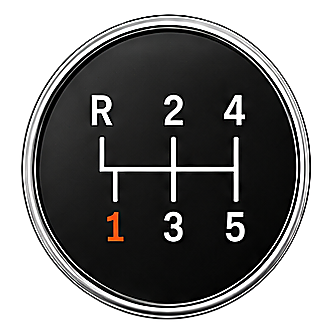
Standard was a Getrag 280/5 with five speeds and a limited-slip differential with 25 percent lock. From May 1994 the six-speed Getrag 420G gearbox was available — but only in 751 or 752 cars, depending on which source you follow. The six-speed is thus the rarest drivetrain combination of the model line and correspondingly sought after in the market.
The turbine wheels — they weren’t just for looks
No other detail of the E34 M5 is mentioned so often and documented so rarely as the M System wheels. So here’s the evidence, and it comes from BMW itself: the 17-inch wheels carried “turbine-like fan inserts made of die-cast magnesium“, which increased the airflow inside the rim by around 25 percent and thereby cooled the brakes. BMW explicitly calls this a motorsport innovation.
| Wheel | Period | Size |
|---|---|---|
| Style 20 — M System I (“Turbine”) | 1988–1992, with the 3.6-litre | 17 × 8 front and rear |
| Style 21 — M System II (“Throwing Star”) | from 1992, with the 3.8-litre | 17 × 8, rear optionally 17 × 9 with 255/40 |
| Style 37 — M Parallel | from May 1994 | 18 × 8 front / 18 × 9 rear |
Whether the covers of the M System II were also made of magnesium or of plastic is not documented — BMW only comments on the 1988 wheels. And a widely used wheel overview lists the same weight for Style 20 and 21, which is questionable given the different construction. Anyone restoring one should weigh it themselves.
891 Touring — the first M Touring ever
From September 1992 to August 1995, 891 M5 Touring. All with the 3.8-litre, all left-hand drive — there was no factory right-hand-drive Touring. It was the first Touring by M GmbH and remained the only one until the M5 Touring of the E61 model line.
BMW M describes the reason for the manual work matter-of-factly: there simply was no production line for such a car. The Touring was therefore “largely hand-assembled at M GmbH in Garching” — and that’s also why Wikipedia lists it as “the last hand-built M car”.
“a superlative sportscar, packed in a sporty, but never showy bodywork”
BMW M on the M5 Touring E34
The special editions — and one that wasn’t
In total, six editions are documented, 178 cars combined:
| Edition | Year | Engine | Units | Market and special feature |
|---|---|---|---|---|
| Cecotto | 1991 | 3.6 | 22 | Europe · Laguna Green or Mauritius Blue, burr walnut, heated seats |
| Winkelhock | 1991 | 3.6 | 51 | Europe · lightweight construction: smaller battery, reduced insulation, Recaro |
| Naghi Motors | 1992 | 3.6 | 15 | Saudi Arabia only |
| 20 Years BMW Motorsport | 1992 | 3.8 | 20 | Europe · Mugello Red only, red seatbelts with Motorsport lettering |
| UK Limited Edition | 1995 | 3.8 | 50 | UK only, right-hand drive, BMW Individual |
| Elekta (Touring) | 1995 | 3.8 | 20 | Italy only · Sterling Silver or British Racing Green |
And now for the correction that can save money when buying: There was no special model “Nürburgring”. What did exist was the factory option M591 — a sportier suspension setup with EDC, Servotronic and wider rear wheels. Dealer listings occasionally advertise this as a “Nürburgring Edition” and charge corresponding prices. No production figure for it is documented anywhere, because it’s simply a checkbox on the order form, not a series.
What matters when buying
Rust before engine
From 1993 BMW switched to water-based paints; cars from this model year onward are considered more prone to rust. What should be checked are sills, wheel arches and the area around the roof frame. The sentence worth remembering comes from the buyer’s guide by Classic & Sports Car:
“The M5’s strength is lost if rot takes hold.”
Classic & Sports Car, buyer’s guide E34 M5
The same source puts a bodywork restoration at 15,000 to 25,000 pounds. For a car whose average price sits in the mid five-figure range, that’s the line between project and total loss. Structural condition weighs heavier than mileage — the S38 holds up over 300,000 kilometres with good care.
Nikasil doesn’t affect the M5
This correction matters because it regularly causes confusion. The Nikasil problem affected the M60 V8 from 1993 to 1996 — among others the 530i and 540i of the same model line as well as the 840Ci — and the European M52. The S38 is not affected: grey cast-iron block, aluminium head.
The irony is not small: of all things, the 540i, which one might buy as the more sensible alternative to the M5, carries the engine risk that the M5 lacks.
What wears on the S38
- Valve stem seals — blue smoke on cold start and on overrun, typical from around 130,000 to 160,000 kilometres
- Timing chain — tensioner and guide rails are age-critical. Rattling on cold start is the warning sign not to be ignored
- Valve clearance — bucket tappets with shims, not hydraulic lifters. This must be adjusted regularly, and it’s either in the service book or it wasn’t done
- Cooling system — water pump, thermostat, radiator, hoses, viscous fan. Both major buyer’s guides cite overheating as the most common cause of serious engine damage
- Suspension — control arm bushings and ball joints from around 130,000 kilometres, rear trailing arm bushings
- Electrics — brittle wiring insulation. Cycle through wipers, blower and lighting completely before buying
What cannot be documented: the cost of an engine rebuild. Classic & Sports Car only writes “extremely high”, without a figure. All figures circulating come from forums without workshop invoices — so we won’t cite any.
What it costs today
| Variant | Average price | Range |
|---|---|---|
| M5 Sedan | $39,367 | $7,600 to $99,999 |
| M5 Touring | $64,575 | from $29,000 |
The British price scale from Classic & Sports Car shows the same structure even more clearly: in the average tier, 20,000 pounds for a 3.6-litre, 25,000 for the 3.8, 30,000 for the six-speed — and 40,000 for the Touring. In concours condition it’s 50,000, 65,000, 75,000 and 100,000 pounds. South African imports run around 25 percent below.
A word of caution: Hagerty reports for the E34 M5 in the US over five years a minus of four percent , while the E28 M5 gained six percent over the same period. So the E34 is no sure bet. What sustains it is the Touring — and the six-speeds.
The hinge point between two worlds
| E28 M5 | E34 M5 | E39 M5 | |
|---|---|---|---|
| Production period | 1984–1988 | 1988–1995 | 1998–2003 |
| Units | 2,241 | 12,254 (or 11,989) | 20,482 |
| Engine | M88/3 or S38B35, R6 | S38B36 / S38B38, R6 | S62, V8 |
| Production | Hand assembly | Hand assembly Garching | regular 5 Series line |
| Bodies | Sedan only | Sedan and Touring | Sedan only |
The E34 sold five and a half times more often than the E28 and thus turned the M5 from a small-series curiosity into a serious model — without giving up hand assembly and the motorsport straight-six. The E39 doubled the production figure once again and gave up both.
It is precisely in this in-between position that the appeal lies. The E34 M5 is old enough to be hand-built, and new enough to work in everyday use. It was sold in 1988 for 98,800 Marks, was sold out in its first production year — and factory driver Jörg Weidinger sums up why it’s read differently today than it was back then:
“I personally love the philosophy of understatement which we had at BMW M back then.”
Jörg Weidinger, BMW M factory driver
The complete data for the model line can be found on the E34 model page. The predecessor can be found under E28, the successor under E39.
Sources
- BMW M — The BMW M5 of 1988 (magnesium fan inserts, 25 percent more airflow)
- BMW M — BMW M5 Touring (E34)
- Classic & Sports Car — Buyer’s guide BMW M5 E34
- Supercar Nostalgia — E34 M5 3.6 and 3.8 (production figures by market and steering side)
- bimmertoday — The production figures of the BMW M5 E34
- Wikipedia — BMW S38 and BMW M5
- classic.com — Market data BMW M5 E34 (retrieved 08.08.2026)
There is no consistent source data on the total production figure, the rev limit of the S38B36, and the production figure of the M591 option. Anyone with factory documents on this: Write to us.