

In the transition from the BMW M3 3.0 (S50B30) to the M3 3.2 (S50B32), introduced in spring 1995, the new engine with 321 PS was in the spotlight. The common assumption is that the update was limited to this. It was not: BMW M GmbH revised the drivetrain, transmission, chassis, brakes and body to make the increased power drivable.12
And a word up frontThis article is a fact check — which is why there is a separate section at the end about which figures firmly established in the scene cannot be substantiated with a manufacturer source. This, too, is part of the result.
Valve timing: from single to double VANOS
The S50B30 operated with a VANOS system that controlled only the intake camshaft — switching between an early and a late position. For the driver, the transition at around 4,500/min was noticeable as a change in character: relaxed down low, explosive up high.
With the S50B32 came the continuously variable adjustment of the intake and exhaust camshaft. BMW Group Classic writes verbatim that it was “a technology used here for the first time.”3 Instead of two positions, the system now regulates across the entire rev range; a dedicated high-pressure system provides the necessary adjustment times. The result is no longer a peak but a line: stronger from low revs, without giving anything away at the top end.

| M3 3.0 · S50B30 | M3 3.2 · S50B32 | |
|---|---|---|
| Production period | 03/1992 – 08/19954 | 03/1995 – 12/19983 |
| Displacement | 2,990 cm³4 | 3,201 cm³3 |
| Output | 286 PS at 7,000/min4 | 321 PS at 7,400/min3 |
| Torque | 320 Nm at 3,600/min2 | 350 Nm at 3,250/min * |
| VANOS | intake only, switching | intake and exhaust, continuously variable3 |
| Transmission | five-speed | six-speed2, SMG optional |
| Front brake | single-piece cast-iron disc | compound brake with aluminium hat2 |
Power transmission: the sixth gear and a stronger differential
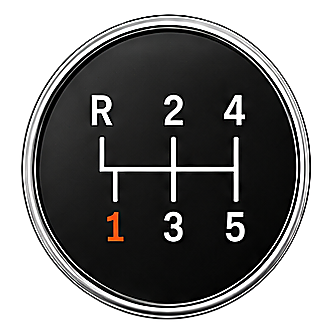
The five-speed transmission gave way to a six-speed transmission. BMW’s press material for the M3 anniversary explains this simply as a matter of demand: “BMW implemented the wish of many BMW M3 customers for an additional gear with a new six-speed transmission.”2 The sixth gear lowers the engine speed on the motorway, allowing gears one through five to be spaced more closely together.
In addition came the Sequential M Gearbox (SMG) — an electrohydraulically actuated manual gearbox without a torque converter, operable via gear knob or steering wheel paddles. On the year of introduction, BMW contradicts itself: bmw-m.com states 1996, while the anniversary press material states 1997 and describes the M3 as the “world’s first large-series production vehicle” with this technology.25 What is documented is the take-up: 1,842 Coupés left the factory with SMG.3
Chassis and brakes
The chassis of the 3.0 was considered very agile but nervous at high speed. On the 3.2, M GmbH significantly changed the axle geometry — more caster at the front axle through revised strut mounts, a stiffer rear axle, and a more direct steering ratio. However, BMW’s press material describes the chassis only in general terms: a “single-joint spring strut front axle” with “reinforced spring plates and steering knuckles,” a “central-arm rear axle,” “31 millimetres lower.”2
The brake, however, is clearly documented. For the 3.2, BMW adopted the compound technology on the front axle: a cast-iron friction ring on an aluminium hat. BMW states its effect as reducing “unsprung mass” and being “significantly less sensitive to thermal stress.”25 In practice, this means the friction ring can expand under heat without warping — exactly the problem the 3.0 suffered from on the racetrack.
Body, styling and electronics
Because the revised strut mounts introduce greater point loads into the body, the front strut towers received additional reinforcement plates. Visually, like all E36 models from model year 1996, the M3 received the slightly forward-curved kidney grille panel with wider kidneys, narrower bolted-on side indicators, and white or white-red indicator lenses. The Styling 24 forged wheel gave way to the more delicate Styling 39 double-spoke wheel, and inside, an automatic climate control system with display replaced the previous unit.
Production numbers
BMW states a total figure for the E36 M3: “Exactly 71,242 units were built as Coupé, Convertible and Sedan.”2 A complete breakdown by body style published by BMW and engine variant does not exist — the individual figures cited by BMW Group Classic do not add up to 71,242 in total, because figures for the 3.0 variants are missing.
Documented figures include: 12,114 Convertibles in total, built in Regensburg6; 8,962 Coupés of the 3.2 version, of which 2,845 were right-hand drive3; 2,690 Sedans of the 3.2 version outside North America.7 The complete LHD/RHD matrix circulating in the scene comes from an analysis by BimmerToday, not from BMW.8
What cannot be substantiated
Three figures firmly established in forums and buying guides do not hold up to source verification. This does not automatically make them wrong — they simply have not been published by BMW, and a specialist article should make that distinction clear.
- “Caster increased from around 3° to around 7°.” No caster value in degrees can be found in any BMW source reviewed. All references found are forum posts. Pure scene knowledge.
- “The 3.2 received the type 210 differential, while the 3.0 still had type 188.” The designations 188 and 210 refer to the ring gear diameter in millimetres and are a workshop and aftermarket convention. They do not appear in the BMW parts catalogue. There is much factual support for the claim, but it is not a manufacturer designation.
- “350 Nm at 3,250/min.” BMW Group Classic lists no torque field for the S50B32, and the press material likewise gives no figure. For the S50B30, on the other hand, 320 Nm at 3,600/min is explicitly documented.2
And one figure that is often stated incorrectlyThe European production M3 3.0 produced, throughout its entire production run, 286 PS.4 The often-cited 295 PS does not belong to a later stage of development, but exclusively to the M3 GT — a homologation model built in 1995 in only 350 units and exclusively in British Racing Green.2
Conclusion
The model change of the E36 M3 was not an engine swap with trimmings. The 3.0 is the purist, rev-hungry car with a noticeable switch point; the 3.2 is the calmer, faster, more long-distance capable one. Double VANOS made power delivery linear, the sixth gear made the motorway bearable, the compound brake made the racetrack manageable. Anyone who drives both notices: these are two cars, not two engine variants.
Sources
- BMW Group Classic: BMW M3 (E36) — model history, production period 03/1992–08/1999, 71,242 vehicles ↑
- BMW press material 7/2007: “20 Years of BMW M3” (PDF) — torque S50B30, six-speed transmission, SMG, compound brake, production figures, M3 GT ↑
- BMW Group Classic: BMW M3 Coupé (E36), 321 PS — 3,201 cm³, 7,400/min, double VANOS premiere, 1,842 Coupés with SMG ↑
- BMW Group Classic: BMW M3 Coupé (E36), 286 PS — 2,990 cm³, 7,000/min, production period 03/1992–08/1995 ↑
- BMW M: “The BMW M3 E36 — Big footsteps and new paths to tread” ↑
- BMW Group Classic: BMW M3 (E36) Convertible — 12,114 vehicles from Regensburg ↑
- BMW Group Classic: BMW M3 (E36), 321 PS, Sedan — 2,690 vehicles ↑
- BimmerToday: “Die Stückzahlen des BMW M3 E36” — secondary source for the breakdown by LHD, RHD and CKD ↑
All sources accessed on 9 August 2026 and checked against a verbatim quote. Figures apply to the European versions mentioned.
Text: Sven H.. Editorial work, source research and fact-checking: s14.de.
Bildnachweise
- Lizenziert · Charles from Port Chester, New York · CC BY 2.0
- Lizenziert · The Car Spy · CC BY 2.0