

01 · Überblick
The car that made BMW big
The 02 Series is the two-door, shortened offshoot of the Neue Klasse. The 1600-2 debuted in March 1966, the year of the company’s 50th anniversary, and remained in the range until 1977. In these eleven years, a manufacturer that had faced takeover in 1959 became the maker of compact sports sedans, the identity BMW is still associated with today.
Exactly how many cars were built remains open. BMW Group Classic states 827,535 sedans, the English Wikipedia 837,038 vehicles, the German Wikipedia 863,195 including CKD kits. The three figures cannot be reconciled, as it remains unclear which body variants and overseas assembly are included in each case. We therefore list them side by side.
Technically, everything follows the Neue Klasse formula: front longitudinal engine, rear-wheel drive, struts at the front, semi-trailing arms at the rear, unitary body. What is new is the proportions. A 2,500 mm wheelbase, a good 4.2 metres in length, under 1,000 kg kerb weight in the early cars — and within that an engine delivering up to 170 PS at its peak.
The breakthrough came in 1968 with the 2002. According to the account handed down, the idea of putting the Neue Klasse’s two-litre engine into the small two-door arose twice, independently of each other, within the company: with engine chief Alexander von Falkenhausen and with development head Helmut Werner Bönsch. US importer Max Hoffman pushed for a car that met local emissions regulations with one carburettor instead of two. The result became BMW’s first major success in the USA.
In 1971 the touring arrived as a hatchback, and in the same year Baur switched from the full convertible to a body with a fixed roll bar. The 2002 turbo set the final point in 1973: Europe’s first series-production car with a turbocharger, 170 PS — a model whose life the oil crisis ended after 1,672 units.
02 · Historie
Eleven years in seven dates
From the 1600-2 to the last 1502.
- 1966 In March, the 1600-2 debuts with 1,573 cm³ and 85 PS. BMW celebrates its 50th anniversary that same year.
- 1967 The 1600 ti brings 105 PS with two Solex twin carburettors. Baur begins with the full convertible.
- 1968 In January, the 2002 launches with 1,990 cm³ and 100 PS, along with the 2002 ti with two carburettors and 120 PS.
- 1971 Three innovations at once: the touring as a hatchback, the 1802 as the mid-range model, and the 2002 tii with Kugelfischer fuel injection and 130 PS.
- 1973 At the IAA in Frankfurt, the 2002 turbo is presented: 170 PS, 211 km/h, Europe's first series-production car with a turbocharger.
- 1975 The E21 launches as the successor. At the same time, the 1502 arrives as an economical entry-level model with 75 PS.
- 1977 The last 1502 leaves the factory. After eleven years, the 02 Series comes to an end.
03 · Modellübersicht
All engine variants
A single engine in four displacements: the entire 02 Series runs on the four-cylinder M10. The range spans from 75 to 170 PS.
Quelle: Werks- und Literaturangaben · geprüft
Technische Daten anzeigen — komplette Modellmatrix
| Modell | Motor | Hubraum | Leistung | Bauzeit |
|---|---|---|---|---|
| 1502 | M10 | 1.573 cm³ | 75 PS (55 kW) | 1975–1977 |
| 1600-2 / 1602 | M10 | 1.573 cm³ | 85 PS (63 kW) | 1966–1975 |
| 1600 ti | M10 | 1.573 cm³ | 105 PS (77 kW) | 1967–1968 |
| 1802 | M10 | 1.766 cm³ | 90 PS (66 kW) | 1971–1975 |
| 2002 | M10 | 1.990 cm³ | 100 PS (74 kW) | 01/1968–10/1975 |
| 2002 ti | M10 | 1.990 cm³ | 120 PS (88 kW) | 1968–1971 |
| 2002 tii | M10 | 1.990 cm³ | 130 PS (96 kW) | 1971–1975 |
| 2002 turbo | M10 with turbocharger | 1.990 cm³ | 170 PS (125 kW) | 09/1973–11/1974 |
| touring (1600 to 2002 tii) | M10 | 1.573–1.990 cm³ | 85–130 PS | 1971–1974 |
04 · Karosserievarianten
Karosserievarianten
Limousine

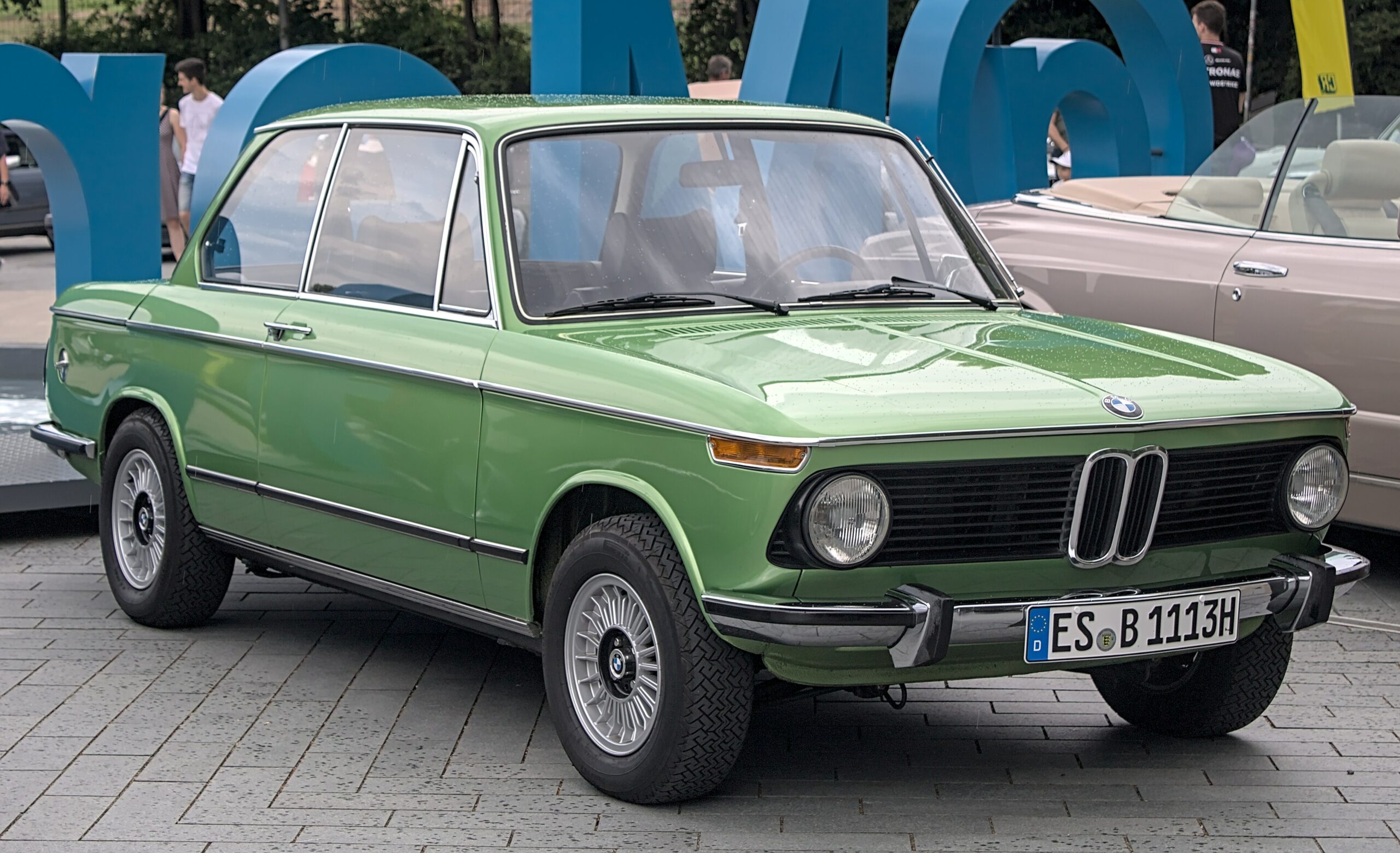
The main body style throughout production: two-door, notchback, unitary body, front longitudinal engine, rear-wheel drive. Wheelbase 2,500 mm, length 4,220 to 4,230 mm, width 1,590 to 1,620 mm, height 1,360 to 1,410 mm, kerb weight 940 to 1,080 kg depending on version.
touring

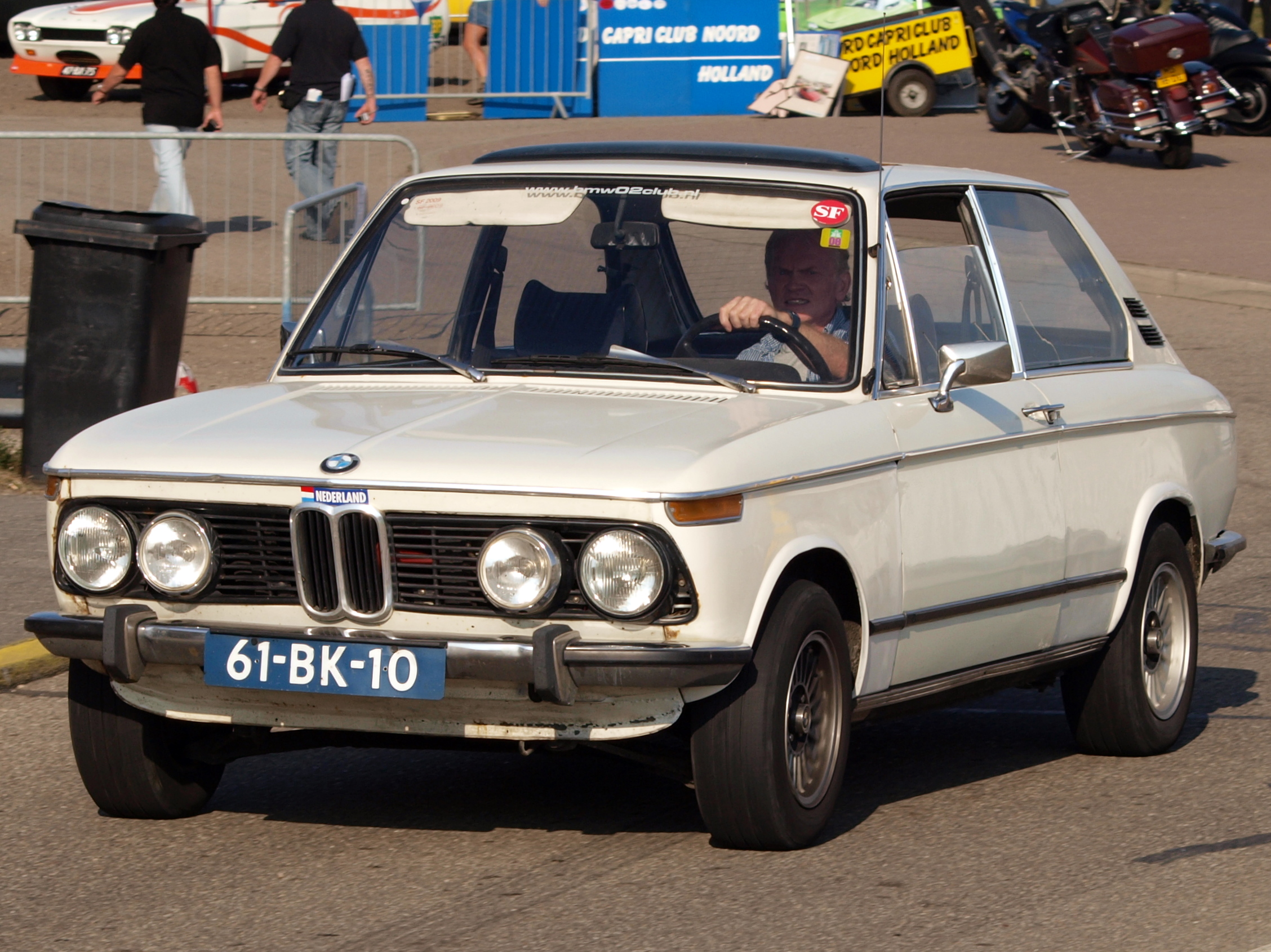
From 1971 the hatchback with a large tailgate on the same wheelbase, offered from the 1600 to the 2002 tii and built until 1974. The production figures diverge: 21,752 according to the English Wikipedia, 25,827 according to the German Wikipedia. The touring has its own page with us.
Convertible by Baur

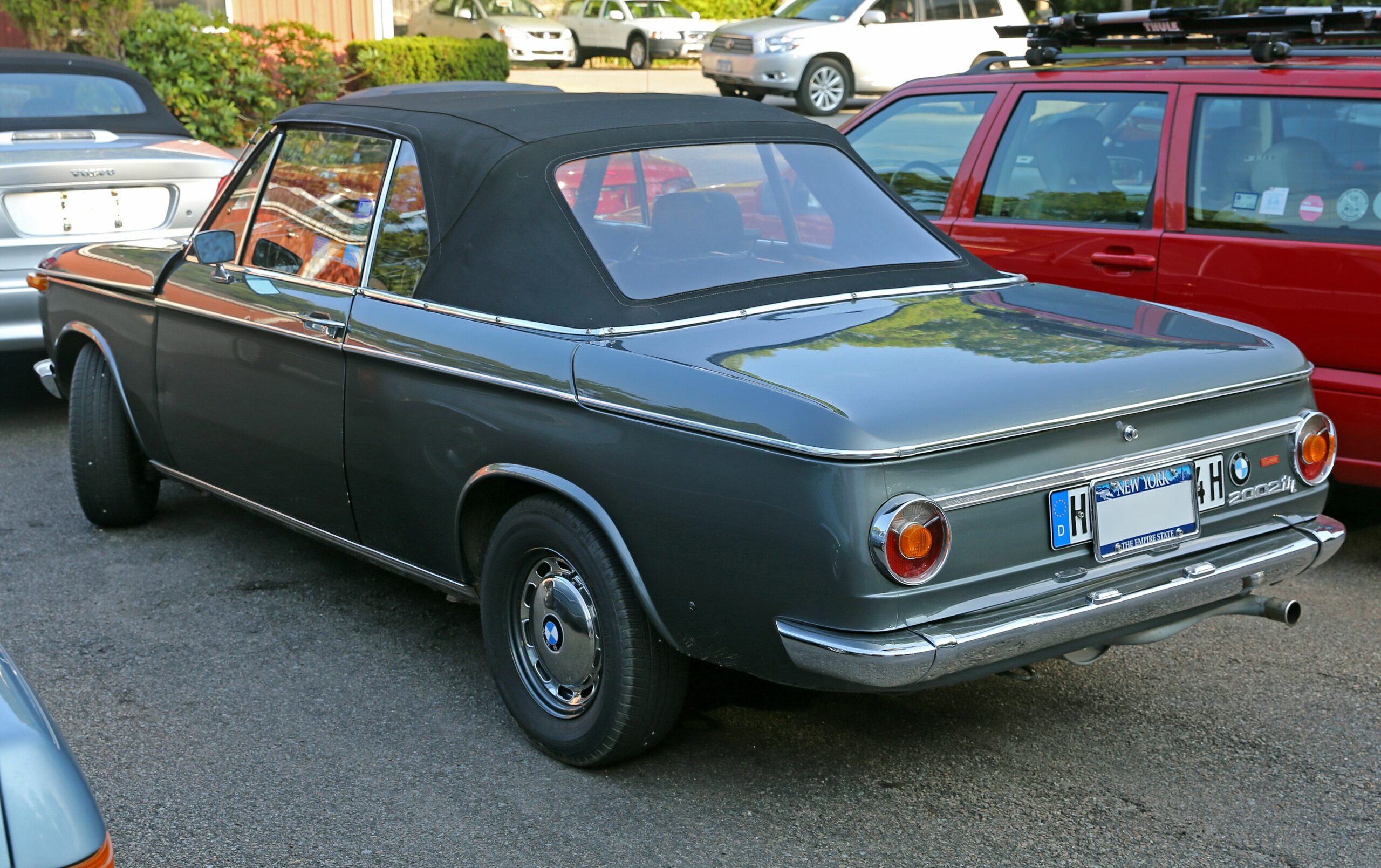
Baur in Stuttgart built a full convertible from 1967, 1,892 units, of which 200 as the 2002. From 1971 came the body with a fixed roll bar, 2,290 units, built until 1975.
2002 turbo
From September 1973 the top of the range: 170 PS, widened wings, front spoiler, internally vented brake discs at the front and a limited-slip differential. Production ended in November 1974 after 1,672 units. It has its own page with us.
05 · Motoren
One engine, eleven years, four displacements
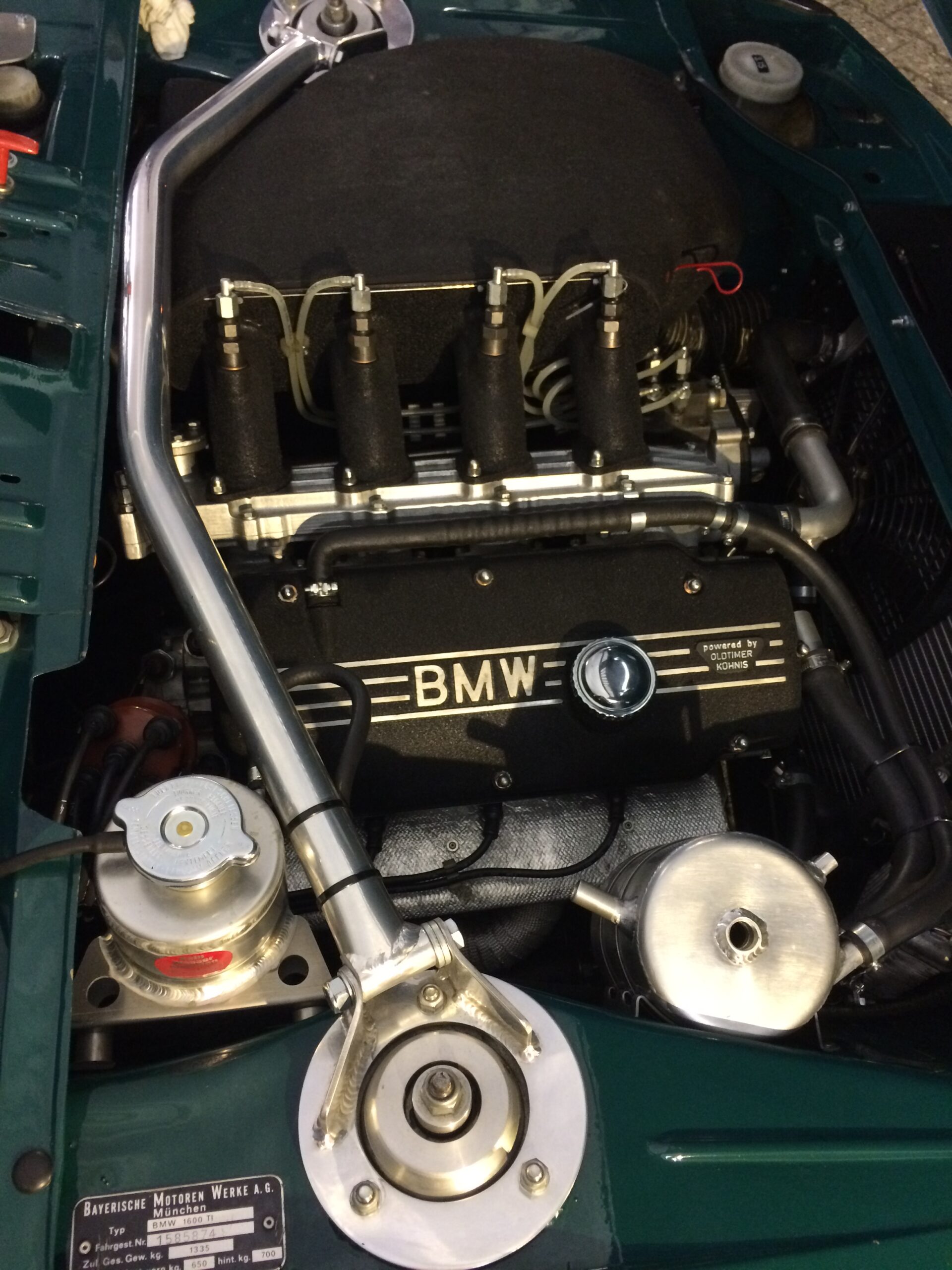
The entire 02 Series runs on the M10 — the four-cylinder that Alexander von Falkenhausen designed for the Neue Klasse and which remained in BMW’s range until 1988. The same engine family later gave rise to the Formula 1 engine M12/13.
M10 · 1,573 cm³ · 75 and 85 PS — 1502, 1600-2, 1602 geprüft
The base engine of the range: cast-iron block, aluminium cylinder head, overhead camshaft with chain drive. In the 1600-2 and 1602 it produces 85 PS at 5,700/min. In the 1502 from 1975 it is 75 PS — reduced compression for regular petrol, BMW's response to the oil crisis. The 1502 continued for two more years after the launch of the E21 and was the last 02 of all.
Technische Daten anzeigen
| Bauart | Inline four-cylinder M10, cast-iron block, aluminium head |
| Ventilsteuerung | overhead camshaft, chain drive |
| Hubraum | 1.573 cm³ |
| Output 1600-2 and 1602 | 85 PS (63 kW) at 5,700/min |
| Output 1502 | 75 PS (55 kW) |
| Gemischaufbereitung | Fallstromvergaser |
| Production figures 1600-2 and 1602 | 266,967 according to the English Wikipedia, 268,015 according to the German Wikipedia |
| Production figures 1502 | 72.632 |
Sources: Wikipedia (DE/EN)
M10 · 1.573 cm³ · 105 PS — 1600 ti geprüft
The 1600 ti was the sporty top of the small-displacement class from 1967 to 1968: two Solex twin carburettors, 105 PS at 6,000/min. With 8,670 units it remained rare and disappeared once the 2002 arrived — the twin-carburettor set-up could no longer be certified in the USA.
Technische Daten anzeigen
| Hubraum | 1.573 cm³ |
| Leistung | 105 PS (77 kW) at 6,000/min |
| Gemischaufbereitung | two Solex twin carburettors |
| Bauzeit | 1967–1968 |
| Stückzahl | 8.670 |
Sources: Wikipedia (EN)
M10 · 1.766 cm³ · 90 PS — 1802 geprüft
In 1971 BMW slotted the 1802 in between the 1602 and 2002. The bored-out M10 produces 90 PS at 5,250/min. In our view it is the most well-rounded engine of the range: more torque than the 1602, less weight on the front axle than the two-litre.
Technische Daten anzeigen
| Hubraum | 1.766 cm³ |
| Leistung | 90 PS (66 kW) at 5,250/min |
| Gemischaufbereitung | Fallstromvergaser |
| Bauzeit | 1971–1975 |
| Stückzahl | 83.351 |
Sources: Wikipedia (DE/EN)
M10 · 1,990 cm³ · 100 and 120 PS — 2002 and 2002 ti geprüft
The two-litre is the engine that made the range famous. In the 2002 it runs with a downdraft carburettor and produces, according to BMW Group Classic, 100 PS at 5,500/min, good for 170 km/h. That was exactly what Max Hoffman wanted: two-litre output without the emissions problems of the twin-carburettor set-up. The 2002 ti with two carburettors and 120 PS remained reserved for the European market and was discontinued in 1971.
Technische Daten anzeigen
| Hubraum | 1.990 cm³ |
| Output 2002 | 100 PS (73.5 kW) at 5,500/min |
| Output 2002 ti | 120 PS (88 kW) |
| Fuel mixture preparation 2002 | one downdraft carburettor |
| Fuel mixture preparation 2002 ti | two Solex twin carburettors |
| Top speed 2002 | 170 km/h, 165 km/h with automatic |
| Production period 2002 | 01/1968 to 10/1975 |
| Production period 2002 ti | 1968–1971 |
| Production figures 2002 | over 330,000 according to BMW Group Classic, 339,092 according to the English Wikipedia |
Sources: BMW Group Classic, Wikipedia (EN)
M10 · 1,990 cm³ · 130 PS — 2002 tii geprüft
The tii received the mechanical Kugelfischer injection pump in 1971, bringing 130 PS and 185 km/h. It was not BMW's first fuel-injected model — that was the 2000 tii of the Neue Klasse, of which only 1,952 units were built. However, the 2002 tii is BMW's first fuel-injection version built in large series: 38,703 cars.
Technische Daten anzeigen
| Hubraum | 1.990 cm³ |
| Leistung | 130 PS (96 kW) |
| Gemischaufbereitung | mechanical injection by Kugelfischer |
| Höchstgeschwindigkeit | 185 km/h |
| Bauzeit | 1971–1975 |
| Stückzahl | 38.703 |
Sources: Wikipedia (DE/EN)
M10 with turbocharger · 1,990 cm³ · 170 PS — 2002 turbo geprüft
At the 1973 IAA, BMW presented the 2002 turbo: a turbocharger on the tii engine, 170 PS at 5,800/min, 211 km/h. It was the first series-production car with a turbocharger in Europe. The oil crisis hit it in the year of its launch; production ended in November 1974 after 1,672 units.
Technische Daten anzeigen
| Hubraum | 1.990 cm³ |
| Leistung | 170 PS (125 kW) at 5,800/min |
| Gemischaufbereitung | mechanical injection with turbocharger |
| Höchstgeschwindigkeit | 211 km/h |
| Getriebe | reinforced Getrag 232 with four gears or close-ratio Getrag 235/5 with five gears |
| Achsübersetzung | 3.36 with limited-slip differential |
| Bremsen | internally vented discs at the front, 250 mm drums at the rear |
| Bauzeit | September 1973 to November 1974 |
| Stückzahl | 1.672 |
Sources: Wikipedia (DE/EN)
06 · Schwachstellen
Reliability & weak points
- Rust is the dominant issue. The body has no corrosion protection by today’s standards. Anyone assessing an 02 assesses the sheet metal first, and only then the mechanicals.
- The front strut towers are load-bearing and crack open on neglected cars. A proper repair is elaborate and belongs in expert hands.
- The M10 itself is regarded as extremely durable. Typical wear points are the timing chain and chain tensioner, as well as the cylinder head gasket in engines that have once overheated.
- The tii’s Kugelfischer injection is robust but expensive once it stops working properly. Specialists who can repair it exist, but they are rare.
- On the 2002 turbo, boost pressure control and model-specific add-on parts come into play. Spare parts here are in a category of their own price-wise.
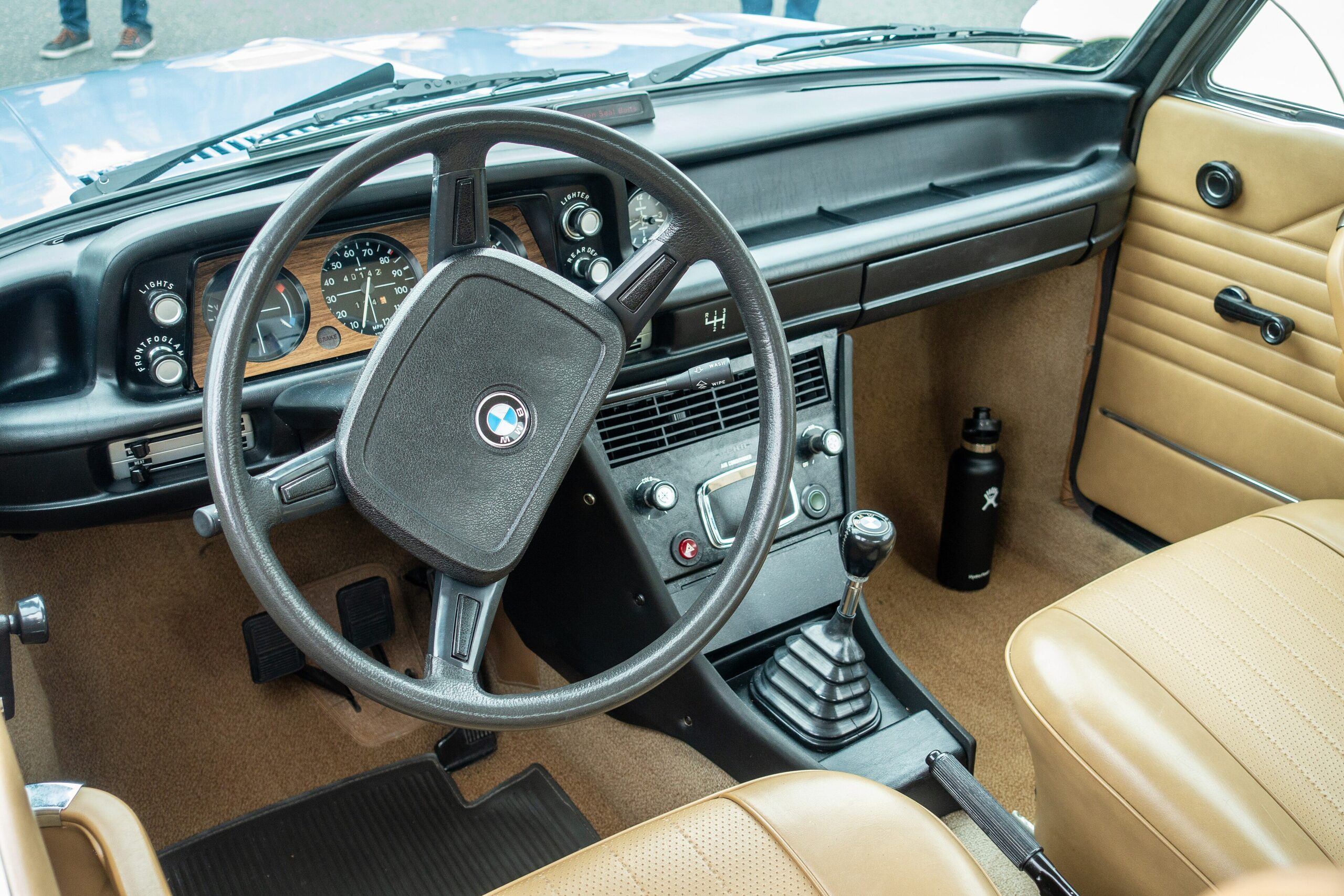
- The electrics and interior are simple in design and easy to repair. Dashboard plastic parts, on the other hand, are hard to replace.
07 · Technik
Chassis, brakes, transmission
Aufbau
Radaufhängung
Bremsen
Getriebe
Technische Daten — Achsübersetzungen & Getriebe
- Wheelbase
- 2,500 mm
- Length
- 4,220 to 4,230 mm
- Width
- 1,590 to 1,620 mm
- Height
- 1,360 to 1,410 mm
- Kerb weight
- 940 to 1,080 kg
- Front axle
- MacPherson struts
- Rear axle
- semi-trailing arm axle with coil springs
- Brakes
- discs at the front, drums at the rear
- Brakes 2002 turbo
- internally vented discs at the front, 250 mm drums at the rear
- Transmission
- four-speed gearbox as standard, five-speed gearbox and three-speed automatic on request
- Transmission 2002 turbo
- Getrag 232 with four gears, reinforced, or Getrag 235/5 with five gears
- Final drive ratio 2002 turbo
- 3.36 with limited-slip differential
- Top speed 2002
- 170 km/h, 165 km/h with automatic
- Top speed 2002 tii
- 185 km/h
- Top speed 2002 turbo
- 211 km/h
Axle and gear ratios for the other models cannot be verified from permissible sources. BMW Group Classic and the PressClub do not list transmission data for the 02 Series. The steering type could likewise not be confirmed by two independent sources.
08 · Topmodelle
Topmodelle
Three cars that define the range.
BMW 2002
The car that turned BMW into a sports sedan brand. 1,990 cm³, 100 PS, from January 1968 — and the company's first major success in the USA.
Zur Unterseite →
BMW 2002 tii
Mechanical Kugelfischer fuel injection, 130 PS, 185 km/h. BMW's first fuel-injection version built in large series, and today the most sought-after variant of the range.
Zur Unterseite →
BMW 2002 turbo
Europe's first series-production car with a turbocharger. 170 PS, 211 km/h, 1,672 units — and after fourteen months, the end brought about by the oil crisis.
Zur Unterseite →
BMW 2002 Touring
The 02's hatchback body — dedicated page with all the details.
Zur Unterseite →
09 · Motorsport
The engine that reached all the way to Formula 1
The 02 Series was present in touring car racing and rallying for years. Overall victory at the 1970 Nürburgring 24 Hours went to a 2002 — though to a car from the private Koepchen team, not a factory entry. BMW Motorsport GmbH was not founded until 1 May 1972, that is, after the 02’s strongest sporting phase.
The engine had the greater impact. The Formula 1 four-cylinder M12/13, with which Nelson Piquet became world champion in 1983, is based on the block of the M10 series. The often-told story that BMW deliberately used high-mileage used blocks for this could not be verified from permissible sources. We present it as a legend, not as fact.
10 · Kaufberatung
What matters: substance beats equipment
The 02 is a simple car. Almost everything on it can be repaired, and parts supply is good for a car of this age. The point at which a project fails is therefore never the mechanicals, but always the sheet metal.
Front strut towers — load-bearing, elaborate to repair, and the most important point of inspection.
Sills and jacking points, inside and out.
Wheel arches front and rear, plus the rear valance.
Battery tray and the area beneath it in the engine bay.
The corners of the windscreen and the frame of the rear window.
Floor pan, spare wheel well and the rear axle mounts.
The order is: sheet metal first, then paperwork, then the engine. A 1602 with a sound body is a better basis than a tii with holes — what is missing in metal ultimately costs more than the difference in purchase price.
11 · Die Konkurrenz
The competition
Alfa Romeo Giulia (105)
The direct rival: a four-cylinder with two overhead camshafts, rear-wheel drive, five gears from the factory. The Alfa revs more eagerly and had the more modern engine earlier on, while the BMW is considered the more robust car in daily use.
Ford Escort (Mk1)
Ford relied on simpler technology and a lower price. On the rally stage the Escort was the more successful car, while on the circuit the two were closer together.
Mercedes-Benz /8 (W114/115)
The alternative from Stuttgart was larger, heavier and designed for significantly more comfort. Anyone looking for a family sedan chose the /8; anyone who wanted to drive chose the 02.
12 · Galerie
Bilder
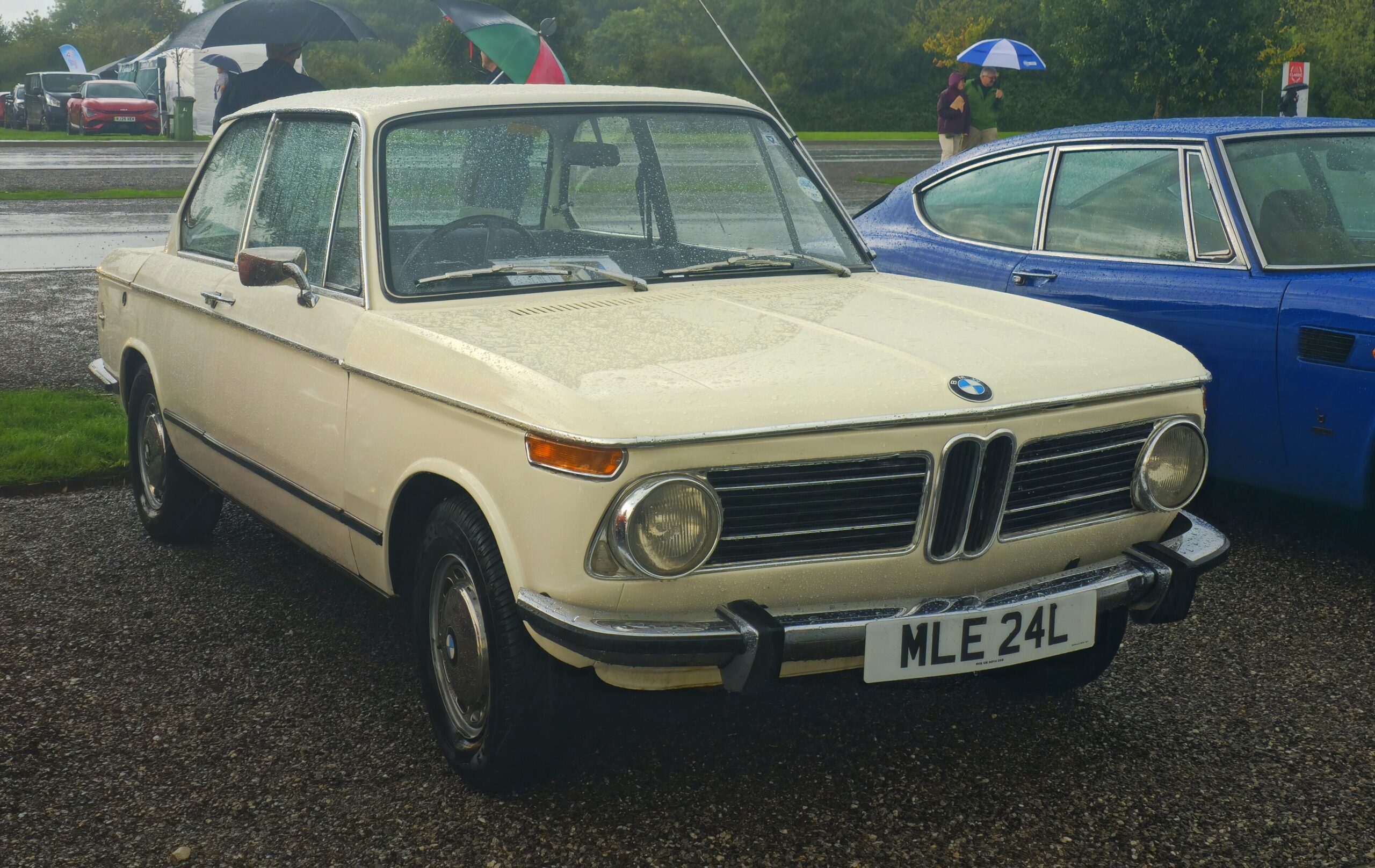
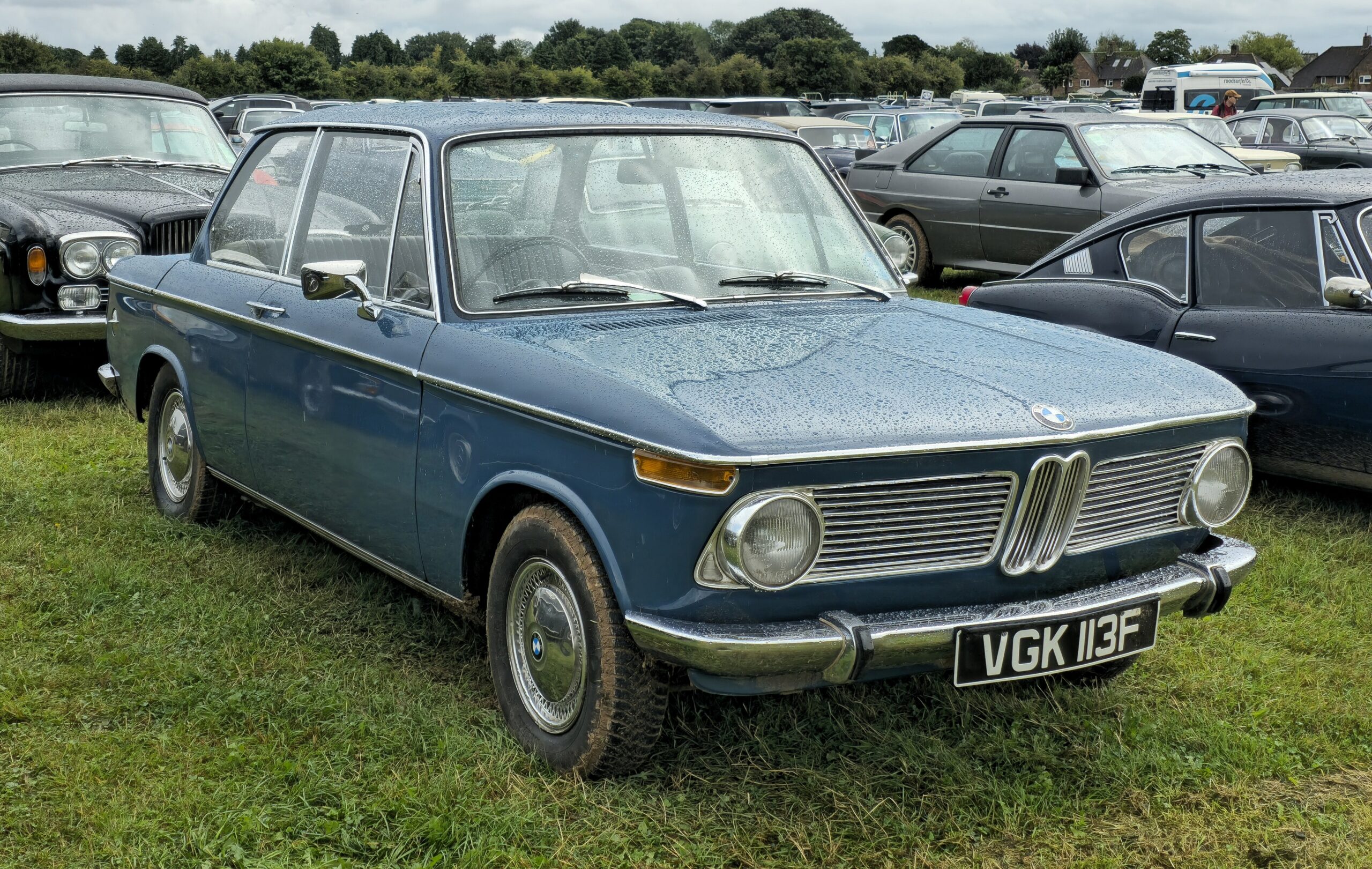
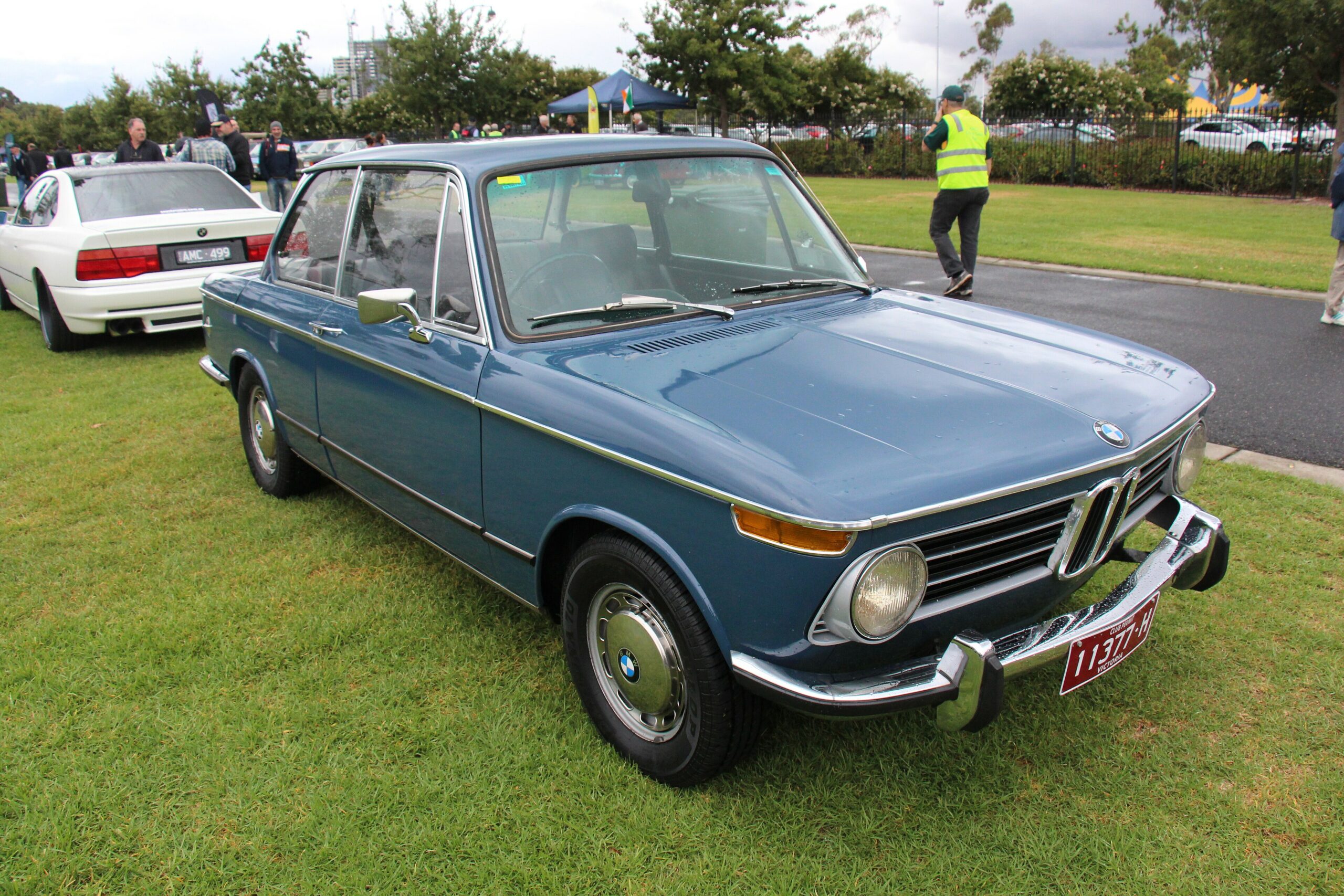
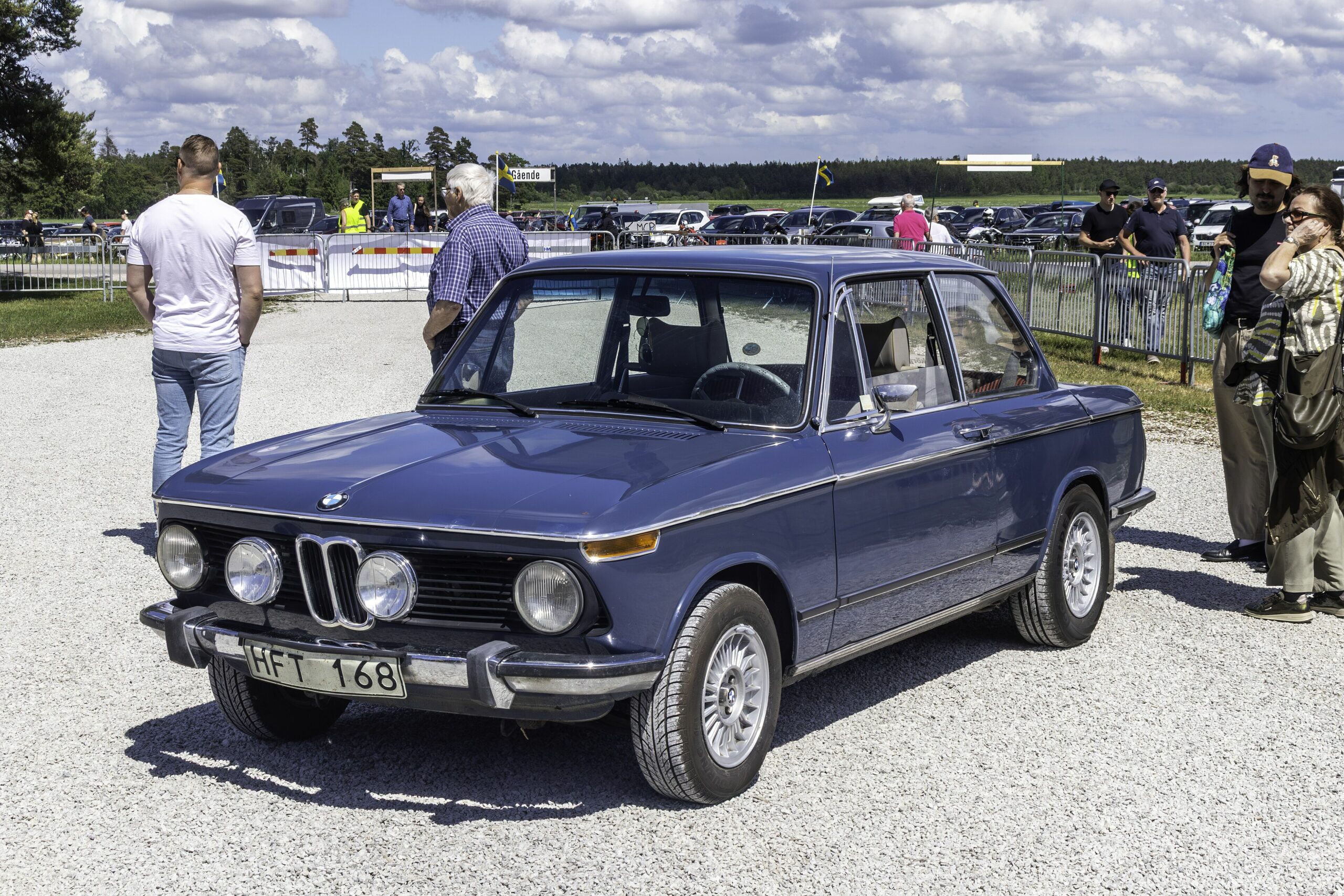
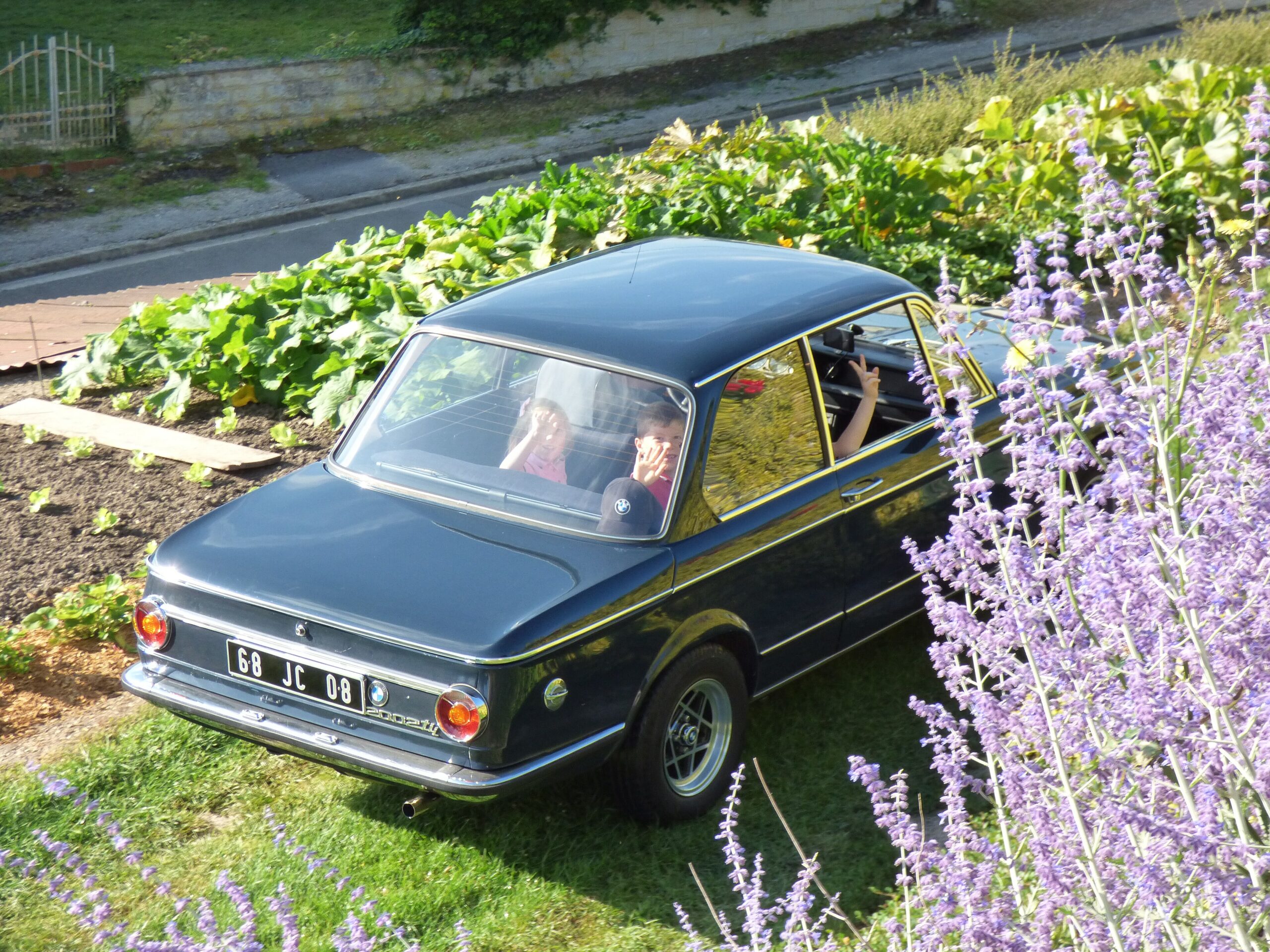
From the 1602 to the tii, plus the Baur Convertible, the touring, the cockpit and the M10.
13 · Quellen
Belege & Literatur
Primary sources are BMW Group Classic, the BMW PressClub and Wikipedia. Information from other sources has been checked at least twice. Where sources contradict each other, the contradiction is stated in the text.